Contractor report ranks countries by likelihood of a democratic opening
A 123-page report prepared by DevTech Systems for USAID under the Swift Expertise and Grounded Analytics task order lists countries that may experience democratic openings, with methodology and country annexes.
What this record contains
The report, submitted in November 2022 and approved in January 2023, applies a two-step method combining quantitative indicators with a qualitative review of structural factors to identify countries likely or unlikely to see political liberalization. It includes a country list, brief analysis of 'somewhat likely' countries, ranked annexes, qualitative country reports (the excerpt shows ratings for Nigeria) and a methodology report. The authors caution that predictions are imperfect and that most openings fail to mature. The excerpt does not address technology companies.
Full text of the record
Text extracted from the original PDF. Layout, tables and images are not reproduced. About 45,313 words.
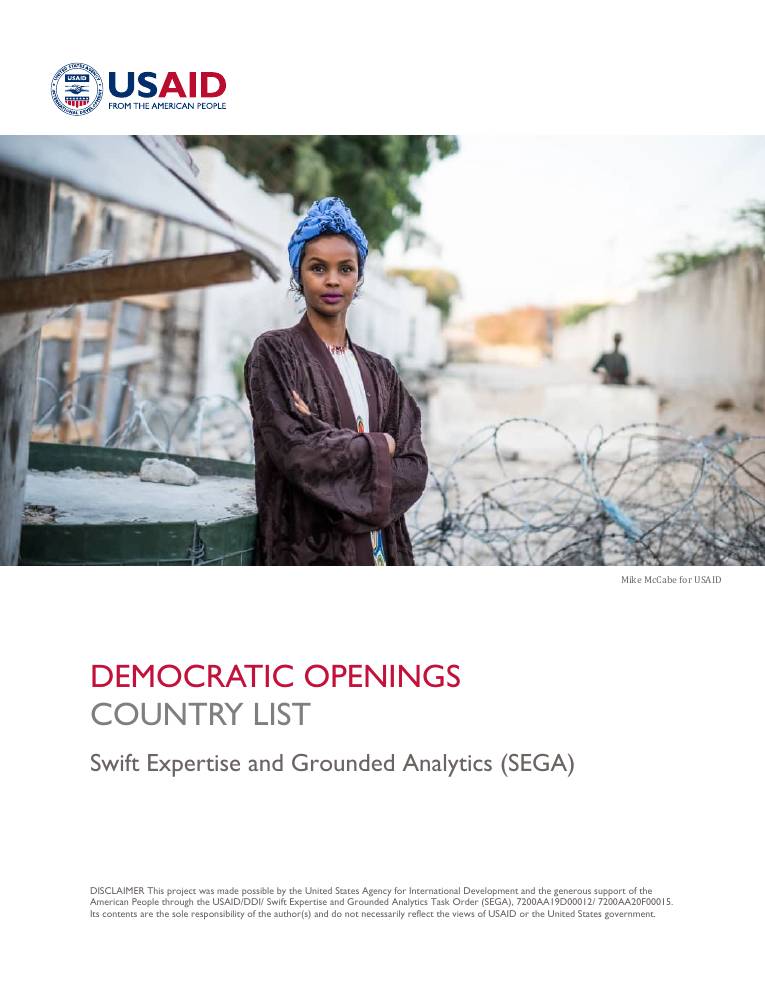
Mike McCabe for USAID
DEMOCRATIC OPENINGS
COUNTRY LIST
Swift Expertise and Grounded Analytics (SEGA)
DISCLAIMER This project was made possible by the United States Agency for International Development and the generous support of the American People through the USAID/DDI/ Swift Expertise and Grounded Analytics Task Order (SEGA), 7200AA19D00012/ 7200AA20F00015. Its contents are the sole responsibility of the author(s) and do not necessarily reflect the views of USAID or the United States government.
PROJECT OVERVIEW
PROJECT TITLE
SWIFT EXPERTISE AND GROUNDED ANALYTICS TASK ORDER UNDER ANALYTICAL SERVICES IV
WORK ORDER NO. 3, DEMOCRATIC OPENINGS
i
Sponsoring USAID Office
The Bureau for Development, Democracy, and Innovation (DDI)
COR
David Jacobstein
Contract No.
7200AA19D00012 Task No. 7200AA20F00015
Contractor
DevTech Systems, Inc.
Deliverable
Democratic Openings, Country List
Submission Date
November 22, 2022
Approval Date
January 3, 2023
CONTENTS
ACRONYMS
III
INTRODUCTION
DEMOCRATIC OPENINGS: DEFINITIONS AND PATHWAYS
DEMOCRATIC OPENINGS: STRUCTURAL FACTORS
Democratic Opening Methodology: An Overview
STEP ONE: QUANTITATIVE COMPONENT
STEP TWO: QUALITATIVE COMPONENT
DATA ANALYSIS AND CALCULATING GLOBAL RANKINGS
DEMOCRATIC OPENING LIST
Brief Analysis Of Somewhat Likely Countries
Annex A: Countries Ranked By Quantitative Component
Annex B: Countries Ranked By Qualitative Component
Annex C: Qualitative Country Reports
Annex D: Democratic Openings Methodology Report
ii
ACRONYMS
DemSpace V-Dem's Democratic Spaces Barometer
DRG
Democracy, Human Rights, and Governance
LDI
V-Dem's Liberal Democracy Index
SEGA
Swift Expertise and Grounded Analytics
USAID
United States Agency for International Development
USG
United States Government
V-Dem
The Varieties of Democracy Project
iii
INTRODUCTION
“Democratic recession” – as defined by more regression than progression in countries characterized by full or partial liberal democracy – is now approaching its 17th year. 1 While the exact number of years may differ among observers and institutions, the increase in the number of instances of democratic backsliding is, for the most part, universally acknowledged and undeniable. Nevertheless, there are some “democratic openings” – or opportunities in which authoritarian, hybrid, or other non-democratic regimes experience some movement, often unexpected, toward political liberalization and democratic advances (countries in which gains for liberal democracy either outweigh losses or at least mitigate them to some degree). For the United States Agency for International Development’s (USAID) commitments to democracy, human rights, and governance (DRG), identifying and predicting such democratic openings would be important. It would suggest where investments of scarce DRG resources might yield the greatest returns and realization of key development outcomes.
Employing a methodology designed and developed under the USAID-funded Swift Enterprise and Grounded Analytics (SEGA) task order, awarded to DevTech Systems under the AS IV IDIQ, this report provides a list of countries who may be, or are likely to, experiencing a democratic opening for USAID’s consideration. The methodology itself, provides a rigorous basis for such predictions and investments based on hard, quantitative data complemented by a qualitative review of those data centered on six primary factors and four less-critical but still important factors to consider. This methodology was designed to be used by operating units—whether missions, regional bureaus or other Washington units like the DRG Center—to evaluate the countries most likely as well as those unlikely to experience a democratic opening in the foreseeable future. USAID can then decide on this basis and other considerations where democracy investments are most likely to bear democratic results. The conclusions will be imperfect at best but better than random forecasts. Moreover, correct predictions of democratic openings hardly mean correct predictions of democratic successes and consolidations to follow the openings.
Democratic openings may fail to mature and often do; in fact, the vast majority don’t succeed and even backslide. Even when they crystallize initially, they may stall or relapse. For example, widespread expectations for a more democratic future in Tunisia, Algeria and Sudan, all supported by “data”, have soured. Similarly, early confidence in a democratic future for Bulgaria, Romania, and the countries of the so-called “color revolutions” has been disappointing, notwithstanding their membership in and support by the European Union, one of the most important inducements for democratic consolidation in those countries. Consequently, the attempt outlined in this report should be taken with appropriate caution. That caution does not obviate the attempt. It places the attempt in an appropriate analytical context for those who advocate for and are charged with achieving results from democracy assistance. DEMOCRATIC OPENINGS: DEFINITIONS AND PATHWAYS
Under the early textbook definition of a democratic opening, authoritarian regimes are most commonly replaced quickly after a traumatic event like the death of the autocrat; a free competitive election with
1 Sarah Repucci and Amy Slipowitz. “Freedom in the World 2022.” Freedom House, February 2022.
https://freedomhouse.org/sites/default/files/2022-02/FIW_2022_PDF_Booklet_Digital_Final_Web.pdf.
surprising results; the adoption of a new constitution guaranteeing democracy and human rights by an apparently regime-controlled parliament; or when a heretofore captured judiciary uncharacteristically and often precipitously issues a decision that undermines the regime. Early examples of democracy replacing existing authoritarian regimes can be traced back to the decolonialization and independence movements in Africa, for example in Kenya, Uganda, and Nigeria, although they resulted in short-lived democracies. Initially many thought that the Cuban revolution of 1959 grounded on the military victory led by Fidel Castro would take a similar course except that Castro and his entourage were really, not just rhetorically Communists, so it was followed by a Leninist dictatorship rather than a liberal democracy.
Today, leading textbook examples of a democratic opening include the 1974 coup d’état by leftist miliary officers in Portugal and the Spanish transition of 1975-78 – both examples from what Samuel Huntington has defined as the Third Wave of democratic openings. 2 The November 1975 death of Spain’s autocratic leader, Francisco Franco, who ruled for 35 years through the fascist period and was an erstwhile ally of Hitler, launched a new, democratic dispensation. With the support of King Juan Carlos, the military dictatorship was replaced by a democratically elected parliament and the (now) constitutional monarchy. The coup in Portugal was supported by an unanticipated popular campaign led by Portuguese citizen refugees returning from Portugal’s recently liberated African colonies.
Following these examples, the world watched as other democratic openings emerged across the globe. In Asia, the 1986 Philippine opening replaced dictator Ferdinand Marcos based on massive “People Power” popular demonstrations and the support of Cardinal Jaime Sin and, as the coup de grace, withdrawal of U.S. support for Marcos by President Ronald Reagan. Marcos fled into exile and was replaced in competitive elections by Corazon Aquino, wife of Marcos’ long-time but assassinated adversary, Benigno Aquino Jr. The ensuing period of liberal democracy arguably ended with the election in 2016 of Rodrigo Duterte who ushered in a democratic regression to authoritarian rule. The most dramatic democratic openings throughout Central Europe began with the 1989 collapse of party and government discipline in East Germany, Poland, Hungary, and Czechoslovakia when the Soviet Union unexpectedly decided not to intervene against a flow of exiles to the west or crush the large anti-regime demonstrations. Those openings were followed by democratic openings in Bulgaria, Romania and the Baltic countries of Estonia, Latvia and Lithuania.
For USAID purposes, however, a broader definition of democratic openings provides more common and therefore more useful examples. A democratic opening need not depend on a specific traumatic event or campaign but rather on a less singular and more gradual opening of political, economic and social space over a longer period of time. As per capita income and the “mini” political and civil society openings increase – as a middle-class forms and enlarges (both in numbers and in influence) – as educational levels increase – as the pressure for a rule of law (initially often for contractual certainty even for the regime’s state-owned enterprises) – and as the desire for democracy swells (often when the number citizens with access to broadcast, cable, and internet outlets grows); the nature of the political and economic character of society can become more open and (potentially) democratic.
Samuel Huntington The Third Wave: Democratization in the Late Twentieth Century, (Norman: University of Oklahoma Press: 1991).
Regrettably, despite these democratic openings, whether traumatic or more gradual, they do not lock in the democratic trajectories one would hope for. As Huntington predicted based on the earlier democratic waves, the third wave of democratization (beginning in the mid-1970s with Portugal and Spain and ending with the democratic regressions beginning in 2006), democratizations are not secure indefinitely. Rather, authoritarians can make a comeback along with democratic reversals, backsliding, or, in the current vocabulary, democratic recessions or regressions. The most obvious examples are the countries of “the Arab Spring” where the past decade provides numerous illustrations of democratic openings gone tragically wrong. In three cases – Syria, Yemen and Libya – the democratic potential associated with the 2011 upheavals gave way to civil wars that triggered unprecedented human suffering and further destabilized the entire region. In Egypt, the euphoria of the 2011 uprising was quickly replaced with debilitating polarization, chaos, and, in July 2013, a military coup that yielded a far more brutal form of authoritarianism than that once associated with the Mubarak regime. As for Tunisia, once heralded as the Arab Spring’s lone success story, it has regressed into one-man rule since July 2021, after producing ten ineffective governments spanning a decade. To this end, this report presents the inaugural application of the democratic opening methodology, and the results thereof, counting for both the traumatic and the gradual paths of democratic openings. However, it is important to note that the methodology itself does not deal with the contours or dynamics of democratic regressions. DEMOCRATIC OPENINGS: STRUCTURAL FACTORS
Both recent and older history, including these examples, demonstrates that only a fraction of countries that experience a "democratic opening" or "democratic trends" eventually transition to a democratic regime. Based on historical evidence, long-term structural factors have repeatedly facilitated or, conversely, proven to be a powerful impediment to such transition. These factors have become clearer in the literature on democratization since Samuel Huntington's seminal 1991 Third Wave book. In its early years, approximately from the late 1980s through the early 2000s, that literature reflected considerable optimism regarding the ability to take advantage of "windows of democratic opportunity" or "democratic breakthroughs" and build lasting democracies out of them -- even in the absence of the socioeconomic and other conditions that earlier generations of scholars had tended to see as essential to the success of democracy. Indeed, the tendency to downplay structural impediments to democracy, and the belief that democracy could strike roots even in terrain that seemed deeply unfavorable to it, was pervasive in writing on democratization from the early 1990s through the early 2000s. Underlying that optimism was the assumption that democracy could be "willed" and structural obstacles could be overcome through "elite pacts," and, more generally, through proper political engineering and institutional design.
Reality, and specifically the spate of democratic reversals experienced by many new democracies in the past two decades, forced a reconsideration of that earlier optimism. There now exists far greater skepticism about the ability of democracy to survive in the face of hostile structural conditions. For the same reason, there is a consensus that the "transition literature" of the 1990s had been far too dismissive of the extent to which such adverse conditions present powerful impediments to sustaining democratic momentum, let alone to building actual democracies. In short, the new consensus is that when it comes to democracy's prospects, long-term socioeconomic and political factors cannot be ignored or wished away, and that they certainly should not be discounted as they so often were two or three decades ago.
DEMOCRATIC OPENING
METHODOLOGY: AN OVERVIEW
The democratic opening list is based upon a methodology designed to recognize a democratic opening, by analyzing the probability of its success or failure to ripen into a democracy. The methodology employed a two-step, mixed methods approach, drawing on quantitative and qualitative approaches. A brief overview of the methodology follows. For an in-depth discussion of the methodology, please refer to Annex D.
STEP ONE: QUANTITATIVE COMPONENT
The first step of the methodology involves an in-depth analysis of rigorously accrued and available
quantitative data on democratic openings. The team considered several quantitative indices, including
Freedom House’s Freedom in the World; the University of Gothenburg’s Variety of Democracy (VDem) Indices; and, the Economist Intelligence Unit’s Democracy Index. In collaboration with USAID’s DRG Office, the team concluded that V-Dem—an on-going international attempt—would be the best fit
for the quantitative approach to democratic openings. Several of V-Dem’s indicators represent the most
rigorous, detailed, and data-driven efforts to quantify democratic dynamics globally. Their application
constitutes Step One, the Quantitative Component, of the methodology. In particular, V-Dem’s
Democratic Spaces Barometer (DemSpace) index—an annual index of democratic performance and
potential—combined with V-Dem’s Liberal Democracy Index (LDI) and its V-Forecast Project. The
combined score of these indices is intended to predict democratic openings, from the most promising to
the least promising countries. The results of Step One, the complete ranking of nearly 170 countries,
can be found in Annex A.
STEP TWO: QUALITATIVE COMPONENT
Quantitative data and indices based on these datasets are not, by themselves, as reliable a source of information as they would be if tempered by deep personal experience with the countries and the interpretations that experience and insight brings to the analysis. Out of the many qualitative elements that can affect a democratic opening, a parsimonious six— (1) per capita income; (2) government performance and effectiveness; (3) the salience of ethnic religious and other identity divisions; (4) dependency on primary commodities and exports and presence of a rentier state; (5) geopolitical and regional influences; and (6) historical legacies-—are likely to have the most effect. In addition, are four less-critical but still important factors to consider: (1) caliber of leadership; (2) the size and autonomy of the middle class; (3) the level of party-system internalization; and (4) governance functions performed by non-government entities. There are many other qualitative factors that could and often do affect democratic openings, but the SEGA team has identified these as the most efficacious and significant for analysts to consider in order to come to timely, practical conclusions. The results of Step Two, the qualitative results, can be found in Annex B.
Data Analysis And Calculating Global Rankings
Each component brings different insights to the selection process, and each approach can help compensate for the blind spots of the other. The quantitative approach leverages information about dozens or hundreds of variables capturing the experiences of almost all countries over many years. It thus reveals general tendencies that can help rule out many countries that are unlikely to satisfy the criteria. Of the several V-Dem products, the methodology uses forecasts by DemSpace along with LDI, to narrow the list to 26 most likely countries, which reduces the workload in the qualitative stage. The qualitative approach consists of deliberation by USAID or outside country and regional experts. 3 They are designed to bring to the process deep, nuanced, and up-to-date knowledge of the countries on the initial list produced by the quantitative step, as well as familiarity with theories of democratization. Their understanding refines the analysis, ruling out forecasted openings that have already failed, openings that are unlikely to take place or to last, and selecting cases for which forecasts of a successful, lasting opening are credible.
Together, the two steps in the methodology provide a coherent, data-based process for recognizing actual and potential democratic openings, ordering them by probability, and then applying a qualitative filter to decide the best candidates for assistance. The report thus, constitutes a judicious, practical, realistic, evenhanded albeit indeterminate attempt to implement a methodology designed to predict democratic openings and point USAID assistance to the countries most likely in an uncertain world to yield successful democratic openings.
3 In this initial implementation of the Democratic Openings Methodology, the SEGA team of expert consultants served this
function.
DEMOCRATIC OPENING LIST
The results of the Democratic Openings Methodology produced a list of 28 countries likely to experience, or currently experiencing, a democratic opening as found in the table below. Seven countries were immediately removed from consideration as they were countries already widely deemed to be democracies. 4 As a result of the qualitative and quantitative analysis, five countries emerged as most likely and most beneficial for further USAID investment. A brief discussion of why these five countries were selected follows the table below. Please refer to Annex C for the respective qualitative country report for all 28 countries.
LIST OF POTENTIAL DEMOCRATIC OPENINGS, RANKED BY LIKELIHOOD
COUNTRY
PROBABILITY OF
OPENING IN 2022 –
2023
V-DEM LIBERAL
DEMOCRACY SCORE IN
2021 (“v2x_libdem”)
COMBINED
SCORES
QUALITATIVE
SCORE
Somewhat Likely
Brazil
0.148
0.512
0.275
Colombia
0.140
0.471
0.256
Armenia
0.124
0.556
0.262
Malaysia
0.227
0.293
0.258
Dominican
Republic
0.102
0.472
0.219
The Gambia
0.152
0.406
0.249
Mexico
0.159
0.387
0.248
Thailand
0.315
0.169
0.231
Montenegro
0.157
0.389
0.247
Zambia
0.274
0.296
0.285
-1
Bolivia
0.194
0.369
0.267
-1
Maldives
0.140
0.445
0.250
-1
Sri Lanka
0.229
0.375
0.293
-1
Ecuador
0.098
0.466
0.214
Unlikely
4 The seven countries removed from consideration were Hungary, India, Mauritius, Pakistan, Poland, Slovenia, and Ukraine.
LIST OF POTENTIAL DEMOCRATIC OPENINGS, RANKED BY LIKELIHOOD COUNTRY
PROBABILITY OF
OPENING IN 2022 –
2023
V-DEM LIBERAL
DEMOCRACY SCORE IN
2021 (“v2x_libdem”)
COMBINED
SCORES
QUALITATIVE
SCORE
Extremely Unlikely
El Salvador
0.276
0.215
0.244
-1
Tanzania
0.185
0.314
0.241
-1
Togo
0.231
0.196
0.213
-1
Nigeria
0.159
0.340
0.233
-1
Benin
0.273
0.280
0.276
-1
Mali
0.306
0.183
0.237
-2
BRIEF ANALYSIS OF SOMEWHAT LIKELY COUNTRIES
BRAZIL
The presidential elections which took place this year in Brazil have created a possible tipping point for the country and a strong foundation for a democratic opening. Former president Luiz Inácio Lula da Silva won the run-off election on October 30, 2022, and a Lula presidency is likely to move Brazil back toward a higher level of liberal democracy. On November 1, 2022, President Jair Bolsonaro agreed to a transition of power allowing the whole of the Brazilian governmental bureaucracy to begin preparing for the da Silva administration.
COLOMBIA
Colombia, while democratic already, is not one of the most democratic countries in the hemisphere, and it seems to be on the cusp of significant reforms, creating space for a domestic opening toward greater democracy. Despite the negative impacts of neighboring Venezuela’s economic collapse on Colombia, the economy remains stable, the governmental bureaucracy remains competent and capable, and the education system remains fairly good and accessible to the middle class. Furthermore, the new president, Gustavo Petro, has an ambitious agenda to promote “total peace” through negotiations and democracy, and he is backed by a two-thirds majority coalition in Congress. ARMENIA
Armenia is at a critical juncture politically, a juncture that has created the potential for a democratic opening. Since the Velvet Revolution of 2018, the Government of Armenia has taken steps to fight corruption, enhance the integrity of the judicial system, and improve transparency in government operations, but results have been slow to materialize. Pro-Russian, anti-democratic forces remain politically strong but the pro-Western, pro-democratic forces have a good chance of prevailing. Armenia demonstrates, however, that the struggle between autocracy and democracy does not always align neatly with that which pits pro-Western forces against their opponents. Still, the challenge of solidifying
the country's pro-Western tilt while strengthening democratic forces is one that creates an opening for greater democracy and that deserves to be pursued.
MALAYSIA
Between Malaysian independence in 1963 and the general election of 2018, a single party (a consortium of a major Malay party and two junior Chinese and Indian parties) held unbroken political power. The defeat of that party in 2018—in large part because of mammoth corruption under the ruling party, especially of its prime minister now convicted of stealing hundreds of thousands of dollars from the national wealth fund (and now in prison)—by a loose collection of parties, the ensuing serious electoral competition, and better, less corrupt governance has created a moment where an opening for a true democracy in Malaysia may be possible.. The future of a sustained democratic opening hinges in part on whether economic and other social issues will trump ethnic/religious communalism in the national political discussions, elections, and public policy and also on whether the previous 1963-2018 ruling party returns to power after the next general elections.
DOMINICAN REPUBLIC
The Dominican Republic has lurched intermittently and awkwardly toward greater democracy and possesses an environment conducive to achieving a democratic opening through fostering marginal improvements. Governmental corruption as well as the marginalization and persecution of ethnic and other minority groups remain strong disadvantages for a sustained democratic opening in the Dominican Republic. However, the electoral process is relatively free and fair with strong participation from citizens, which creates opportunities for a democratic opening.
ANNEX A: COUNTRIES RANKED BY
QUANTITATIVE COMPONENT
COUNTRY RANKING, BY QUANTITATIVE COMPONENT
COUNTRY
PROBABILITY OF
OPENING IN 2022 – 2023
V-DEM LIBERAL
DEMOCRACY SCORE IN
2021 (“v2x_libdem”)
COMBINED SCORES
Sri Lanka
0.229
0.375
0.293
Slovenia
0.141
0.599
0.290
Zambia
0.274
0.296
0.285
India
0.217
0.357
0.278
Benin
0.273
0.280
0.276
Brazil
0.148
0.512
0.275
Bolivia
0.194
0.369
0.267
Armenia
0.124
0.556
0.262
Malaysia
0.227
0.293
0.258
Colombia
0.140
0.471
0.256
Maldives
0.140
0.445
0.250
The Gambia
0.152
0.406
0.249
Mexico
0.159
0.387
0.248
Montenegro
0.157
0.389
0.247
El Salvador
0.276
0.215
0.244
Tanzania
0.185
0.314
0.241
Poland
0.139
0.413
0.240
Mali
0.306
0.183
0.237
Nigeria
0.159
0.340
0.233
Thailand
0.315
0.169
0.231
Ukraine
0.154
0.318
0.222
Hungary
0.133
0.362
0.220
Pakistan
0.213
0.226
0.219
COUNTRY RANKING, BY QUANTITATIVE COMPONENT
COUNTRY
PROBABILITY OF
OPENING IN 2022 – 2023
V-DEM LIBERAL
DEMOCRACY SCORE IN
2021 (“v2x_libdem”)
COMBINED SCORES
Dominican Republic
0.102
0.472
0.219
Mauritius
0.103
0.464
0.218
Guatemala
0.146
0.324
0.217
Ecuador
0.098
0.466
0.214
Togo
0.231
0.196
0.213
CAR
0.279
0.161
0.212
Indonesia
0.105
0.428
0.211
Georgia
0.090
0.493
0.210
Haiti
0.208
0.210
0.209
Guyana
0.119
0.367
0.209
Malawi
0.080
0.533
0.207
Fiji
0.155
0.269
0.204
Ethiopia
0.262
0.151
0.199
Guinea-Bissau
0.109
0.357
0.197
Gabon
0.186
0.207
0.196
Bhutan
0.080
0.479
0.195
Botswana
0.078
0.486
0.195
Lebanon
0.132
0.282
0.193
Uganda
0.173
0.212
0.192
Mongolia
0.072
0.494
0.189
Albania
0.085
0.403
0.185
Iraq
0.156
0.219
0.185
Mauritania
0.201
0.168
0.184
Kenya
0.082
0.400
0.181
Guinea
0.291
0.111
0.180
Lesotho
0.064
0.503
0.180
COUNTRY RANKING, BY QUANTITATIVE COMPONENT
COUNTRY
PROBABILITY OF
OPENING IN 2022 – 2023
V-DEM LIBERAL
DEMOCRACY SCORE IN
2021 (“v2x_libdem”)
COMBINED SCORES
Philippines
0.115
0.281
0.179
Kosovo
0.076
0.421
0.179
Romania
0.048
0.644
0.176
Tunisia
0.067
0.459
0.175
Cote D'Ivoire
0.127
0.241
0.175
Sudan
0.370
0.082
0.174
Serbia
0.125
0.242
0.174
Myanmar
0.361
0.083
0.173
Bosnia-Herzegovina
0.083
0.353
0.171
Somalia
0.311
0.093
0.170
Honduras
0.119
0.239
0.168
Congo
0.260
0.109
0.168
Singapore
0.085
0.332
0.168
Angola
0.146
0.190
0.167
Paraguay
0.065
0.426
0.167
Nepal
0.060
0.464
0.167
DR Congo
0.167
0.160
0.163
Argentina
0.037
0.658
0.156
Jordan
0.096
0.250
0.155
Vietnam
0.190
0.126
0.155
Uzbekistan
0.255
0.092
0.153
Mozambique
0.097
0.241
0.153
Iran
0.188
0.124
0.153
Libya
0.154
0.150
0.152
Surinam
0.034
0.648
0.149
Bulgaria
0.039
0.548
0.146
COUNTRY RANKING, BY QUANTITATIVE COMPONENT
COUNTRY
PROBABILITY OF
OPENING IN 2022 – 2023
V-DEM LIBERAL
DEMOCRACY SCORE IN
2021 (“v2x_libdem”)
COMBINED SCORES
Cyprus
0.031
0.689
0.146
Algeria
0.145
0.145
0.145
Venezuela
0.287
0.072
0.144
Comoros
0.163
0.126
0.143
Peru
0.031
0.654
0.143
Madagascar
0.084
0.241
0.142
Croatia
0.032
0.634
0.142
Liberia
0.044
0.460
0.142
Sierra Leone
0.047
0.425
0.141
Niger
0.049
0.397
0.140
Burkina Faso
0.040
0.476
0.138
Moldova
0.030
0.615
0.135
Morocco
0.076
0.241
0.135
South Sudan
0.306
0.059
0.134
East Timor
0.034
0.487
0.129
Nicaragua
0.300
0.055
0.128
Papua New Guinea
0.049
0.336
0.128
Greece
0.023
0.668
0.124
Bangladesh
0.122
0.120
0.121
Egypt
0.117
0.123
0.120
Cameroon
0.113
0.126
0.120
Burundi
0.185
0.076
0.118
Austria
0.018
0.749
0.116
Turkey
0.116
0.115
0.116
North Macedonia
0.034
0.396
0.116
Kuwait
0.048
0.272
0.114
COUNTRY RANKING, BY QUANTITATIVE COMPONENT
COUNTRY
PROBABILITY OF
OPENING IN 2022 – 2023
V-DEM LIBERAL
DEMOCRACY SCORE IN
2021 (“v2x_libdem”)
COMBINED SCORES
Namibia
0.023
0.514
0.108
South Africa
0.019
0.593
0.106
Senegal
0.020
0.552
0.104
Solomon Islands
0.022
0.473
0.103
Rwanda
0.084
0.123
0.102
Cape Verde
0.016
0.648
0.101
Panama
0.018
0.560
0.101
Laos
0.103
0.097
0.100
Czech Republic
0.014
0.709
0.099
Djibouti
0.078
0.124
0.098
Cuba
0.115
0.077
0.094
Canada
0.011
0.755
0.092
Azerbaijan
0.119
0.068
0.090
Kazakhstan
0.063
0.128
0.090
Chad
0.115
0.067
0.088
Chile
0.010
0.770
0.087
Syria
0.186
0.040
0.086
Swaziland
0.063
0.110
0.083
Afghanistan
0.313
0.021
0.081
Yemen
0.193
0.033
0.080
Israel
0.009
0.653
0.077
Uruguay
0.007
0.761
0.075
France
0.007
0.795
0.073
Taiwan
0.006
0.699
0.067
Slovakia
0.006
0.769
0.067
Ghana
0.008
0.568
0.066
COUNTRY RANKING, BY QUANTITATIVE COMPONENT
COUNTRY
PROBABILITY OF
OPENING IN 2022 – 2023
V-DEM LIBERAL
DEMOCRACY SCORE IN
2021 (“v2x_libdem”)
COMBINED SCORES
Iceland
0.006
0.752
0.065
South Korea
0.005
0.789
0.063
Tajikistan
0.084
0.047
0.063
Qatar
0.043
0.089
0.062
Australia
0.005
0.808
0.061
China
0.074
0.044
0.057
Lithuania
0.004
0.736
0.057
Barbados
0.005
0.683
0.057
Trinidad and Tobago
0.005
0.655
0.056
Latvia
0.004
0.733
0.054
New Zealand
0.003
0.837
0.051
Portugal
0.003
0.810
0.049
Netherlands
0.003
0.810
0.048
Spain
0.003
0.784
0.048
Oman
0.016
0.141
0.048
Japan
0.003
0.736
0.047
Equatorial Guinea
0.041
0.054
0.047
United Arab Emirates
0.027
0.081
0.046
Norway
0.002
0.857
0.046
Turkmenistan
0.048
0.042
0.045
Ireland
0.002
0.820
0.044
Belgium
0.002
0.815
0.040
Finland
0.002
0.829
0.040
Jamaica
0.002
0.690
0.038
Switzerland
0.001
0.836
0.034
Sweden
0.001
0.878
0.030
COUNTRY RANKING, BY QUANTITATIVE COMPONENT
COUNTRY
PROBABILITY OF
OPENING IN 2022 – 2023
V-DEM LIBERAL
DEMOCRACY SCORE IN
2021 (“v2x_libdem”)
COMBINED SCORES
Denmark
0.001
0.877
0.030
Costa Rica
0.001
0.850
0.029
Estonia
0.001
0.837
0.029
Luxembourg
0.001
0.797
0.028
North Korea
0.040
0.015
0.024
Saudi Arabia
0.013
0.044
0.024
Eritrea
0.053
0.010
0.023
Germany
0.002
NA
NA
Cambodia
0.106
NA
NA
Kyrgyzstan
0.155
NA
NA
USA
0.016
NA
NA
Zimbabwe
0.150
NA
NA
Italy
0.005
NA
NA
Russia
0.107
NA
NA
Belarus
0.262
NA
NA
UK
0.008
NA
NA
ANNEX B: COUNTRIES RANKED BY QUALITATIVE
COMPONENT
Each factor of the Step Two: The Qualitative Component of the methodology was scored by the SEGA team using the following scale: +2 (strong structural advantage), +1 (structural advantage), 0 (neutral), -1 (structural disadvantage), -2 (strong structural disadvantage). The scores for each factor were then averaged to reach the total score.
Country Ranking, By Qualitative Component
Per Capita
Income
Government
Performance
and Effectiveness
Ethnic, Religious,
and Other
Identity
Divisions
Role of the State
in the Economy
Geopolitical and
Regional
Influences
Historical
Legacies
Additional
Exploration 5
Total
Country
Brazil
N/A
Colombia
N/A
The Gambia
-1
-1
Dominican
Republic
-1
N/A
Mauritius
Mexico
-1
N/A
Armenia
-1
-1
Malaysia
-2
-1
-1
5 The Additional Exploration column scores the four less-critical but still important factors: (1) caliber of leadership; (2) the size and autonomy of the middle class; (3) the level
of party-system internalization; and (4) governance.
Country Ranking, By Qualitative Component
Per Capita
Income
Government
Performance
and Effectiveness
Ethnic, Religious,
and Other
Identity
Divisions
Role of the State
in the Economy
Geopolitical and
Regional
Influences
Historical
Legacies
Additional
Exploration 5
Total
Country
Thailand
-1
Ecuador
-1
-1
N/A
Montenegro
-1
-1
-1
-1
Ukraine
-2
-1
-2
-1
Benin
-1
-2
-1
-1
-1
El Salvador
-2
-2
-2
N/A
-1
Bolivia
-1
-2
-1
-1
N/A
-1
Tanzania
-2
-2
-2
-1
-1
Sri Lanka
-1
-2
-1
-2
-1
-1
Zambia
-2
-1
-1
-1
-1
-1
-1
Maldives
-2
-2
-1
-1
-2
-1
Nigeria
-1
-2
-2
-1
-1
-1
-1
-1
Togo
-2
-1
-1
-2
-1
-1
Mali
-2
-2
-2
-1
-2
-1
-2
-2
Ukraine 6
-2
-1
-2
-1
6 The Russian invasion in February 2022 has dramatically changed the situation along almost every conceivable dimension: militarily, politically, economically and socially. This
summary is an attempt to score Ukraine along the 10 factors constituting the Qualitative Component despite the dynamic conditions in the country at the moment.
Country Ranking, By Qualitative Component
Per Capita
Income
Government
Performance
and Effectiveness
Ethnic, Religious,
and Other
Identity
Divisions
Role of the State
in the Economy
Geopolitical and
Regional
Influences
Historical
Legacies
Additional
Exploration 5
Total
Country
Slovenia
N/A
N/A
N/A
N/A
N/A
N/A
N/A
N/A
India
N/A
N/A
N/A
N/A
N/A
N/A
N/A
N/A
Poland
N/A
N/A
N/A
N/A
N/A
N/A
N/A
N/A
Hungary
N/A
N/A
N/A
N/A
N/A
N/A
N/A
N/A
Pakistan
N/A
N/A
N/A
N/A
N/A
N/A
N/A
N/A
ANNEX C: QUALITATIVE COUNTRY
REPORTS
Each factor in the country reports was scored using the following scale: +2 (strong structural advantage), +1 (structural advantage), 0 (neutral), -1 (structural disadvantage), -2 (strong structural disadvantage).
BRAZIL
PER CAPITA INCOME
Rating: 1
This is an income level that has been compatible with democracy in Brazil and similar to that of other Latin American countries that are considered democratic. By itself, it is a net advantage, but that advantage is blunted by the high level of income inequality and economic decline since 2011. GOVERNMENT PERFORMANCE AND EFFECTIVENESS
Rating: 1
Brazil has a large and well-developed state bureaucracy. Some activities, such as the military, the direct cash transfer program, and foreign ministry, are very competent. However, corruption is pervasive, and the reach of the federal government in areas of Brazil’s vast territory that are sparsely populated, as well as in the large urban slums, is far from complete.
SALIENCE OF ETHNIC RELIGIOUS AND OTHER IDENTITY DIVISIONS
Rating: 0
Although Brazil is far from the idealized “racial democracy” that was once claimed, and although there are increasingly self-conscious and organized racial groups (Afro-Brazilians and Amazonian indigenous), racial identities are relatively fluid, which prevents them from being strongly politicized. There is deeper polarization between evangelical Christians (who have strongly supported authoritarian President Jair Bolsonaro) and the rest of society. This cleavage generates more of a threat to democracy. ROLE OF THE STATE IN THE ECONOMY
Rating: 2
Brazil’s economy is quite diversified, exporting goods as diverse as agriculture, aircraft, pharmaceuticals, and IT services.
Geopolitical And Regional Influences
Rating: 1
Although Brazil has some less democratic neighbors, Bolivia and Venezuela, Venezuela’s negative example of economic collapse strengthens support for democracy elsewhere. So do Brazil’s other neighbors. South America overall is a fairly democratic region, and U.S. influence has tended to be prodemocracy since the 1990s. HISTORICAL LEGACIES
Rating: 2
Brazil achieved a stable liberal democratic regime in the mid-late 1980s following two decades of
military-led authoritarianism. However, Brazil’s Liberal Democracy score fell from 0.79 in 2015 to 0.51
in 2021, during the presidencies of Michel Temer (2016–2018) and Jair Bolsonaro (2018–2022). On
October 2, 2022, a new president will be elected. Polls strongly indicate that Bolsonaro will not be reelected and that former President Luiz Inácio Lula da Silva will win, in either the first or second round. Although Bolsonaro is likely to refuse to recognize defeat, and although the conservative military
leadership favors him, it is unlikely that the military would get involved in a coup attempt. A Lula
presidency is likely to move Brazil back toward a higher level of liberal democracy.
COLOMBIA
PER CAPITA INCOME
Rating: 1
A structural advantage, but not a strong one. Although many live in poverty, much of the population has sufficient means to be able to make autonomous decisions about politics and to cast meaningful votes in elections. The education system is fairly good and accessible to those in the middle class. GOVERNMENT PERFORMANCE AND EFFECTIVENESS
Rating: 1
Colombia has a strongly independent judiciary. The bureaucracy is competent and capable within the capital and other large cities. However, there are powerful regional authorities that limit the penetration of the national government. Furthermore, corruption is pervasive, and, although the half-century-long insurgency has officially ended, there remain pockets of armed and increasingly criminal resistance. There are also powerful criminal organizations.
SALIENCE OF ETHNIC RELIGIOUS AND OTHER IDENTITY DIVISIONS
Rating: 1
The slowly strengthening salient cleavage between Afro-Colombians and others has not yet become
very politically divisive, perhaps in part because of legislative quotas. Colombia recently elected an AfroColombian woman, Francia Márquez, as Vice President. There is an indigenous quota, too. ROLE OF THE STATE IN THE ECONOMY
Rating: 2
A strong structural advantage, Colombia has a proven track record of employing a rule-based fiscal framework to manage its economic growth prudently. The country is among the top economic performers in the region and at times, has represented some of the most pro-business oriented administrations in Latin American. Although it produces oil, the economy is quite diversified. GEOPOLITICAL AND REGIONAL INFLUENCES
Rating: 0
Neighboring Venezuela’s economic collapse, and the flood of Venezuelan migrants, discredits authoritarian left populism. Peru sets a somewhat more positive example, but liberal democracy levels in Ecuador and Bolivia are similar to Colombia’s. South America overall is a fairly democratic region, and U.S. influence has tended to be pro-democracy since the 1990s. Since Colombia is already fairly democratic, there is little net external pressure for a significant democratic opening. That pressure arises domestically.
HISTORICAL LEGACIES
Rating: 1
Colombia is often said to have democratized in 1958, but in reality party competition was restricted until 1974. Improvements continued gradually in later years, peaking at a liberal democracy score of only 0.55 in 2015. Ongoing problems include violent legacies of a 50-year guerrilla war, vote buying, clientelism, organized crime, and corruption. However, new President Gustavo Petro has an ambitious agenda to promote “total peace” through negotiations and democracy, and he is backed by a two-thirds majority coalition in Congress.
ARMENIA
PER CAPITA INCOME
Rating: 0
GOVERNMENT PERFORMANCE AND EFFECTIVENESS
Rating: -1
Governance deficits that built up between Armenia's independence from the Soviet Union in September 1991 until the Velvet Revolution in the spring of 2018 have yet to be addressed in earnest. They include systemic corruption, weak rule of law, and opacity in policymaking. Since the summer of 2018, the Government of Armenia (GoA) has taken steps to fight corruption, enhance the integrity of the judicial system, and improve transparency in government operations, but results have been slow to materialize. Corruption remains endemic in the public administration, as is the selective application of the law which both enables and reflects. The judiciary remains under the influence of interests tied to the previous regime, and that situation undermines the ability of the current government to push for judicial reform. The GoA lacks the ability to engage in strategic planning, and policy implementation is poor and inconsistent. There is a dearth of expertise at the highest levels of government, and the Velvet Revolution led to an influx into the public administration of people with little, if any, governmental experience. Public opinion surveys reveal that citizens have a negative assessment of the government's management capacities.
All these problems were exacerbated by the humiliating defeat of Armenia's armed forces in the second Armenia-Azerbaijan war (September-November 2020). The conflict resulted in Armenia having to cede control of not just large parts of the Nagorno-Karabakh (NK) enclave, but also of surrounding territory that it had captured during the previous conflict in 1994. The defeat by Azerbaijan caused a sharp decline in the credibility and authority of the government, disrupted its ability to operate (let alone implement reforms), and created significant political turmoil. Since then, renewed fighting—this time along the Armenia-Azerbaijan border—has seen Azerbaijani incursions into Armenian territory, raising the risk of further deadly escalation between the two countries. Azerbaijani advances across the border into Armenia in May 2021, November 2021, and September 2022 have undermined security in the affected regions and led to a further discrediting of the government, particularly after Azerbaijani forces seized territory in Armenia proper. Still, Prime Minister (PM) Nikol Pashinian's Civil Contract party was able to win snap elections in 2021, and in May 2022, the GoA released its Public Administration Reform Strategy, which nominally aims to improve the quality of public services, improve efficiency within the public administration, and ensure more effective policy implementation. But political polarization is likely to persist, if not deepen, and it will hinder government effectiveness and performance. Given that it faces an unfavorable military balance of power with Azerbaijan, the GoA has little choice but to negotiate with its counterpart in Baku, and it may have to make further painful territorial concessions over NK. Armenians, however, generally perceive any such concessions as a national humiliation. The government’s ability to proceed with public administration and other reforms will remain a hostage to that situation. A return to stability may require peace with Azerbaijan, but peace may necessitate territorial concessions that are likely to meet with widespread opposition and could trigger instability.
Salience Of Ethnic Religious And Other Identity Divisions
Rating: 1
Armenia features small ethnic minorities—mostly Russians, Yazidis, Kurds, and Assyrians—but ethnic divisions have not constituted a substantive obstacle to democracy. Similarly, in a country where 94 percent of the population identifies as Armenian Apostolic, religious minorities have frequently complained about discrimination, but this problem has not been a significant impediment to democracy. ROLE OF THE STATE IN THE ECONOMY 7
Rating: 1
The role of the state in the economy has decreased steadily since the 1990s, and progress in that area has accelerated since 2018. Armenia ranked 47 out of 190 countries in the 2020 edition of the World Bank’s Ease of Doing Business report. Economic policy has become more business friendly, even though politically connected monopolies continue to dominate some sectors. The government has taken steps to improve the business operating environment, and it has provided companies (especially those in manufacturing) with financial support and equipment to help them become more competitive. Efforts to combat corruption in tax administration and customs may lead to further improvements in the environment for private businesses.
GEOPOLITICAL AND REGIONAL INFLUENCES
Rating: -1
Russian influence in Armenia remains strong, in part as a result of Armenia’s (largely unsuccessful) efforts to harness Russian support in order to balance out strong Turkish backing for Azerbaijan. Armenia is a member of the Collective Security Treaty Organization (CSTO) and the Eurasian Economic Union (EUU), both of which serve as vehicles for Russian influence. The country depends on Russia for exports and remittances. Russia also maintains a large military base in Armenia. Most importantly, the Kremlin can rely on extensive networks of political influence, which it built up in Armenia between 1998 and 2018. Prominent Armenian politicians have questioned the need for Armenian independence and called for a supranational union with Russia. The GoA also has befriended Iran, with which it shares hostility toward Azerbaijan and distrust of Turkey’s regional role and ambitions. Strong energy and tourism linkages bind the two countries together. Economic ties with China have grown as well, including in the form of Chinese foreign direct investment (FDI).
Some analysts have long feared that Moscow aims to turn Armenia into a permanent outpost of Russian influence in the South Caucasus. Others argue that, given Armenia’s history with Turkey and Ankara's support for Azerbaijan, the GoA has little choice but to ally with powerful anti-Western autocracies. All in all, the influence wielded by autocracies in Armenia thus seems detrimental to democracy. That being said, the country retains a cultural orientation toward the West and large sections of its population strongly identify with Western democratic norms and societal values. Public and government alike remain open to greater European and U.S. involvement in the country, and major Armenian universities
7 Dependency on primary commodities and exports and presence of a rentier state.
have expanded partnerships with Western counterparts. Critically, Armenia retains far more autonomy from Moscow than is true of other countries aligned with Russia. In 2017, it joined the European Union’s Eastern Partnership.
HISTORICAL LEGACIES
Rating: 0
The striking success of the peaceful civic protests that led to the ousting of Armenia's longstanding autocratic leader, Serzh Sargsyan, provides a potentially potent historical reference point that could inspire other such manifestations of "people power." At the same time, the "old guard," though sidelined by the 2018 Velvet Revolution, remains influential and fundamentally hostile to democracy. As noted above, it still constitutes the dominant forces in the judicial branch of government, and does not hesitate to use that influence to undercut the executive and the legislature. It has been re-energized by Armenia’s human and territorial losses in the 2020 war with Azerbaijan and by other military setbacks in the past two years.
ADDITIONAL EXPLORATION
Rating: 0
1. Caliber of leadership. Armenia appears to be neither particularly blessed, nor especially cursed, by the quality of its political leadership. Opposition leaders, including a largely unreformed old guard, have engaged in grandstanding (particularly over NK) and have sought to derail reforms. The new, reformist political leadership that emerged out of the 2018 Velvet Revolution still lacks political and governmental experience.
2. Size and autonomy of the middle class. In a country where the poverty rate hovers around 45 percent, the middle class remains small. The professional class has expanded, however, partially as a result of the growth experienced by such sectors as information technologies. At critical junctures, the middle class has asserted itself politically, most notably during the 2018 color-revolution-style protests that ousted then-president Sargsyan.
3. Level of party-system institutionalization. There is no stability in the party system. An unprecedented number of political groupings—22 parties and four political alliances in a country of three million people—competed in the June 2021 parliamentary elections. Political parties are not policy-oriented or agenda-driven, but highly personalistic and built around their leaders. They lack roots in society and are weak organizationally. Elections for the most part remain contests among individuals, not political programs.
4. Quality of governance by non-governmental institutions. Civil society is generally viewed as relatively strong, and NGOs have compensated for the failings of political parties when it comes to drawing attention to key policy issues and acting as vectors of change. That remains the case even though since the Velvet Revolution many civil society activists have joined the ruling party and/or integrated government. Most notably, in October 2022, two dozen CSOs strongly condemned PM Pashinian’s choice of a staunch political ally to serve as the next chairman of the Central Election Commission (CEC).
MALAYSIA
PER CAPITA INCOME
Rating: 1
Malaysia’s GDP per capita is now a bit above $26,200, which is a substantial increase over its subsistence income of 50 years ago and qualifies it squarely as a middle-income country, so on those grounds is a good candidate for a democratic opening. In the past, Malays were primarily small-scale farmers planting rice on 1-2 acres, often rented, or tapping rubber on less than 10 acres, also often rented. Chinese were originally brought to Malaysia as laborers to mine tin, and then remained as laborers when the tin mines gave out. Some became small-scale traders or middlemen and merchants. Incomes for the Chinese as a whole were higher than for Malays but remained very low, a few thousand dollars per annum at best. With the advent of manufacturing or assembly, Malaysia moved up the value chain and the income ladder.
GOVERNMENT PERFORMANCE AND EFFECTIVENESS
Rating: 1
In general and over time, Malaysia has enjoyed relatively good governance, not at the level of Singapore but better than almost all of the other ASEAN countries. It inherited a professional bureaucracy created by the British and has kept most of those assets except for the strong pro-Malay recruitment and promotion policies rather than a pure meritocratic policy, all to the detriment of the country’s Chinese and Indian minorities who have had to find their successes primarily in the private sector. Corruption was relatively low-level compared to its regional neighbors (other than Singapore) let alone among developing countries globally… until the premiership of Najib Razak the son of Malaysia’s first prime minister who dominated the main Malay party (the United Malays National Organization) until its 2018 electoral defeat by a group of parties including one created by Najib’s predecessor. He has been convicted of massive corruption in which $700 million was channeled from the national sovereign wealth fund, 1Malaysia Development Berhad (1MDB), into Najib’s personal bank account. Najib appealed but the Supreme Court recently sustained the verdict and his only recourse is through a pardon by the King, who comes from his home state and has deep connections to him, his father, and his family. A general public backlash would accompany any such pardon.
SALIENCE OF ETHNIC RELIGIOUS AND OTHER IDENTITY DIVISIONS
Rating: -2
Malaysia has profound ethnic, religious, and identity divisions primarily in West Malaysia between the Malay (Muslim) majority and the large but minority populations of Chinese (Taoist, Buddhist) and Indian (Hindu) minorities. Those tensions exploded into nation-wide violence after the May 1969 elections. The result was a brief but complete national curfew enforced initially by the Army and then by the police, followed by the imposition of an affirmative action program supporting Malays and enacted by the Malay parties’ majority in parliament. It exacerbated resentment by the Chinese and Indian majorities, helped create a substantial Malay middle class, but was also resented by the Malay rural voters who believe it did not go far enough. Malays refer to themselves (and are now commonly referred to) as
bumipuetera (princes or sons of the soil) as against the Chinese and Indian “guests” who were induced by the British colonial government to immigrate in the nineteenth century. The dominant ruling coalition party, the Alliance later the National Front (Barisan Nasional) consisting of a dominant Malay party, and two subordinate Chinese and Indian parties prevailed until its surprise defeat in the 2018 general election but has now deteriorated somewhat although it may be rebounding. The serious electoral competition since 2018 has provided Malaysia with the first truly competitive, multiparty electoral system since independence and the prospect of a true democratic opening along multiple dimensions. The future of a sustained democratic opening hinges in part on whether economic and other social issues will trump ethnic/religious communalism in the national political discussions, elections, and public policy.
ROLE OF THE STATE IN THE ECONOMY
Rating: -1
The state has taken an increasing role in the economy and societal structure of Malaysia since the discovery and exploitation of gas and some oil reserves beginning in the 1970s although it still does not dominate the economy the way other resource-dependent countries do. Still, it has created or enhanced state-owned enterprises and subsidized them with the income from the export of the gas and oil. It has done so as part of its affirmative action program by subsidizing Malay-owned private businesses and the recruitment of disproportionately Malay government officials in an expanding government bureaucracy. In addition, it has done so as largesse to its major political followers and cohorts. Still the largest number of enterprises and the bulk of the economy is in private hands and there are many owners of small and even large businesses. The Malaysian economy is not monopolized by the state, and natural resources, while important, do not play an overwhelming role in the national economy. Moreover, the state has used its income to encourage and support new, internationally competitive sectors in the economy, beginning with foreign (particularly Japanese and Korean) investments in electronic assembling plants but in recent years into a globally small but competitive technology sector. Malaysia is trying to move up the value chain and has been reasonably successful in doing so. GEOPOLITICAL AND REGIONAL INFLUENCES
Rating: 0
Malaysia has played a relatively minor role regionally and is not a major country geo-strategically. Its regional significance has come primarily through its role in the ten-country Association of Southeast Asian Nations (ASEAN)—of which it was one of the five founding members in 1967—rather than as an individual country. ASEAN consists of semi-authoritarian or completely authoritarian/autocratic countries although (from a global standard) that may be a bit too harsh on Malaysia, Indonesia, the Philippines, and Singapore which have fluctuated. Of its 10 members, 7 are rated Not Free by Freedom House, 3 (including Malaysia) are rated Partially Free, and none are rated Free, so it is in a region without sustained, consolidated democracies. Unlike Singapore, Vietnam, and (traditionally) the Philippines and Thailand, Malaysia has remained relatively neutral geo-strategically although on balance and if pushed, it is more aligned with the West than with China or (even less) with Russia. Until recently when China began to challenge the mineral rights and territorial waters of the littoral, coastal ASEAN states, the great powers have been content to leave the region to its own devices although the U.S. has
security treaties with Thailand and the Philippines and some basing rights with Singapore and to some extent with Vietnam.
Malaysia is also a member of the Organization of Islamic Cooperation and for about a decade, Prime Minister Mahathir bin Mohamad attempted to make the OIC a central focus for and element in Malaysian foreign policy but Malaysia was never among the OIC’s powerhouse countries and the role of the OIC in Malaysian foreign policies declined after Mahathir’s premiership. HISTORICAL LEGACIES
Rating: -1
The primary legacies of British colonial rule are the much more developed economy and society and also the much more diverse communal (ethnic) composition of the country’s population, especially in West Malaysia. Prior to British rule, apart from the tiny population of hunting and gathering “original people” in the tropical forest interior, almost the entire settled population consisted of the small population of Malays inhabiting mostly the riverine, riparian areas with subsistence horticulture and some agriculture. The British opened up the entire country, not just the riverbanks, with roads, railroads, professional administration, and courts with (still admired) the unbiased rule of law. The British also encouraged the immigration of Chinese laborers primarily to mine tin and South Indian laborers primarily to work the rubber plantations that the British pioneered away from the rivers. Malaysia’s economy developed markedly as a result of these various policies. Malaysia’s ethnic/communal diversity has provided a dynamic economy, primarily due to the immigrants, but also the ethnic/communal tensions that exploded immediately after the 1969 elections and the subsequent (and consequent) Bumiputera affirmative economic, educational, and political action program, resented for different reasons by the various communities (see above). That legacy would be a strong structural advantage economically and probably socially if there were greater communal harmony, but the ethnic/communal conflicts turn it into a mixed legacy and arguably a structural disadvantage. ADDITIONAL EXPLORATION
Rating: 2
Malaysia is experiencing a dramatic democratic opening. Beginning with independence in August 1957 through the elections of 2018, Malaysia was dominated by the Alliance, later renamed the Barisan Nasional (the National Front), a coalition of a dominant Malay party and subordinate Chinese and Indian parties. A secondary Malay party nominally committed to the creation of an Islamic state, and an ethnically diverse but predominantly Chinese and Indian party, the Democratic Action Party (the progeny of the dominant party in Singapore), provided very limited electoral competition, and the Malay competitor did control two of West Malaysia’s 11 states on the eastern coast of West Malaysia, but it never threatened control of the national parliament. The ethnically diverse Democratic Action Party challenged the ruling coalition in many jurisdictions and often won those where Chinese and Indians were a majority but almost never in the disproportionately (gerrymandered) Malay rural districts and it therefore never really challenged the Alliance/Barisan. Following the 2015 1MDB corruption scandal (see above), the coalition lost the 2018 election to a group of parties, including one headed by PM Najib Razak’s immediate predecessor, Mahathir Mohammed. This election was a political bombshell: it exploded 60 years of stable but uncompetitive elections and the complete political domination by the
Alliance/Barisan Nasional. The subsequent political dynamics of the country are too complicated for a simple summary but they inaugurated the beginning of true electoral competition, a change in national administration, and (if democratic theory is correct) should also inaugurate better governance, including diminished corruption. If there is a single paradigmatic example of a recent democratic opening, Malaysia is it. As always, whether the democratic opening will be sustained and whether it will lead to a consolidated democracy remains to be seen, but certainly this is a democratic opening par excellence. The Alliance/Barisan and the (smaller Malay “Islamic” party) are long-standing and well-organized political parties. The more recent parties are still fluid, and parliamentarians along with other political notables frequently move parties.
The print and broadcast media have always been concentrated. With the advent and spread of smartphones, computers, and the Internet, social media have been more diverse although the government has begun to take legal action against some social media critics. Sedition, libel, and treason were always punishable in court and that power has been abused by the government from time to time. Still, Malaysia has a free media space compared to many of its neighbors.
The constitution guarantees freedom of assembly, and in practice governmental restrictions are not common except in times of emergency as in 1969 when virtual martial law was imposed for several months (its extent and duration varying in different parts of the country).
DOMINICAN REPUBLIC
PER CAPITA INCOME
Rating: 1
A structural advantage. The standard of living is high enough to be compatible with meaningful participation in political life.
GOVERNMENT PERFORMANCE AND EFFECTIVENESS
Rating: 1
Although the state is underfunded and hindered by corruption, the territory it oversees is small enough that penetration is pretty uniform throughout.
SALIENCE OF ETHNIC RELIGIOUS AND OTHER IDENTITY DIVISIONS
Rating: -1
Dominicans consider persons of mixed race to be White; only those of pure African descent are considered Black. However, there is sometimes severe discrimination against Blacks, defined in this way. Some politicians argue that Blacks are not Dominican, but Haitian. A recent government began a process of denationalizing—withdrawing citizenship from—Black Dominicans, a blatant violation of civil rights and therefore a problem for democracy.
ROLE OF THE STATE IN THE ECONOMY
Rating: 2
The Dominican economy relies on a mix of agriculture, tourism, and remittances. It is not an exporter of mining resources.
GEOPOLITICAL AND REGIONAL INFLUENCES
Rating: 1
The current Abinader government is strongly aligned with the U.S. and determined to be as unlike Haiti, Cuba, and Venezuela as possible.
HISTORICAL LEGACIES
Rating: 1
The Dominican Republic has ratcheted repeatedly toward greater democracy. After decades of dictators, it transitioned to a fairly democratic regime in 1978 that lasted ten years. It deteriorated during the second and third terms of former dictator Joaquín Balaguer (1986–1996) but subsequently recovered, only to deteriorate slowly from 2001 to 2019, but not as far as before. The country reached
its historic peak liberal democracy score of 0.47 in 2021, following the election of current President Luis Abinader.
THE GAMBIA
PER CAPITA INCOME
Rating: -1
The Gambia has seen a steady increase in GDP per capita and more broadly macroeconomic performance following the recent political transition from President Yaya Jammeh to President Adamma Barrow. GDP per capita rebounded from the stark decline experienced in 2008 when GDP fell from a high of US$924.50 in 2008 to US$607.40 in 2014. In 2021, The Gambia experienced an average annual growth rate of 2.6 percent reaching a GDP per capita of US$835.60. 8 While the country saw a slight deceleration of GDP as a result of the COVID-19 pandemic, The Gambia quickly recovered due in large part due to the economy’s dependence and activity on tourism, construction, and agriculture in combination with the continued influx of foreign direct investment and remittances. The economy’s recovery from the pandemic also contributed to improvements in the share of Gambians living below the international poverty line which improved by 0.06 percentage points from 11.7 percent in 2020 to 11.1 percent in 2021. Yet, despite the historical trajectory of GDP growth and improvements in Gambians’ standards of living, leading experts suggest that The Gambian economy is set to decelerate once again primarily due to global inflation hand in hand with demand- and supply-side disruptions. In addition, the country’s economic dependency on agriculture and fishery creates vulnerabilities not only due to demand and supply fluctuations, but to climate shocks and uncertain weather patterns. Due to these factors, The Gambia appears to have neither a structural advantage nor disadvantage for democratic opening based on this threshold factor.
GOVERNMENT PERFORMANCE AND EFFECTIVENESS
Rating: 1
The Gambia is a small, fragile, and low-income West African country with a population of just over 2 million. The country itself, is still in the early stages of emerging from more than 20-years of despotic rule under the leadership of President Yaya Jammeh, which was characterized by weak governance, poor economic management, corruption, and human rights abuses, among others. In 2016, The Gambia experienced it first successful democratic transition of power in which the country elected Adamma Barrow. Following the 2021 free and fair elections, President Barrow was elected for his second term. The largely peaceful election was viewed by many as a testament to the stability of The Gambia and its path towards democratic gains.
Since assuming his role, the Barrow government has taken steps to improve government transparency and mitigate corruption, for example through the passing of the Access to Information Act, terminating the use of foreign contract judges, and reconstituting the Judicial Service Commission. In addition, The Gambia has seen a significant decline in the use of illegitimate physical force. 9 With that being said, there are many improvements that have yet to be made and/or realized, particularly with respect to civil
8 https://data.worldbank.org/country/gambia-the
9 https://freedomhouse.org/country/gambia/freedom-world/2022
rights. While the protection of civil rights is codified in The Gambian constitution, the existing nondiscrimination clauses do not recognize sexual orientation or gender expression for example. In addition despite the recognition and protection of the right to privacy as outlined in the constitution, citizens’
rights are “extensively qualified by claw-back clauses.” 10 Despite the need for further improvement as
the country itself continues to transition from the autocratic role of former President Jammeh to the
democratic rule of his successor, President Barrow, The Gambia appears to be at a structural advantage
for a democratic opening on this threshold factor.
SALIENCE OF ETHNIC RELIGIOUS AND OTHER IDENTITY DIVISIONS
Rating: 1
The Gambia is a multiethnic society, yet boasts one of the most significant examples of coexistent of divergent ethnic and religious communities despite a tumultuous history. The largest ethnic group in The Gambia includes the Mandinka people, comprising over roughly 30 percent of the population. Other key ethnic groups include Wolof, Fulani, Diola or Jola, and the Soninke peoples, closely mirroring the ethnic identities of its neighbor, Senegal. Unlike its multiethnicity, The Gambia is predominantly Muslim, with over 95 percent of the population identifying themselves as Muslim. The remaining are mostly Christian with an even smaller percentage adherents of traditional beliefs. Despite the country’s ethnic and religious divisions, the country has not experienced any substantive obstacles or challenges to the legitimacy of its nation state nor towards the advancement of democratic principles. ROLE OF THE STATE IN THE ECONOMY
Rating: 2
The Gambia is built upon a market-based economy that relies heavily on traditional agriculture and to a lesser extent, the tourism industry. The economy is further characterized by relatively weak centralized economic planning and government regulation, although there are no significant barriers limiting market activity. Generally speaking, however, while corruption hampered the Jammeh government, the Gambian government strives to promote a free market, enabling the economy to flourish. Since the transition to the Barrow government, for example, President Barrow has undertaken measures to reduce the complexities of entrepreneurship and the costs of doing business.
GEOPOLITICAL AND REGIONAL INFLUENCES
Rating: -1
While there is little evidence to suggest that The Gambia, including the Barrow Government, is under the undue geopolitical and regional influence of nonstate actors, armed forces, or foreign governments at this time—the country is geographically surrounded by Senegal. In recent years, the government has received criticism for its connections to Senegal both politically and economically. For example, allegations have been made that the Barrow Government has allowed the continued presence of the
10 https://bti-project.org/fileadmin/api/content/en/downloads/reports/country_report_2022_GMB.pdf
Economic Community of West African States (ECOWAS) military. With respect to the economy, Senegal has significant commercial interests in the country, leaving the Gambian economy vulnerable to export dependency, price fluctuations, and market shocks. Extending beyond its neighbors, The Gambia recently signed a duty-free trade agreement with Beijing and appears to be continuing discussion with China regarding foreign direct investments. Thus, with respect to geopolitical and regional influences, The Gambia appears to be at a slight structural disadvantage for a democratic opening, but there is an existing window of opportunity for U.S. engagement.
HISTORICAL LEGACIES
Rating: 0
The Gambia is emerging from a long=standing legacy of dictatorship and turmoil. Over the last few decades, The Gambia has experience arbitrary arrests, torture, and lives spent in exile and fear of repression. Formerly part of British West Africa, The Gambia gained its independent in 1965, two decades following World War II. In 1994, through a bloodless military coup, coup leader and former President Jammeh seized power and began his iron fist rule that extended for the next 22 years. During this time and as a result of persecution and torture, The Gambia held one of the world’s highest rates of migration. Following the free and fair elections held in 2016, President Jammeh’s reign ended, transitioning power to Present Barrow. However, as the country seeks reconciliation and the return of migrants, The Gambia continues to combat the legacies of human rights violations, institutional dysfunction, and the influential tactics exercised during Jammeh’s reign.
ADDITIONAL EXPLORATION
Rating: 1
Over the past five years, The Gambia has experienced significant shifts in its political system—including the caliber of its leadership, autonomy of the middle class, stabilization in political parties, and the quality of civil society. While the transition from former President Jammeh to President Barrow has not been without fault, The Gambia is on a path toward democratic reform largely due to the political will and national ownership of the people. As outlined in the recent National Development Plan, The Gambia seeks to restore rule of law within the country, deepen democracy, advance transitional justice, and transform the security sector. However, progress towards these achievements and the promise of a flourishing democracy remains fragile as political tensions persist and commitments to genuine institutional reform waver.
MEXICO
PER CAPITA INCOME
Rating: 1
A structural advantage. Mexico has the highest per capita GDP of the Latin American countries in our group of 25. The economy sustains a vibrantly pluralist society with many active and autonomous associations that have the resources to challenge government authority.
GOVERNMENT PERFORMANCE AND EFFECTIVENESS
Rating: 1
Although criminal drug-trafficking organizations have established parallel authority in some regions of Mexico and pose severe threats to citizen security (and each other) and state control in those zones, Mexico built an impressive state apparatus in the decades after the Revolution, and that state persists. Institutionalized agencies collect revenue, provide social services, and enforce regulations. Criminal interference (including corruption) distorts the implementation of policies but is far from undermining it completely.
SALIENCE OF ETHNIC RELIGIOUS AND OTHER IDENTITY DIVISIONS
Rating: 0
Mexico was one of the largest population centers in the pre-Columbian Americas and its population today is mostly mestizo. There are many indigenous communities that speak their own languages and dress differently. They suffer discrimination, especially in the rural south. Although political leaders celebrate the country’s indigenous heritage, indigenous uprisings played an important role in the Revolution and, to a lesser degree, in the Zapatista uprising in 1994. However, such uprisings no longer threaten the national regime.
ROLE OF THE STATE IN THE ECONOMY
Rating: -1
Despite being the second largest economy in Latin America, with strong macroeconomic institutions and trade openness, the Mexican economy has consistently underperformed as compared to other countries within the region. Notably, the economy has fallen behind with respect to its economic growth, financial inclusion, and the reduction of the country’s poverty levels. Potential for Mexico to be a high-growth economy continues to remain unrealized since its transition in the 1990’s from being an oil-dependent economy to an economy with a more diversified portfolio of exports. GEOPOLITICAL AND REGIONAL INFLUENCES
Rating: 0
Structurally, Mexico’s proximity to the United States and the massive trade and population flows between them should amount to strong pro-democracy influence. However, this influence is tempered by the long history of territorial annexation, discrimination against Mexicans in the U.S., and fear of U.S. economic dominance, all of which probably helped delay Mexico’s transition to democracy until 1997– 2000. Current President López Obrador has been surprisingly cooperative with the U.S. in spite of his strong nationalism.
HISTORICAL LEGACIES
Rating: 1
A post-revolutionary authoritarian single party, the PRI, ruled Mexico for most of the 20th Century. There was a gradual liberalization after 1988, leading to a transition (to liberal democracy = 0.69) in 2000, when the PRI first lost a presidential election. Scores remained above 0.60 until a slight decline to 0.53 in 2021, under current President López Obrador.
THAILAND
PER CAPITA INCOME
Rating: 1
GOVERNMENT PERFORMANCE AND EFFECTIVENESS
Rating: 0
Thailand has a reasonably effective public administration that provides basic public services across the
country. However, service delivery is far more effective in cities (especially the larger urban centers)
than it is in more isolated rural areas. Furthermore, the centralization of administrative structures and
concentration of decision-making authority in the capital has long been a problem.
Since the army carried out a coup in May 2014, the domination of governmental decision-making by an
alliance between the monarchy and the military has had a debilitating impact on government
effectiveness. The high level of factionalism within the ruling Palang Pracharat (PP) party, which is divided
between competing army factions, has impeded coherent policymaking. In 2016, a new king, Maha
Vajiralongkorn, ascended the throne. Unlike his father, this new king is extremely unpopular and has
proven to be a grave liability from a governance perspective.
Key institutions and decision-making arenas controlled by the military are not subject to the rule of law.
Military influence over government operations means that the latter are opaque, and that decisionmaking tends to be centralized and rigid. Even more debilitating to government performance have been the authoritarian and other behavioral excesses of the king, who has concentrated even more power in
his hands, meddles in policy-making and political life, and has been busy amassing even more wealth. (In
2017, he assumed direct control over a fund that manages US$40 billion of "royal investments" that are
really state assets.) The line separating the state treasury from the king’s purse is, at best, ill-defined.
There is a glaring lack of transparency regarding how state funds are spent by the monarchy. The
judiciary lacks independence from interests associated with the monarchy and the military. Courts are
politicized and corrupt. Thailand’s anti-corruption legislation is poorly and inconsistently enforced, and
bribing is chronic in political life, the judicial system, procurement processes, and business transactions
in general. The military junta is a primary source of high-level corruption.
The state has been unable to bring under control the insurgency that broke out in 2004 in the three
southernmost provinces with a Muslim-Malay majority (Thailand's “Deep South”). It does not have a
monopoly on the use of force in that part of the country. The state’s "counter-insurgency" operations in
the Deep South have resulted in large-scale human rights violations, including extrajudicial killings by
government forces and insurgents alike.
SALIENCE OF ETHNIC, RELIGIOUS, AND OTHER IDENTITY DIVISIONS
Rating: -1
Though Thailand is a multiethnic country, its elites have long endeavored to create a sense of "Thainess," which historically the monarchy has sought to embody. However, this effort at constructing a shared Thai identity has been pursued through forced assimilation policies that sometimes have backfired. For
almost a century, Thailand has faced unrest in its three southernmost provinces, which feature a MalayMuslim majority that sees itself as the victim of discrimination and neglect. The full-fledged insurgency that erupted in the Deep South in 2004 has resulted in not just violence between the Thai army and
Malay-Muslim insurgents, but also between Buddhist and Muslim inhabitants of that region. Ethnic
minorities in the north, many members of which lack citizenship, have been discriminated against and
repressed.
ROLE OF THE STATE IN THE ECONOMY
Rating: 0
In the late 1980s, Thailand shifted from state-led economic growth to a private sector-led, exportoriented economic strategy. Since then, the role of the state in the economy has decreased markedly, and Thailand now is viewed as a free-market country with a pro-business environment. Many regulations
and other obstacles that once stood in the way of entrepreneurial activity have been lifted.
Nonetheless, negative state influences on economic transactions are still felt due to the following
factors: the vulnerability of the business environment to corruption (anti-corruption legislation is not
adequately enforced); the judicial system’s lack of independence; the power of entrenched economic
interests linked to the monarchy and/or the military; and the disproportionate role that personal
contacts (including to senior decision-makers) play in securing access to real estate, licenses, and other
assets critical to economic success.
GEOPOLITICAL AND REGIONAL INFLUENCES
Rating: 0
Geopolitical and regional influences do not impact in substantial ways Thailand’s democratic potential. HISTORICAL LEGACIES
Rating: 0
Historical legacies do not have a consequential impact on Thailand’s democratic potential, even though policies of forced assimilation, the longstanding Malay-Muslim question in the Deep South, and repression of ethnic minorities in the north have left scars.
ADDITIONAL EXPLORATION
Rating: 0
1. Caliber of political leadership. The Thai political establishment is widely regarded as corrupt and in cahoots with military chiefs and business tycoons. There are exceptions, but politicians in that category have been silenced and sometimes forced into exile (as in the case of former Prime Minister Takhsin Shinawatra, who was ousted by the army in 2006), and the parties associated with them have been banned (as happened to the Future Forward Party, which was disbanded in 2020). Since 2016, King Maha Vajiralongkorn has provided erratic, corrupt, and inept leadership. Retired General Prayuth Chan-ocha
Prayuth, who when he was army chief led the May 2014 coup and has served as prime minister since then, is also viewed as having provided weak leadership. He does not truly control the ruling coalition over which he formally presides, and, like the king himself, he is a deeply unpopular figure. 2. Size and autonomy of the middle class. The urban middle and upper-middle classes remain divided over the desirability of democratic reforms and in their attitudes toward military rule and the monarchy's pre-eminent role in decision-making. There are sharp disagreements in their ranks over whether a "strong hand" is needed to steer the country through difficult challenges, or whether, instead, democratic transformations are necessary. The lower-middle class is viewed as more supportive of democratic reforms than better-off middle-class constituencies. Among the latter, there is significant apprehension over the empowerment of the rural poor that genuine democratization would produce. Many professionals and businesspeople are less inclined to push for structural changes in the existing system than to maneuver within it in order to advance their respective interests. That being said, middle-class youth led the 2020–21 protests calling for the resignation of Prime Minister Prayuth, a reduction in the powers of the monarchy, and an end to military rule. These protests, and the role of middle class educated youth in them, shook up Thai politics and may be the harbingers of things to come.
3. Level of party-system institutionalization. Thailand’s party system is weakly institutionalized and highly fragmented. Parties are usually led by elites with shallow roots in society. There is significant intra-party factionalism and infighting. Party switching has been common practice. Pro-reform parties with a potentially large audience are banned and/or severely disadvantaged under existing laws and regulations. A new constitution enacted in 2017 was designed, in large part, to weaken political parties and strengthen unelected institutions close to the monarchy and/or the military. The latter have relied heavily on the Constitutional Court to disband opposition parties or disqualify their candidates for parliament. The most recent parliamentary elections, in 2019, were contested by no fewer than 77 parties and were marred by massive irregularities and a highly uneven political field. 4. Quality of governance by non-governmental institutions. Thailand has long featured a relatively vibrant civil society (approximately 18,000 NGOs were officially registered in 2021), even though many CSOs suffer from poor internal management. Business associations—especially the Thai Chamber of Commerce and the Federation of Thai Industries—are strong and influential. Professional associations are generally well run. The youth-led pro-democracy demonstrations of 2020–2021 tapped into the energy of a variety of civic groups, especially online ones.
MONTENEGRO
PER CAPITA INCOME
Rating: 1
GOVERNMENT PERFORMANCE AND EFFECTIVENESS
Rating: -1
Three decades of rule (1991–2020) by the Democratic Party of Socialists (DPS) resulted in pervasive graft, waste, opaque practices, a culture of impunity, and inefficiencies in public institutions. Under successive DPS-led governments, Montenegro came to be known for high-level corruption and state capture, for being a haven for illegal trafficking, and for ties between organized criminal gangs and political parties. Many analysts had hoped that the defeat of the DPS in the August 2020 parliamentary elections would enable the country to make significant progress toward addressing these problems, but those hopes have yet to be realized. State institutions are still very politicized and remain in need of professionalization. There has been little progress in the fight against corruption and organized crime. Clientelism and cronyism remain deeply entrenched within state institutions and continue to undermine governmental performance. Judicial reforms have stalled, and there even has been regression in this area in the past two years. The DPS maintains control of the judiciary, which it uses to obstruct efforts to reform this sector. Judicial institutions remain sorely lacking in both capacity and professionalism. Significant weaknesses in the institutional environment include inconsistent and selective implementation of laws and ineffective implementation of policies. Severe political polarization hinders the smooth working of government institutions and is delaying the institutional reforms required for European accession. The longstanding leader of the DPS, Milo Djukanovic (who has held key positions in the country for over 32 years) remains president, and his party is still the largest one in parliament (though it is short of the majority it would need to form a cabinet). Tensions between the president and DPS on the one hand, and the PM, the cabinet, and the coalition of parties supporting them on the other, have caused gridlock and prevented coherent policy-making in the past two years. Since the August 2020 elections, Montenegro has struggled to form a stable government. The cabinet created after the election proved short-lived, and the coalition behind it finally collapsed in January 2022. A minority government formed in May 2022 was forced to step down three months later following a vote of no-confidence. Each cabinet change brings about a significant rotation of personnel, especially in decision-making positions. A fragmented parliament has made it difficult for the government to secure a majority for the legislation it submits. In any event, the government is widely believed to lack both the will and the capacity to contain corruption. It also has shown that it cannot, or will not, protect journalists who cover sensitive issues related to corruption and ties between criminal interests and politicians. Attacks against media professionals have led to self-censorship and, therefore, to a deficit of transparency and accountability when it comes to government operations. The DPS is widely viewed as obstructing many of the reforms needed for European accession, particularly on such issues as corruption, transparency in political life and government operations, and judicial independence.
SALIENCE OF ETHNIC RELIGIOUS AND OTHER IDENTITY DIVISIONS
Rating: -1
Ethnic differences—particularly between ethnic Serbs on the one hand, and, on the other hand, those
who identify with a separate ethnic Montenegrin identity—overlap with, and reinforce, political
cleavages as well as divisions over policy, especially foreign policy (e.g., opinions regarding such issues as
the country’s membership in NATO, which Montenegro joined in 2017; recognition of Kosovo, which
split away from Serbia in 2008; support for, or opposition to, sanctions against Russia; the desirability of
closer ties with Serbia; and of Montenegro joining Serbia’s Open Balkan project). Pro-Serbian and proRussian parties predictably draw their support primarily from among ethnic Serbs. Thus, political polarization in the country is not just acute and growing, but it unfolds largely along ethnonationalist
lines. The mutually reinforcing nature of political and ethnic divisions undermines prospects for a true
Montenegrin national identity built around a sense of shared citizenship.
The 2020 elections witnessed massive displays of Serbian nationalism. Since then, identity politics has
increased markedly. The trend in public discourse has been not toward highlighting what citizens of
Montenegro have in common, but toward an emphasis on the ethnic and religious divides among them.
Hate rhetoric directed at particular communities (especially Muslims) has been on the rise. Religiously
or ethnically motivated attacks have taken place on both individuals and property. Many of these attacks
have targeted members of the Muslim/Bosniak community.
The Serbian Orthodox Church (SOC) is a powerful political actor. It actively takes sides in elections,
sponsoring massive religious-political gatherings and supporting ethnic Serb candidates and Serbian
nationalist parties. It also is used by the Kremlin, which relied on it in 2006 to agitate against
independence from Serbia and in 2016 to oppose Montenegro's (ultimately successful) bid to join
NATO. The SOC played a key role in the then-opposition’s victory in the 2020 parliamentary elections.
ROLE OF THE STATE IN THE ECONOMY
Rating: 1
Since the late 1990s, significant progress has taken place toward establishing a market economy, with attendant privatization, protection for private companies, and improvements in the business environment. Montenegro has been a member of the World Trade Organization (WTO) since 2012, and has generally met its related obligations. Incentives for entrepreneurship have been strengthened. The country now features an open, service-based economy with free market competition and limited government intervention. The above notwithstanding, much progress remains to take place in such areas as reducing public-sector employment; boosting entrepreneurship; restructuring state-owned enterprises (SOEs); implementing regulatory and institutional reforms; creating a more level playing field for private-sector actors; ensuring a more effective and consistent implementation of the rules that govern economic activity, procurement contracts, and the prevention of monopolistic practice; and reducing the role of criminal groups in the country’s economic life.
GEOPOLITICAL AND REGIONAL INFLUENCES
Rating: -1
Russia and Serbia wield considerable political influence in the country. They have openly meddled in
Montenegrin elections, including the parliamentary contests of August 2020, which was won by a proRussian, pro-Serbian alliance of parties. The government in Belgrade finances ethnic Serbian
organizations in Montenegro and has close ties to some Montenegrin media outlets as well as to ethnic
Serbian politicians and interest groups and lobbies that take their cues from Serbia. For its part, Russia is
the largest foreign investor in the country. It is deeply interested in Montenegro for several reasons: the
country’s membership in NATO (and, therefore, the potential access it provides to sensitive
intelligence); its expected membership in the European Union (EU); and its location on the Adriatic Sea,
where Moscow maintains an extensive naval presence. In 2016, Russia supported a coup attempt in
Podgorica, in an ultimately unsuccessful effort to prevent the country from joining NATO. To wield
influence in Montenegro, the Kremlin relies on politicians close to it as well as on the Serbian Orthodox
Church, the largest religious institution in the country and an important political actor. Since 2020, proSerbian and pro-Russian officials occupy important positions in the public administration, including in the security, military, and intelligence sectors.
HISTORICAL LEGACIES
Rating: -1
From a democracy perspective, the legacy of history is mixed, though its negative dimensions have become more pronounced in the past two years. An examination of Montenegrin history reveals evidence of a functioning multicultural society featuring a history of accommodation among different religious and ethnic groups. However, the past two years have witnessed a worrisome trend toward the instrumentalization of history for political advantage, with extremely negative consequences for social and political cohesion. Ethnically-based activists and ideologues have celebrated war criminals and other figures implicated in violence against civilians during the 1990s, asking that such figures be "rehabilitated," and in some instances demanding that public monuments be built to celebrate them, or that streets be renamed after them. The1995 massacre at Srebrenica, in neighboring Bosnia, has been turned into a political litmus test. Accountability for war crimes carried out during the 1990s has yet to take place, and no high-ranking Montenegrin officer has ever faced charges related to those events. The lack of a truth-and-reconciliation mechanism has allowed grudges, mutual recriminations, and hatreds from the past to fester, and the public debate still features routine blaming of political opponents for war crimes carried out during the 1990s.
ADDITIONAL EXPLORATION
Rating: 0
1. Caliber of leadership. The quality of political leadership is generally poor. Opinion surveys indicate that Montenegrin citizens view political elites as deeply corrupt and tainted by ties to organized crime. Pro-western politicians are often perceived as crooks, while ethnic Serbian nationalists are regarded by their opponents as doing the bidding of Belgrade and Moscow. Politicians routinely trade in mutual accusations of involvement in illicit activities and acting as pawns of foreign powers, and that situation, which has worsened in the past two years, has contributed to policy gridlock. Opportunistic behavior by cynical politicians driven by personal ambitions has sapped governance, and the European Parliament’s rapporteur for Montenegro recently expressed frustration with that situation, noting its deleterious impact on the country’s ability to make progress toward critical reforms needed for EU accession. As noted above, politicians have weaponized ethnic and religious identities for political advantage, disregarding the effects of such behavior on the country’s social fabric.
Over the course of three decades (from 1991 until 2020), the DPS built extensive corruption and patronage networks to maintain power, and that legacy has yet to be overcome. Protection from senior politicians and government officials continues to provide criminals with impunity. President Djukanovic (reportedly one of the world’s wealthiest heads of state) has been linked to international cigarette smuggling and other criminal activities, and he and his son Blazo were listed in the Pandora Papers. 2. Size and autonomy of the middle class. The urban middle class played an important role in the 2020 electoral defeat of what many of its members regarded as a corrupt oligarchy. The middle class is generally viewed as supportive of democracy and faster progress toward European integration. But ethnonationalist sentiment and religious cleavages, which have become more salient, undermine the extent to which the middle class can be a cohesive and effective force for democracy. 3. Level of party-system institutionalization. The Montenegrin party system is fairly stable, but it is also highly fragmented, and public trust in political parties is low. In a country of just over 600,000 people, more than 50 parties are registered. Due to the continued prevalence of clientelism and patronage in political life, party platforms are under-developed. Many parties operate as vehicles for personal ambitions and the distribution of patronage (party-related employment is high), and/or they are driven by ethnonationalist agendas.
The DPS remains the strongest party, but it cannot on its own form a parliamentary majority. Many other parties are small, weak, and based on personalities and/or ethnic identity. Combined with growing polarization, this situation has made governance difficult. The coalition of parties that won the August 2020 elections has had a hard time putting together a stable government. It took four months after the elections before a new government could be cobbled together, and the coalition behind that government collapsed in January 2022. A minority government formed in May 2022 was forced to step down three months later following a vote of no-confidence.
4. Quality of governance by non-governmental institutions. The NGO sector shows real strengths, particularly at the national level. For a country of its size, Montenegro has a high number of active civil society organizations (CSOs). The latter partially compensate for the weaknesses of political parties, especially when it comes to drawing attention to rule of law and transparency deficits, the need for institutional reforms, and the protection of minority rights. Still, CSOs face many obstacles that hinder their operations, including financial sustainability and the sector’s high dependency on international donors (particularly the EU). Persistent and arguably worsening ethnonationalist divides hinder the development of a true civil (and civic) society.
ZAMBIA
PER CAPITA INCOME
Rating: -2
In 2021, Zambia’s GDP per capita was US$1,120.60. This represents a significant drop from its peak in 2013 at US$1,878.30 and also reflects the negative economic effects of the COVID-19 pandemic—real GDP contracted by 4.9 percent in 2020. 11 Nevertheless GDP per capita remains greater than the historically low values seen from 1960 until the period of growth that began in 2000. 12 Despite uneven growth in the last 20 years, Zambia continues to have a low GDP per capita and remains categorized as a Least Developed Country (LDC)—despite its graduation to a lower middle-income country in 2011. 13 Poverty remains high, with 57.5 percent of people in Zambia living below the global poverty line; in rural areas, more than three quarters (77 percent) of people live below the global poverty line. 14 Of concern is the fact that Zambia’s current debt to GDP ratio is 123 percent. 15 Much of Zambia’s investment and growth from the early 2000’s to the pre-COVID years was financed by internal and external lenders. The country’s over-reliance on copper exports leaves it vulnerable to the vagaries of the global copper market and the undiversified economy—combined with high debt levels that severely curb investment capabilities—suggest a challenging return to greater growth. 16
GOVERNMENT PERFORMANCE AND EFFECTIVENESS
Rating: -1
The Zambian government consistently delegates responsibilities to local authorities. The Eighth National Development Plan, adopted in April 2022, delegates significant responsibilities to local governments for the implementation of the socio-economic development initiatives. However, district governments are historically ineffective in fulfilling such mandates. Recent studies reveal that the majority of district level civil servants lack commitment; this is particularly acute among the most educated, who are more likely to leave local government positions in favor of more prestigious jobs in the private sector, NGOs, academia, or the central government. 17 Low commitment and high turnover, particularly among the best trained, in addition to resource constraints, significantly hampers the effectiveness of district councils to implement national policies. There is further concern that the government of Zambia is being “captured”
https://data.worldbank.org/indicator/NY.GDP.PCAP.CD?contextual=default&end=2021&locations=ZM&start=1960&view=chart . See also https://www.afdb.org/en/countries-southern-africa-zambia/zambia-economic-outlook
https://data.worldbank.org/indicator/NY.GDP.PCAP.CD?contextual=default&end=2021&locations=ZM&start=1960&view=chart 13 https://www.oecd.org/dac/financing-sustainable-development/development-finance-topics/Zambia-Transition-Finance-countrypilot.pdf 14 https://www.oecd.org/dac/financing-sustainable-development/development-finance-topics/Zambia-Transition-Finance-countrypilot.pdf 15 https://www.imf.org/en/Countries/ZMB#countrydata
16 Geda, Alemayehu. "The Economic and Social Impact of COVID-19 In Zambia." United Nations Conference on Trade and Development. UNCTAD Research Paper No. 79 UNCTAD/SER.RP/2021/22. December 2021.
17 https://www.brookings.edu/blog/africa-in-focus/2022/07/29/bureaucratic-commitment-to-local-government-service-lessonsfrom-zambia/
by private interests, in large part due to the heavy involvement of Chinese corporations in the country and concerns that policy decisions are being made for their benefit. 18
SALIENCE OF ETHNIC RELIGIOUS AND OTHER IDENTITY DIVISIONS
Rating: -1
Zambia is home to dozens of ethnic groups, 70 official languages, and 30 different dialects; the largest ethnic group by far is the Bemba, which account for a third of the population. 19 Historically, this plurality of ethnic identities has not resulted in the ethnic conflict found in other regions. The independence movement and the resulting one-party government that emerged was characterized by ethnic balancing and coalition building. This was viewed as necessary for maintaining power by avoiding ethnic exclusivity that would incite conflict, particularly among the elite ruling class. The history of inter-ethnic coalitions arguably supported the relatively peaceful transition following the country’s first multi-party election in 1991. 20 However, recent years have seen an increase in the consolidation of power, and political infighting, along ethnic lines, as well as the abuse of the “One Zambia, One Nation” slogan to repress political opponents. 21
ROLE OF THE STATE IN THE ECONOMY
Rating: -1
Zambia’s economy is highly reliant on mining, and government involvement in the economy has not promoted growth. Zambia’s public debt has steadily increased since 2010, with more rapid growth during the pandemic years. In 2020 public debt was 143 percent of GDP and, as cited above, in 2021 it sat at 123 percent. 22 Despite directing nearly half of its tax revenues to debt servicing, in November 2020 Zambia became the first African country in the pandemic-era to default on its debt after missing a $42.5 million interest payment. 23 Complicating potential negotiations for debt relief—which was a key mechanism for Zambia to reduce its debt burden in the early 2000s—is the fact that approximately a quarter of Zambia’s debt is held in notoriously opaque loans from China or Chinese entities. 24 In response to these pressures, the Zambian government agreed to buy a majority stake in the Mopani Copper Mines through a $1.5 billion deal funded by debt. 25 ZCCM-IH, Zambia’s state mining arm, is seeking private investment to expand the mine and has since made numerous public statements that the government has no plans to fully nationalize the copper mine or indeed any other industries. 26 This is not a return to the nationalized mining operations from 1969 when the government provided “cradle to
18 https://www.ifri.org/sites/default/files/atoms/files/habasonda_zambia_2018.pdf
19 https://www.cia.gov/the-world-factbook/countries/zambia/. See also
https://www.ifri.org/sites/default/files/atoms/files/habasonda_zambia_2018.pdf
20 https://journals.sagepub.com/doi/10.1177/0022343319884983
21 https://www.ifri.org/sites/default/files/atoms/files/habasonda_zambia_2018.pdf
22 Dependency on primary commodities and exports and presence of a rentier state.
23 https://www.imf.org/en/Countries/ZMB#countrydata
24 https://www.economist.com/middle-east-and-africa/2020/05/02/zambia-was-already-a-case-study-in-how-not-to-run-aneconomy. See also https://www.reuters.com/article/ozabs-uk-zambia-economy-idAFKBN28R1LU-OZABS 25 https://www.usip.org/publications/2021/09/zambias-new-leadership-and-stakes-africa
26 https://www.reuters.com/article/uk-zambia-mining-glencore/cash-strapped-zambia-takes-on-1-5-billion-debt-to-buy-glencorecopper-mine-idUSKBN29O199
grave” welfare programs to miners and their families. 27 The acquisition of the Mopani Copper Mines ostensibly provides the government with another revenue stream beyond taxes, but the inconsistency of global copper prices and the nature of copper being a non-renewable resource raise concerns for its reliability in promoting sustainable economic growth. 28 In the agricultural sector, the government’s Food Reserve Agency (FRA) provides a market to farmers by buying their products and ensuring distribution, with an aim of providing a reliable income to farmers and ensuring national food security. However, the government is not actively engaged in the mechanization or sustainable advancement of farming methods; significant research suggests that investment in the agricultural sector in countries like Zambia, where there is a comparative advantage, can meaningfully escalate economic potential. 29 This remains an untapped opportunity.
GEOPOLITICAL AND REGIONAL INFLUENCES
Rating: -1
As referenced above, approximately a quarter of Zambia’s debt is owed to China. Much of that debt is due to aggressive infrastructure and construction projects—an estimated 83 percent of which are implemented by Chinese or Chinese-affiliated companies. Numerous projects have been reviled due to the expense, poor quality, and failure to align with Zambia’s needs. China’s interest in Zambia is largely linked to its interest in the copper industry. China is the world’s top consumer of copper and Zambia a top copper producer; in 2020, Zambia exported $1.19 billion worth of raw copper to China. 30 Approximately 600 Chinese enterprises currently operate in Zambia and the majority of those are in the Copperbelt region to support Chinese mining operations there. Trade between the two countries continues to grow and China considers its relationship with Zambia a long-term strategic objective. 31 The large percentage of Zambia’s debt that is held by China exacerbates and prolongs China’s influence in Zambia.
HISTORICAL LEGACIES
Rating: 0
Zambia was colonized by the British in 1888 and remained under British control until independence in 1964. Colonial activity in the copper industry continues to shape modern inequities—economically and politically. The establishment of major copper mines in the early 1930s—and the agriculture and service providers required to support the mines and their workers—resulted in the concentration of economic activity and investment in the center of the country around the mines. That urban “enclave” continues to exist and contributes to the stark divide between the infrastructure, investment, and resources available to these central urban areas compared to the rural sector. 32 Those in the urban centers have greater resources as well as greater access to the levers of power, and historically can and do demand
copper-mine-idUSKBN29O199
28 The Colonial Legacies of Copper Dependence
29 https://www.mdpi.com/2071-1050/12/11/4559/htm 30 https://www.mdpi.com/2071-1050/12/11/4559/htm
31 https://oec.world/en/profile/bilateral-product/raw-copper/reporter/zmb
32 https://foreignbrief.com/daily-news/first-zambia-china-trade-and-investment-forum-
begins/#:~:text=China%2C%20which%20Zambia%20considers%20a,total%20investment%20of%20%243%20billion.
greater social protections from their government compared to the more isolated and less politically powerful rural populations. However, areas where mining and industry are historically concentrated combat the legacy of toxic mining practices. Kabwe, home to some 300,000 people and the site of a tin mine and smelter opened in colonial times, is the most polluted city on the planet. Over 95 percent of children in Kabwe have lead poisoning—with accompanying adverse health effects and permanent developmental limitations—and no efforts have been made to date to combat the source of the lead toxicity. 33
ADDITIONAL EXPLORATION
Rating: -1
Recent years have seen increasing repression and violence for political purposes in Zambia. The ruling Patriotic Front (PF) has intensified crackdowns on opposition leaders, media, activists, and others who speak out against the government, allege corruption, or otherwise paint the PF in a negative light. 34 The PF has recently promoted police to use “any means necessary” to maintain law and order, and police killings and excessive use of force is increasing. Violence in advance of the 2016 election heavily focused on regions likely to oppose the incumbent PF party and messaging about the violence urged voters to re-elect the PF as the only candidates capable—through use of state apparatus—of protecting them from violence. 35
Zambia’s population is youth dominated, with over 65 percent of the population below the age of 25. Population grows at nearly three percent annually with sustained high birth rates—almost six children on average for women—although there are disparities according to urban versus rural location, education level, and income. 36 This “youth bulge” combined with a lack of educational infrastructure and an undiversified economy raises the potential of future social and political instability. 37
33 The Colonial Legacies of Copper Dependence
area#:~:text=%E2%80%9CMore%20than%2025%20years%20after,children%20are%20the%20most%20vulnerable.%E2%80%9D
for-august-election/
for-august-election/. See also https://www.ifri.org/sites/default/files/atoms/files/habasonda_zambia_2018.pdf 37 https://www.cia.gov/the-world-factbook/countries/zambia/#people-and-society
BOLIVIA
PER CAPITA INCOME
Rating: -1
A structural disadvantage. Although Bolivia has had many democratic years at even lower income levels, it has been in spite of the widespread poverty rather than because of it. The share of the population that has a secure middle-class standard of living or better is very small, and this generates constant dissatisfaction.
GOVERNMENT PERFORMANCE AND EFFECTIVENESS
Rating: 0
Service delivery to rural municipalities improved dramatically during the Morales government. However, the state has too few reliable resources at its disposal to meet many citizens’ needs. Furthermore, there are deep disputes about national identity and national control over the prosperous eastern lowlands region.
SALIENCE OF ETHNIC RELIGIOUS AND OTHER IDENTITY DIVISIONS
Rating: -2
The cleavage between the indigenous majority and the rest of the population is the most salient cleavage in Bolivian society, and it is related to major conflicts over governments, the regime, and the nature of the Bolivian state.
ROLE OF THE STATE IN THE ECONOMY
Rating: -1
The Bolivian state depends heavily on revenue from mining exports, primarily natural gas. However, it is not as dependent on natural resource exports as major oil exporters such as Venezuela and Saudi Arabia.
GEOPOLITICAL AND REGIONAL INFLUENCES
Rating: 1
Bolivia receives a negative example from Paraguay and a recent significant decline from Brazil, but positive examples from Peru, Chile, and Argentina. South America overall is a fairly democratic region, and U.S. influence has tended to be pro-democracy since the 1990s.
HISTORICAL LEGACIES
Rating: -1
Within Latin America, Bolivia was a relative latecomer to democracy (1982). That transition ushered in 20 years of fairly stable democratic government. But when popular-indigenous protests forced President Gonzalo Sánchez de Lozada to resign in 2003, a decline in democracy set in until at least 2020. In many ways President Evo Morales governed democratically—his indigenous base gave him high approval ratings—but he also undermined judicial independence, extended his electoral eligibility in a dubious way, and tried to interfere with the 2020 election, leading to self-exile. The last two years have been a small improvement but still unstable.
MALDIVES
PER CAPITA INOME
Rating: 0
The Maldives is an archipelago situated in the Indian Ocean about 450 miles southwest of Sri Lanka and about 550 miles south of the southern tip of India. Unless global climatic conditions change quickly and fairly dramatically, the entire archipelago will be underwater in the foreseeable future due to sea level rise. Its per capita GDP of about US$7,455 places it among the World Bank’s high middle-income countries, but it has fallen by 32 percent, so about a third, just in the past year. Its income formerly primarily from fisheries is now heavily dependent on tourism. So the Covid epidemic cut heavily into its income. With Covid under reasonable control and tourism rebounding, the income for the Maldives should rebound, but how far and how soon are not clear. Moreover, tourism is a volatile industry and all the more so if the country is dependent on any one or just a few sources of income, in this case tourism and fisheries.
GOVERNMENT PERFORMANCE AND EFFECTIVENESS
Rating: -2
Notwithstanding an opposition victory in the 2018 presidential election and some initial attempts to
revise some anti-democratic laws, the Maldives remains a semi-authoritarian country rated as Partly
Free by Freedom House. In fact, that election saw the misuse of state resources in the attempt to reelect the incumbent, police interference with opposition campaigns, and other abuses. Corruption remains very high and endemic. Transparency International ranks Maldives at 85 out of a total of 180
countries and declining. The previous president was convicted of money laundering and handed a 5-year
prison sentence although the conviction was overturned by the Supreme Court. Multiple officials in his
government have been arrested for corruption and many others are suspected of corruption. Threats of
terrorism continue as do clampdowns by the security forces including on CSOs ostensibly in the name
of anti-terrorism. In the past, public security forces were used to restrict and arrest the political party
opponents of the government and the ruling Progressive Party of the Maldives (PPM) as well as their civil
society critics.
The constitution requires all citizens to be Muslim and requires that high public offices be occupied by
Sunni Muslims. Freedom of expression is presumably guaranteed (so long as it is “not contrary to any
tenet of Islam”), but in practice the government severely restricts the media, and journalists face
violence in response to their work if it is critical of the government or of prevailing cultural, especially
religious, practices. The probability of a democratic opening is very slim.
SALIENCE OF ETHNIC RELIGIOUS AND OTHER IDENTITY DIVISIONS
Rating: -2
The 2008 Constitution requires that all Muslims be Sunni but in principle carves out protections for adherents to other religions. However, the constitution also provides that the republic "is based on the principles of Islam" and that "no law contrary to any principle of Islam” can be applied. In 2015, a new
comprehensive penal code to incorporate the major tenets and principles of Islamic law. The practice of Islam itself is severely restricted. Imams are required to deliver government-approved sermons. The public practice of any religion other than Islam is forbidden by statute and non-Muslims are prohibited from becoming citizens. The foreign workers constituting between a quarter and a third of the population have no political rights and cannot practice any religion except Islam. The previous government threatened those it perceived as insulting Islam and stoked physical attacks against them and against secularists and defenders of freedom of conscience, including threats or at least countenancing of physical attacks by violent groups. Still, to date there has been no overt religious conflict. ROLE OF THE STATE IN THE ECONOMY
Rating: -1
Because tourism is such an important component of the economy, the state plays a significant economic role through licenses, permits, and direct subsidies to the tourism sector. Similarly fishing, the second largest component of the economy, is also regulated by the state. These state authorizations provide extensive opportunities for corruption which is endemic. Rising sea levels and the dire need to protect the islands before they become uninhabitable augment yet further the reach of the state into the economy through public works to combat rising seas and additional private sector licensure. GEOPOLITICAL AND REGIONAL INFLUENCES
Rating: 0
Maldives is a member of the South Asian Association for Regional Cooperation and has been an onagain, off-again member of the Commonwealth from which it withdrew in 2016 following charges by Commonwealth officials of human rights abuses and deteriorating democracy. However, it reapplied and
was readmitted in early 2020. It is also a member of the Organization of Islamic Cooperation but does
not play a leading role in the organization. As a small country, the Maldives has relatively little regional
influences, and in fact is growingly dependent on its neighbors for its growing public works’ needs.
HISTORICAL LEGACIES
Rating: -1
Maldives was originally Buddhist but its population and monarch were converted to Islam in the 12th century by Arab traders. Briefly it became a Portuguese colony in the middle of the 16th century and then, after a religious revolt, a Dutch colony in the middle of the 17th century and finally a British protectorate just before the turn of the 19th century. It achieved its independence in 1953 when the Sultanate was abolished in favor of the First Republic, and after that a series of coups and counter-coups with not infrequent intervention by India to establish order. As in its other colonies and protectorates, the British left a legacy of some economic development (primarily in fisheries) but a greater social, political, and governmental legacy in the rule of law and a professional bureaucracy. However, much of that legacy was undermined by the coups and political instability.
ADDITIONAL EXPLORATION
Rating: -2
The caliber of leadership in the recent past has been poor, including threats against its political opponents and those with differing religious views. The middle class is relatively small and major domestic economic actors are tied to or aligned with the government. Although parties have persisted and contested elections, the dominant party has used its powers to keep its political party opponents and civil society organizations weak. Sunni Islam is a compulsory subject in the primary and secondary schools, and even universities have come under increasing influence of religious leaders or physical attacks by them and even state-administered sanctions for deviations from stringent religious orthodoxy. There is very little allowable diversity of political or social views in Maldives.
SRI LANKA
PER CAPITA INCOME
Rating: 0
This rating reflects 2021 statistics and does not consider the collapse of Sri Lanka's economy in 2022. GOVERNMENT PERFORMANCE AND EFFECTIVENESS
Rating: -1
Historically, Sri Lanka has featured generally effective though over-centralized administrative structures. The state has been present and able to deliver basic services across the country. However, some regions (particularly the northern and eastern provinces) have lagged behind others. In addition, state capacities have not kept up with growing demands from a rapidly expanding population, and they were strained by the 26-year civil war (1983–2009). Insufficient public investments in health, education, and infrastructure have created significant gaps in those areas. Decades of intense politicization of the civil service, and pervasive cronyism and corruption within it, have taken a significant toll on institutional capacities as well. They have weakened the overall level of expertise and competence found in government, undermined the quality of both policymaking and policy implementation, and resulted in a bloated bureaucracy.
Control of the state by the Rajapaksa family (2005–2015 and 2019–July 2022) had a debilitating impact on governance. Even though corruption in government has long been systemic and generally unpunished, the concentration of power in the hands of a single family saw the further spread of nepotistic and predatory practices at the highest levels of decision-making. The Rajapaksa years also led to further militarization of institutions, severely undermined the rule of law and the independence of the judiciary, weakened prosecutorial agencies and the anti-corruption commission, and undercut checks and balances. They were characterized by extremely poor management of state affairs and by ruinous economic policies in particular, culminating in the collapse of the economy in the spring and summer of 2022.
SALIENCE OF ETHNIC RELIGIOUS AND OTHER IDENTITY DIVISIONS
Rating: -2
The salience of ethnoreligious and linguistic divisions, and the chronic discrimination, hate speech, and
violence associated with them, have created significant obstacles to democracy in Sri Lanka. Many
Sinhalese (who represent over 70 percent of the population) equate Sri Lankan identity with Sinhalese
identity. Both Muslims and Tamils (who together constitute almost one-quarter of the population)
suffer from institutionalized and rampant discrimination. The conflict between the Buddhist Sinhalese
majority and the largely Hindu Tamil minority (approximately 15 percent of the population) has been a
recurrent feature of political and social life since Sri Lanka achieved independence in 1948. Sinhala was
made the official language in 1956, leading to overt anti-Tamil bias in hiring and promotion within the
civil service. In 1983, following an outbreak of large-scale violence directed at Tamil civilians, TamilSinhalese tensions escalated into a full-blown civil war pitting the Liberation Tigers of Tamil Elam (LTTE),
a Tamil separatist and terrorist group, against Sri Lankan security forces. At least 100,000 lives were lost before the LTTE was militarily defeated in May 2009. Since then, the weight of the military’s presence and influence in the Tamil-populated areas of the north and east has been such that Tamils feel under occupation in their own country. They remain disproportionately affected by violations of political rights and civil liberties, and by physical abuse at the hands of the police and the security forces. Sri Lanka also features a history of anti-Muslim violence, the perpetrators of which have rarely been brought to justice. Prominent public figures, including well-known Buddhist monks, have engaged in Islamophobic discourse. Physical attacks against Muslims became increasingly frequent after 2013, and the police repeatedly failed to intervene to protect the victims. The April 2019 "Easter bombings," carried out by Islamist extremists, and which killed over 250 people at several churches and hotels, fueled anti-Muslim sentiment and rhetoric. They prompted a surge in violence directed at Muslims, and increased the sense of vulnerability in Sri Lanka’s Muslim community.
The rule of the Rajapaksa family further solidified the dominance of the country’s Sinhala-Buddhist majority, intensifying feelings of marginalization and discrimination among Muslims and Tamils. Extremist Buddhist monks and others wedded to an exclusivist view of Sri Lanka as a Sinhalese-Buddhist country played a key role in ensuring the victory of Gotabaya Rajapaksa in the November 2019 presidential election. The president then openly played to Sinhala sentiment, further entrenching intolerant Buddhist nationalism and exacerbating the ethnonationalist fault lines in Sri Lankan society. Extremist Buddhist monks were given a green light to whip up both anti-Tamil sentiment and Islamophobia. Military officers accused of war crimes were promoted to key positions in the civil service, while the government engaged in efforts to change the demographic composition of the northern and eastern provinces. Thus, under the Rajapaksa family, Sri Lanka arguably evolved into an "ethnocracy": a country run by Sinhalese and for Sinhalese, featuring institutionalized Sinhalese Buddhist hegemony and overt discrimination against ethnic and religious minorities, and in which Tamils in particular are routinely referred to as "invaders" and cast as alien to the country’s "true essence."
ROLE OF THE STATE IN THE ECONOMY
Rating: -1
Sri Lanka was one of the first countries in the developing world to initiate policies of free-market liberalization during the 1970s, but despite promising initial results progress was not sustained due to the outbreak of the civil war in 1983. While the country experienced a second wave of trade reforms in the late 1980s and early 1990s, results were mixed, due in large part to the continuing violence (and its impact on foreign investors).
State-owned enterprises (SoEs) still play an outsized role in Sri Lanka's economy. The country featured over 500 of them in 2021, and the government at that time was giving no indication that it was intent on pushing for their privatization. More generally, under the Rajapaksa family, the authorities showed no clear commitment to move the economy in a more market-based direction. Private-sector actors often were coopted into government. For its part, the military stepped up its involvement in the country's economic life. In the Tamil homeland of the north and east in particular, that involvement, and the broader military occupation of the region, significantly undercuts opportunities for local businesses.
Geopolitical And Regional Influences
Rating: 0
Under the Rajapaksa, Sri Lanka deepened economic and broader ties with China, as the latter expanded
its efforts to develop its presence along vital sea lanes. Chinese-funded white elephant projects fueled Sri
Lanka's growing foreign debt and ultimately led to the country becoming a poster child for the "debttrap diplomacy" associated with China’s Belt and Road Initiative. Meanwhile, Sri Lanka’s relations with its "Western partners" have experienced strains, but they remain significant. While China’s growing
influence and interest in Sri Lanka is concerning for a variety of reasons, including democratic prospects
on the island, at this juncture geopolitical and regional influences overall do not have a clear structural
impact, either positive or negative, on Sri Lanka’s democratic potential.
HISTORICAL LEGACIES
Rating: -2
Transitional justice mechanisms needed to address the painful legacy of the 26-year civil war have yet to be established. Instead, the rule the Rajapaksa family further undermined accountability mechanisms for civil-war era violations and further entrenched ethnic polarization, including through the government’s ethnonationalist rhetoric and its appointment to senior decision-making positions of individuals responsible for war crimes. Thirteen years after the end of the civil war, no process of national reconciliation has been initiated, a situation that contributes to persistent civil disobedience and protests by Tamils in the northern and eastern provinces.
ADDITIONAL EXPLORATION
Rating: -1
1. Caliber of leadership. A culture of impunity is well entrenched among politicians. Whether in the majority or the opposition, politicians have refrained from pursuing corruption allegations against their rivals, so as to ensure mutual protection and absence of accountability. Public loathing of the political class is widespread. The disastrous management of the country’s affairs by the Rajapaksa clan and its many political allies and cronies plays a large role in accounting for the dismal situation in which Sri Lanka currently finds itself.
2. Size and autonomy of the middle class. The middle class’s ability to act as a cohesive force is gravely impeded by the persistent ethnic and religious divides that separate its Sinhalese, Tamil, and Muslim components. Those cleavages are reflected in the party system, with some parties (based primarily in the north and east) being closely associated with Tamil demands and aspirations, while others represent exclusively Sinhala interests. Middle-class Sinhalese were a significant part of the Rajapaksa's family power base. However, many took part in the mass-based, citizen-led protests that led to the ousting of President Gotabaya Rajapaksa and his brother (and former President) Prime Minister Mahinda Rajapaksa in July 2022.
3. Level of party-system institutionalization. The party system is generally weak and highly fragmented. Parties revolve heavily around personalities and are largely patronage-based. Under President Rajapaksa, the Sri Lanka’s People Front (SLPP) enjoyed a two-thirds majority in parliament, while opposition parties
were weak, disorganized, and generally ineffective. Those parties most closely associated with prodemocracy stances and national reconciliation have lacked broad popular support, especially among Sinhala.
4. Quality of governance by non-governmental institutions. Sri Lanka has a long civil-society tradition.
Historically, the country has featured a relatively robust NGO sector, at both the national and local
levels. NGOs have been active in politically sensitive areas (such as human rights), on social and cultural
issues, and with regard to self-help and mutual aid alike. Those that provide emergency relief, carry out
small-scale infrastructure projects, or deliver basic health care, education, and other services are
generally well-run. Professional associations and trade unions, too, have been relatively strong, but they
also have proven highly vulnerable to government co-optation.
ECUADOR
PER CAPITA INCOME
Rating: 1
A small structural advantage. Many people have the means, education, or organization to make meaningful choices in politics.
GOVERNMENT PERFORMANCE AND EFFECTIVENESS
Rating: 1
State penetration is effective in the Andean highlands and the coast, less so in the sparsely populated Amazonian region. Despite the dramatically diverse geography, it is a manageably small territory. However, policy implementation is often inefficient due to corruption, and since the 1990s transit has often been disrupted by indigenous protests.
SALIENCE OF ETHNIC RELIGIOUS AND OTHER IDENTITY DIVISIONS
Rating: -1
Historically Ecuador’s indigenous citizens were divided by geography (highlands, coast, and jungle) and smaller tribes, and so were politically divided as well. However, since about 1992 (symbolically, the 500th anniversary of 1492), its indigenous peoples began organizing together and forming a shared indigenous identity. They have become a powerful force that conducts massive protests that have gone so far as to force presidents to resign. However, they stage these actions only sporadically and constitute a (sizable) minority of the population, so political life is not always centered around ethnic identities.
ROLE OF THE STATE IN THE ECONOMY
Rating: -1
Ecuador is significantly, but not overwhelmingly, dependent on oil exports. GEOPOLITICAL AND REGIONAL INFLUENCES
Rating: 0
Ecuador’s immediate neighbors are democratic Peru and Colombia and its level of liberal democracy is similar to Colombia’s. Conservative President Lasso may be wary of examples from its two neighbors, which now have center-left governments, but it’s doubtful that these influences matter much. It is well aligned with the United States.
HISTORICAL LEGACIES
Rating: 0
Ecuador was fairly stable and democratic (liberal democracy between 0.41 and 0.48) from 1980 to 2006, although it was often tumultuous, with massive protests and impeachments. The populist presidency of Rafael Correa (2007–2017) lowered its score to 0.27, but it recovered to 0.49 under Correa’s copartisan Lenín Moreno. Current President Guillermo Lasso (elected 2021) sounds like a sincere supporter of democracy, but he is likely to face stiff opposition.
EL SALVADOR
PER CAPITA INCOME
Rating: 0
Neutral. Many Salvadorans have a standard of living that is poor and precarious and therefore find it impossible to resist dependence on more powerful actors: employers, government officials, or criminal organizations. However, other Salvadorans do have conditions that enable them to make their own free choices in politics.
GOVERNMENT PERFORMANCE AND EFFECTIVENESS
Rating: -2
The state does not exercise effective control over much of its territory. Criminal organizations pose a constant threat to citizen security and state authority.
SALIENCE OF ETHNIC RELIGIOUS AND OTHER IDENTITY DIVISIONS
Rating: 2
Salvadoran society is overwhelmingly mestizo or of European descent; less than 2 percent is indigenous, Black, or Asian. There is little in the way of identity politics, although evangelicals have made inroads into the majority Catholic population.
ROLE OF THE STATE IN THE ECONOMY
Rating: 0
While El Salvador has made notable progress with respect to poverty reduction and inequality, due to persistent corruption and oligarchical leadership, the country has experienced only modest economic growth. Challenges, including crime and violence as well as fiscal sustainability, further influence the country’s potential economic growth and serve as key drivers of migration for Salvadorans. GEOPOLITICAL AND REGIONAL INFLUENCES
Rating: -2
Liberal democracy levels are low in its neighbors and falling in Honduras, Guatemala, and especially Nicaragua. Relations with the U.S. are dominated by the migration and criminal violence issues, with democracy support on the back burner.
HISTORICAL LEGACIES
Rating: -2
El Salvador had little trace of democracy for most of its history, but moved slowly and steadily toward more liberal democracy after 1990, rising from 0.09 to 0.49 in 2017. The Chapultepec Peace Accords of 1992 between the FMLN insurgency and the government were crucial for this improvement. However, the long civil war left a legacy of violent criminality and repression that resulted in the election of Nayib Bukele. Bukele is considered autocratic due to his militarization of the police, his removal of the attorney general and supreme court justices, his intention to run for reelection (which had previously been unconstitutional), and his own admission. El Salvador’s liberal democracy score fell to 0.21 in 2021.
TANZANIA
PER CAPITA INCOME
Rating: -2
Tanzania is the result of a union between Tanganyika and Zanzibar (both technically still sovereign states within the United Republic of Tanzania). With a per capita GDP of US$2,455, Tanzania is at a structural disadvantage for a democratic opening based on this threshold factor, and in fact it is far from a democratic country. It ranks 34th from the bottom on the Freedom House scale of 100 countries, so just above the lowest third. Still, between 2009 and 2017, it experienced good growth rates of 67 percent per annum. It has successfully transitioned from a state-controlled economy to a market economy, but the state still maintains a substantial presence in some sectors like mining (gold), banking, and telecommunications. Nearly two-thirds of the population is engaged in agriculture, which, however, accounts for just about 26 percent of GDP and has little room for growth. The banking sector has been opened to foreign investment, which now accounts for nearly half of the sector’s financial assets. The previous government developed an ambitious development plan including a better business environment, but for budgetary and political reasons, it has underperformed in implementation. GOVERNMENT PERFORMANCE AND EFFECTIVENESS
Rating: -2
The ruling Chama cha Mapinduzi (CCM) party has governed Tanzania continuously for over 60 years. President John Magufuli, elected in 2015, died of Covid in 2021 and was succeeded by Vice President Samia Suluhu Hassan. Magufuli deviated from precedent in which government positions were relatively well balanced among Tanzania’s ethnic and religious groups by appointing a disproportionate number of the Sukuma ethnic group to which he and the vice president belonged. Using a variety of threats, he consolidated political power in the presidency at the expense of members of the cabinet, the legislature, the judiciary, the CCM itself, local governments, the media, and civil society more broadly. Not surprisingly, corruption remains a major problem in Tanzania: it ranks 87th from the top (least corrupt) on Transparency International’s 180-country Corruption Perception Index. Recent audits have found that public funds have been mismanaged, misappropriated, or unaccounted for both at the national and local levels. The Prevention and Combatting Corruption Bureau (PCCB) has been generally criticized for concentrating on low-level corruption. Just among the most prominent public officials, in 2020 alone, nine senior members of the PCCB itself and 22 senior officials of the Tanzanian Revenue Authority were suspended for major corruption and the director of the Ports Authority was arrested for embezzlement. Understandably the public has little faith in government’s management of public services and finances and believes that corruption and mismanagement are widespread. Judges are political appointees, the judiciary is underfunded, and even then, has no independent budget. It protects the government from legal action while government critics are prosecuted, fined, and imprisoned. Meanwhile the opposition Chama cha Demokrasia na Maendeleo (Chadema), whose chairman has been arrested, charged with terrorism, and remains in custody without bail, cannot compete on anything resembling an equal playing field.
SALIENCE OF ETHNIC RELIGIOUS AND OTHER IDENTITY DIVISIONS
Rating: 0
Concrete ethnic or communal conflict in Tanzania is not significant. There is no demographically dominant ethnic group in the country. However, as noted above, the president and vice president are members of the Sukuma (which is the largest ethnic group in Tanzania but comprises only a bit more than 15 percent of the population, followed by the Nyamwezi and Chagga) and they have increasingly favored the Sukuma both politically and economically. So far, that favoritism has not resulted in violence but it has resulted in disaffection by the other ethnic groups. Small-scale violence does occur between pastoralists (like the Maasai) and settled agriculturalists (like the Waarusha), but large-scale violence has so far been avoided. Zanzibar is predominantly Muslim while Tanganyika is predominantly Christian or animist, but so far religion has not been a divisive factor perhaps because Zanzibar is an island so the populations do not interact constantly. Still, although Zanzibar has its own political elite and political power over the island, national political power, including the entire leadership, lies in the hands of the mainland and its Christian majority. So, the Tanzanians on Zanzibar are effectively excluded from national political dynamics: hardly an ideal democracy. It would not be surprising if, in the future, these divisions became more overt and threatened Tanzania’s current political tranquility. ROLE OF THE STATE IN THE ECONOMY
Rating: -2
Gold represents over half (56 percent) of the value of Tanzania’s exports, while agriculture, which accounts for half the workforce, accounts for about 26 percent of the country’s GDP. Still, 80 percent of the contents (not the value) of its exports are agricultural products (coffee, cotton, sisal, tea, etc.). The state controls licenses and permits for gold mining, and, although illicit gold mining continues, the state controls well over half of the exports of Tanzania’s primary products, and the public is highly dependent on the state for its economic prospects and conditions. The private sector is relatively small compared with the public sector and concentrated on marketing agricultural goods and selling consumer products. Moreover, as among other countries in which resource extraction and export are so vital, corruption among public officials and their private collaborators is rampant. Tanzania is a classic example of state control of the most important sources of exports and thereby the economy, public policy, and the polity itself: the single-party state with increasing concentration of power in the presidency controls both the political and economic sources of power and influence. With increasing control over politics and public administration in the hands of the CCM, in fact of the president, the prospects for democracy are poor.
GEOPOLITICAL AND REGIONAL INFLUENCES
Rating: 0
Tanzania is one of 16 member states of the South African Development Community (SADC) the main international association of countries in southern Africa. Organized primarily to promote economic development and alleviate poverty in the region, it also tries to play a role in guaranteeing or even establishing peace and security. However, much like similar regional organizations, it does so more in theory than in practice and when border or immigration disputes arise, it is often all but powerless to intervene except for offering to mediate or else it sides with the larger regional powers particularly South Africa. Tanzania does not play an oversized role in the region and conversely, the regional powers
have not interfered significantly in Tanzanian affairs. However, like its neighbors to the north and south, it is semi-authoritarian (while those to its east are fully authoritarian or even autocratic). HISTORICAL LEGACIES
Rating: 1
Tanzania achieved its independence from Great Britain in 1961 (Tanganyika) and 1963 (Zanzibar), and before that was a colony and part of German East Africa until the end of World War I after which it became a British colony. Tanzania remains a member of the Commonwealth of Nations and, like many other former British colonies, Great Britain still plays a minimal and declining role in Tanzanian life, more symbolic than practical. To the extent that Tanzanians appreciate the principles of the rule of law, due process, and individual freedoms, these ideals are primarily the result of its British heritage. Actual ethnic or communal conflict in Tanzania is not significant. There is no demographically dominant ethnic group in the country. However, as noted above, the president and vice president are members of the Sukuma whom they have increasingly favored. So far, favoritism has not resulted in violence. ADDITIONAL EXPLORATION
Rating: -1
Tanzania’s leadership has been mediocre. Julius Nyerere as leader of the independence movement and
“father of the Tanganyika nation” ruled for decades. Zanzibar was led by Abeid Amaan Karume and
governed as its president and also as vice president of the United Republic of Tanzania. Nyerere was a
socialist, emphasizing economic equality and favoring rural areas under the slogan of Ujamaa (familyhood). The result was far more limited economic growth and economic distortion from maximum growth as well as the restricted and underdeveloped growth of an urban (or even a rural) middle class.
Both the ruling CCM and the opposition Chadema are long-standing and well-organized political parties,
although CCM benefits from government favor and largess while Chadema is strapped for funds and
organization capacity.
The media is severely constrained. The Media Services Act provides for broad governmental authority
over media content and the licensing of outlets and journalists and provides for severe penalties,
including prison terms, for publication of what are deemed defamatory, seditious, or other illegal
content. The government employs these authorities broadly and severely to journalists subjecting media
outlets to harsh repression.
Although the constitution guarantees freedom of assembly, in practice the government restricts
attempts through social media to organize with broad powers provided to the police to prohibit
gatherings that “could threaten public safety and order.” Political rallies have been banned since 2016 as
have, in practice, meetings to discuss constitutional reform particularly those organized by Chadema.
Still, Tanzania has an active CSO community, but the government has broad authority over CSO
registration and deregistration as well as arduous and burdensome financial reporting requirements
which, along with legal harassment and arrests, the government uses to harass its opponent CSOs.
TOGO
PER CAPITA INCOME
Rating: -2
Togo has enjoyed an increasing GDP per capita since 2008, with average GDP growth around 5.3 percent. In 2021, GDP per capita was US$992.00. Between 2017 and 2021, annual GDP growth averaged 5.9 percent. The pandemic slowed growth in 2020 to 1.8 percent, but the country has rebounded due to progress in the services sector. 38 Despite steady GDP growth, in 2018 the poverty rate was 78 percent, which was a 12.8 percent decline from 2015. 39 Furthermore, the poverty level remains twice as high in rural areas (58.8 percent) than in urban areas. Additionally, the poverty rate for female-headed households is 45.7 percent compared to male-headed households (45.2 percent) as women have less access to economic opportunities, education, health, and basic socioeconomic facilities. The country remains particularly vulnerable to “fluctuations in international prices due to supply shocks, security risks in the north of the country, new waves of COVID-19, growing and costly domestic debt, and fiscal risks from public-private partnerships, state-owned enterprises, and domestic subsidies.” 40 Due to these factors, Togo appears at a strong structural disadvantage for democratic opening based on this threshold factor.
GOVERNMENT PERFORMANCE AND EFFECTIVENESS
Rating: -1
Despite the implementation of reforms to the constitution and adoption of a code of ethics in 2019, Togo remains a repressive country that has seen the same political party retain power since 1963. Presidential term limits were reinstated in 2019; however, the 2020 election was seen as highly corrupt with Gnassingbe Eyadema winning his fourth term with 71 percent of the vote. While opposition parties are free to form, they have next to no presence in the National Assembly and have achieved minimal seats at the municipality level. The government has taken legislative steps to reduce corruption and increase openness and transparency, however, buy-in from officials remains low, which hinders the effectiveness of these measures. The government has embarked on several e-Government projects to digitize administrative procedures and contribute to the prevention of and fight against corruption. In response to the Covid-19 pandemic, for example, the government of Togo was able to effectively distribute stimulus payments directly to their citizens. This initiative has been widely praised. SALIENCE OF ETHNIC RELIGIOUS AND OTHER IDENTITY DIVISIONS
Rating: -1
Togo has a diverse population with around 13 different ethnic groups and 3 official languages. The predominant ethnic group, the Ewe, have been historically excluded from holding positions of influence in the government. The dominant religions, with approximately one third of the population practicing,
38 https://www.worldbank.org/en/country/benin/overview
39 https://www.macrotrends.net/countries/TGO/togo/poverty-rate 40 https://www.worldbank.org/en/country/benin/overview
are traditional religions, such as Vodun or Vodoo, although individuals of many faiths are practiced
throughout the country. Although there are no clear ethnic or other demographic majorities nationally,
the country is distinct between its northern and southern regions. The northern regions of the country
form the base of power, and support for the Gnassingbe family—father and then son—have served as
president of Togo since 1967. The strongest internal divisions in Togo are political due to this northsouth divide. Furthermore, President Gnassingbe’s Kabye ethnic group holds an outsized level of influence in all areas of the government.
ROLE OF THE STATE IN THE ECONOMY
Rating: -2
Togo has a small economy, dominated by the tertiary sector, that has been hit hard by the Covid-19 pandemic. The Togolese government is reported to be spending roughly US$20 million per month to curb inflation. The budget deficit widened to 6.5 percent in 2021 as a result of the pandemic, which increased public debt to 64.7 percent of GDP. The economy remains highly vulnerable to supply shocks, security risks in the north of the country, new waves of Covid-19, growing domestic debt, and fiscal risks from public-private partnerships, state-owned enterprises, and domestic subsidies. GEOPOLITICAL AND REGIONAL INFLUENCES
Rating: 0
In 2022, Togo joined the Commonwealth of Nations, seeming to reject the country’s lingering colonial ties to France. In the past, President Gnassingbe and his father have used their close to ties to France to quash rebellions and retain a tight grip on power. This shift appears to have been driven by the younger generation’s negative attitude toward France.
HISTORICAL LEGACIES
Rating: 0
Togo has made progress towards democracy since the violent confrontations of the 1990s between the government and southern-based opposition groups. Some changes were adopted to open the political system; however, the country remains divided along north-south lines, and the Gnassingbe family, and their ethnic group, has retained their grip on governmental power. Additionally, as discussed above, Togo has recently joined the Commonwealth of Nations, marking the potential end of French colonial era influence.
ADDITIONAL EXPLORATION
Rating: -1
As discussed above, President Gnassingbe won a fourth term as president despite the introduction of presidential term limits. His political party, the UNIR, retains power due to the imbalanced structure of the electoral system and the use of the court system to sideline prominent opposition leaders. Despite consistent economic growth, poverty levels remain relatively unchanged, and the majority of people work in informal/subsistence positions.
NIGERIA
PER CAPITA INCOME
Rating: -1
GOVERNMENT PERFORMANCE AND EFFECTIVENESS
Rating: -2
The state is unable to provide for security, and the degree of insecurity in the country is unprecedented. Sources of ongoing, rampant violence include: a jihadi insurgency (fueled by Boko Haram and the Islamic State of West Africa Province) in the northeast; predation by criminal gangs, especially but not only in the center and the northwest; more frequent and increasingly deadly farmer-herder confrontations, especially in the north; activity by separatist militias in the southeast and southwest; pervasive banditry, kidnapping for ransom, cattle rustling, looting, and vigilantism; militia activity and other forms of violence in the Niger Delta; piracy along the coast; and communal and sectarian violence across the country. The state itself is the source of egregious human-rights violations, including in the form of extrajudicial executions, torture, enforced disappearances, and arbitrary arrests carried out by the security forces, the military, and the police. These abuses are part and parcel of the government’s counterinsurgency efforts in both the northeast and the southeast. Former U.S. Ambassador to Nigeria John Campbell has described Nigeria as a failed state, echoing the views of numerous analysts (and those expressed in private by many Nigerian government officials). Across large swaths of the country, the state is not recognized as legitimate.
The public administration is widely decried as inefficient at the federal, state, and local levels alike. Longstanding institutional decay is visible everywhere. Government institutions are hollowed out by corruption, cronyism and clientelism. Policymaking lacks coherence, and the economy (and the pandemic) have been handled poorly by decision-makers. Service delivery is highly deficient and sometimes inexistent, particularly in certain parts of the country. There is a dearth of economic expertise even at the highest levels of government. The latter has shown little, if any, readiness or capacity for strategic planning, let alone the ability to implement the structural reforms needed to address the country’s multifaceted crises.
Corruption is systemic and endemic in both public and private institutions, especially (but not only) in the oil and security sectors. Highly publicized but at best half-hearted and largely cosmetic efforts to combat it have fallen very short and brought about no meaningful progress. Indeed, the problem arguably has worsened in the past several years. Senior "anticorruption officials" have faced corruption allegations. There has been limited progress toward greater independence and professionalism in the judiciary.
SALIENCE OF ETHNIC RELIGIOUS AND OTHER IDENTITY DIVISIONS
Rating: -2
Identity conflicts remain chronic, and communal violence has escalated in recent years. The north-south divide and the development imbalance, inequities, and sociocultural cleavages associated with it have yet to be addressed. Sectarian clashes and ethnic violence are prevalent, especially in the northern and the central parts of the country. In the southeast, radical Igbo activists continue to engage in violence in their alleged pursuit of a sovereign Biafran state. Other ethnonationalist movements led by regionally dominant ethnic groups have called for secession as well, including in the southwest, where Yoruba activists agitate for the formation of a separate Yoruba nation. In the north, violent clashes between sedentary farmers and herders have intensified, and they have a clear ethno-religious dimension: most herders are Muslim Fulani, while most farmers are Christians (of various ethnicities). Given steadily worsening environmental degradation in the north, the southward migration of members of the Fulani herding community is likely to continue—and, therefore, violent confrontations between herders and farmers are likely to intensify as well. In the southwest, violent clashes between the Yoruba and Hausa communities are frequent. The federal quota system, designed as a power-sharing formula, fuels discrimination and resentment that contribute to the violence associated with identity divisions. ROLE OF THE STATE IN THE ECONOMY
Rating: -1
Nigeria remains a rentier state, with all the attendant hurdles that this situation creates for democracy. Oil wealth has corrupted public life and private-sector activity alike. There has been a steady trend toward privatization and deregulation (largely as a result of pressure from donors). That trend has resulted in the breaking of some state monopolies and state cartels in several sectors, including retail and wholesale trade, banking, telecommunications, and construction, and it has enabled some private companies in those sectors to flourish. Nonetheless, administrative corruption and inefficiency, the persistent role of the state in the economy, erratic macroeconomic policymaking, and above all the state’s inability to provide for security explain why Nigeria continues to rank as one of the countries with the worst business climate worldwide.
GEOPOLITICAL AND REGIONAL INFLUENCES
Rating: -1
Nigeria remains highly vulnerable to regional jihadi activity and to the insecurity and delegitimization of the state to which it contributes.
HISTORICAL LEGACIES
Rating: -1
Nigeria has never been able to sustain a democratic system. Public skepticism, if not cynicism, regarding prospects for democracy is fueled by a history of military coups; by the military’s continued disregard of democratic norms; by recurrent, severe, and violent insurgencies led by ethnonationalist secessionist movements or violent religious extremists; by longstanding impunity for senior government officials, members of the security forces, and well-connected individuals; by chronic large-scale human rights violations; and more generally by persistent and severe overlapping political and socioeconomic crises. Nigeria’s legacy of sectarian and ethnic violence has left many groups with scores to settle. The 1966
Niger Delta Republic and the short-lived Republic of Biafra (1967–1970) provide important reference points for activists agitating for secession.
The 1967–1970 civil war, which caused the death of over one million people, has left deep scars. There has been no national reckoning with the atrocities committed during it, let alone with its root causes. The grudges associated with it therefore continue to fester. That historical trauma is the source of a lingering sense of injustice among Igbos, who spearheaded the secession, and who resent that the war crimes and suffering inflicted upon them during the war have yet to be addressed. Because Igbos are Nigeria’s most widely dispersed ethnic group, the grievances they harbor strain social cohesion across the entire country. Yet another legacy of the 1967–1970 civil war has been the prevalence of ethnic quotas in all aspects of public life. That approach to governance was intended to prevent another secession through the distribution of jobs and other resources across ethnic groups. Yet, far from operating as a unifying factor, the quota system instead has heightened ethnic and religious consciousness, and further solidified the identity divides discussed above. Quotas also have led to resentment and claims of discrimination among those identity groups that see themselves as being disadvantaged under the system.
ADDITIONAL VARIABLES
Rating: -1
1. Caliber of political leadership. Corruption, greed, and incompetence abound in a political class that generally is uninterested in advancing the public good. President Mohammed Buhari is widely viewed as having performed very poorly since his election in 2015. A country in which two-thirds of the population is below thirty continues to be governed by a gerontocracy led by officers who won the civil war 52 years ago.
2. Size and autonomy of the middle class. The middle class is small (an estimated 60 percent of Nigerians live on less than $2 per day) and growing insecurity and economic stress has put further strain on it and led to downward mobility for many of its members. The degree to which the middle class can assert itself as an independent, cohesive and potent political force is limited given the prevailing rentierism and political clientelism; the fragmented nature of civil society; the fact that it is active mostly at a very local level; and its inability truly to transcend the country's numerous social, regional, and identity-based cleavages.
3. Level of party-system institutionalization. The role of political parties continues to be undercut by widespread vote buying and intimidation, as well as by the extent to which candidates for office continue to rely on "godfathers"—i.e., wealthy political sponsors that dispense patronage in exchange for (significant) favors by those whose election they enable and who are indebted to them. There is little actual difference between the ruling All Progressives Congress (APC) party and the opposition People’s Democratic Party (PDP): both hark back to the same old political class; both lack coherent policy platforms; and both operate as vehicles for personal political and economic advancement by their leaders.
4. The quality of governance by NGOs is very limited, due to the factors noted above. The same institutional weaknesses that exist in the public sector also frequently hobble the private sector and civil society, which remain organizationally weak and fragmented.
BENIN
PER CAPITA INCOME
Rating: -1
Benin has enjoyed an increasing GDP per capita since 2000. In 2021, GDP per capita was US$1,428.40. Over the last five years (between 2017 and 2021), GDP growth averaged 5.9 percent. 41 The pandemic slowed growth in 2020 (3.8 percent GDP growth,) but the Benin economy rebounded in 2021 with 6.6 percent growth in GDP. This growth was largely driven by the service and construction sectors, although the economy remains reliant on agriculture. Despite economic growth, an estimated 72 percent of the working population is underemployed, with approximately one in five people living below the international poverty line of US$1.90 per day; 90 percent of the population engages in informal or subsistence work. 42 Consumer inflation, while at 1.7 percent in 2021, is increasing in 2022 in part due to the conflict in Ukraine. Accelerating inflation is expected to increase fiscal deficits as the government implements measures to support the purchasing power of households already under strain prior to inflation. 43 Due to these factors, Benin appears at a structural disadvantage for democratic opening based on this threshold factor.
GOVERNMENT PERFORMANCE AND EFFECTIVENESS
Rating: -2
Benin peacefully transitioned from a military dictatorship to a democracy in 1990. Subsequent elections were peaceful and included several peaceful transfers of power. The 2019 election, however, was marred by violence in response to an endorsement requirement instituted by the two ruling parties— the Republican Bloc and Progressist Union—that erased the legitimacy of subsequent elections. The endorsement requirement requires all candidates included on the ballot to receive endorsement from sitting government officials, which effectively excludes all opposition party candidates due to the ruling parties’ control of nearly all elected positions. 44 In response to rulings by the African Court on Human and Peoples’ Rights that this requirement violated Benin’s constitution and the African Charter on Democracy, Elections, and Governance, President Patrice Talon withdrew Benin from the Charter. 45 The government is also increasingly jailing opposition leaders and detailing journalists who call out government misdeeds, such as corruption. 46 Voter turnout has dropped significantly in Benin since the endorsement requirement was instituted in 2019 as many see elections as a façade to justify predetermined outcomes. International election observers noted low turnout due to the limited number and parties represented on the ballot, but emphasized their congratulations for Benin’s success in a peaceful election and adherence to the national legal code. 47
41 https://data.worldbank.org/country/BJ
42 https://www.worldbank.org/en/country/benin/overview 43 https://www.worldbank.org/en/country/benin/overview
44 https://issafrica.org/iss-today/a-third-election-without-main-opposition-parties-in-benin 45 https://africacenter.org/spotlight/dismantling-benin-democracy/
46 https://africacenter.org/spotlight/dismantling-benin-democracy/
la. See also https://africacenter.org/spotlight/dismantling-benin-democracy/
Salience Of Ethnic, Religious, And Other Identity Divisions
Rating: +1
Benin has a diverse population with reportedly more than 50 ethnic groups and 52 registered national languages. The predominant ethnic groups are the Fon, Adja, Yoruba, and Bariba. Approximately half of the population identifies as Christian and nearly one-third (28 percent) identify as Muslim, although individuals of many faiths also practice Vodoo or other traditional religions. 48 Although there are no clear ethnic or other demographic majorities nationally, the country is distinct between its northern and southern regions. The more populous south is home primarily to Christians while the Muslim population is concentrated in the north of the country. 49 Militant Islamist groups from neighboring Burkina Faso and Niger are increasingly entering northern Benin as violence spreads south from the Sahel but they do not have a major foothold. 50 The strongest internal divisions in Benin are political, as described above, due to the increasing marginalization and repression of political opposition by President Talon’s government. Furthermore, there is a sense that President Talon is preferential to the more populous south of the country to the disadvantage of the northern communities (the home region of the former president). 51 ROLE OF THE STATE IN THE ECONOMY
Rating: -1
Following the transition from military dictatorship to democracy in 1990, Benin began a series of privatization and restructuring programs. Public enterprises were consolidated and, in large, part, privatized. 52 Some, like the cotton firm SODECO, transitioned to public-private partnerships. In recent years, President Talon has blurred or effectively erased the line between public and private interests. He and his family effectively own the entire cotton sector between their private ownership of the majority stake in SODECO and the government’s control of the remaining shares. 53 President Talon has also resurrected or promoted additional government programs in which he has a controlling private stake or related commercial interests.
GEOPOLITICAL AND REGIONAL INFLUENCES
Rating: 0
Following independence in 1960, Benin became a Marxist-Leninist dictatorship. The fall of the Soviet Union, however, combined with a surge of internal pressure for political and economic liberalization, led to a cooperation among diverse groups that culminated in the development of a democratic constitution. 54 The recent consolidation of power by president Talon has helped to precipitate a significant drop in key democratic indicators—reflected in Benin’s falling Freedom House Freedom in
48 https://minorityrights.org/country/benin/
49 https://www.state.gov/reports/2021-report-on-international-religious-freedom/benin/
50 https://www.reuters.com/world/france-help-benin-gulf-guinea-states-battle-militants-2022-07-27/ 51 https://bti-project.org/en/reports/country-report/BEN
52 https://www.imf.org/external/np/hipc/2000/ben/bendp.pdf
53 https://bti-project.org/en/reports/country-report/BEN. See also https://www.state.gov/reports/2018-investment-climate-
statements/benin/
54 https://democracyparadox.com/2022/06/21/rachel-beatty-riedl-on-benin-democracy-in-hard-places/
the World score from 82 (out of 100) in 2017 to 59 in 2022. 55 Once seen as a beacon for democracy following its peaceful transition to democracy in 1990, Benin is now experiencing a significant downturn in its position as a stable regional democracy.
HISTORICAL LEGACIES
Rating: 0
The primary historical legacy is the division between the northern and southern parts of the country. Prior to colonialization, these regions were distinct kingdoms that competed against each other economically, primarily through slave trade. 56 Both kingdoms were consolidated as a French colony in the late 19th century until complete independence in 1960. 57 Nationally, Benin is a diverse country with no clear ethnic majority, but the demographic distribution of the population still reflects this historical legacy, as discussed above. The wealth and social prestige of families historically involved in the slave trade also maintain a socio-economic advantage (such as the family of current president Talon); Benin continues to have challenging discussions about such inequities and their country’s historical role in the slave trade. 58
ADDITIONAL EXPLORATION
Rating: -1
As discussed above, President Talon is increasingly consolidating power, and the government is
effectively becoming a single party system. Despite consistent economic growth, poverty levels remain
relatively unchanged and the majority of people work in informal/subsistence positions. Economic
factors have driven 4.4 million—over 40 percent of Beninese people—to live abroad. 59 The
government’s closure of the border with Nigeria, for security reasons, eliminated overnight the importexport businesses, which hurt the middle class. 60
55 https://freedomhouse.org/country/benin/freedom-world/2022 56 https://rad-aid.org/wp-content/uploads/CR_Benin.pdf
57 https://www.britannica.com/place/Benin/History. See also https://www.ajol.info/index.php/ijah/article/view/152314 58 https://www.washingtonpost.com/world/africa/an-african-country-reckons-with-its-history-of-selling-
slaves/2018/01/29/5234f5aa-ff9a-11e7-86b9-8908743c79dd_story.html
59 https://www.cia.gov/the-world-factbook/countries/benin/#people-and-society
60 https://www.dandc.eu/en/article/cotonou-and-porto-novo-economic-slump-has-hit-middle-class-hard
MALI
PER CAPITA INCOME
Rating: -2
GOVERNMENT PERFORMANCE AND EFFECTIVENESS
Rating: -2
A fragile state for decades, Mali arguably had become a failing state by 2012, and since 2018 it may best be regarded as a failed state. State failure indeed is the thread that runs through the multiplicity of deep, intertwined and systemic crises—in the security, humanitarian, political, developmental, and economic realms—that Mali confronts and from which there is no end in sight. The state lacks both a monopoly of violence and legitimacy and is unable to protect life and property across the country’s large, often sparsely populated areas. It controls no more than one-third of the national territory (which is nearly twice the size of Texas) and cannot effectively monitor the country's borders. It is unable to provide security and justice to populations that are left to mend for themselves, particularly in the northern and central parts of the country. There is simply no state presence in many rural localities, and an estimated three-quarters of all civil servants are based in the capital (home to only 13 percent of the total population). Even in Bamako, the level of dysfunctionality within state institutions that have been hollowed out by decades of systemic corruption remains extraordinarily high. Pervasive graft, embezzlement of scarce resources, nepotism, cronyism, and waste in government institutions prevent effective policy design and implementation. For decades, the state has been oriented far more toward donors, and toward collecting the rents associated with foreign assistance, than toward the population it is supposed to serve. Viewed by Malians as corrupt, incompetent, predatory, or absent, the Malian state is devoid of political legitimacy and does not command true political authority, a prerequisite for state effectiveness.
The Malian Armed Forces (FAMA) remain critically weak, inefficient, and unreformed, despite the vast amounts of resources donors have poured into efforts to build up their capacities since 2013. Corruption, nepotism and cronyism continue to sap military effectiveness. The FAMA are not in a position to defeat the local insurgent groups affiliated with Al-Qaeda and the Islamic State that have wreaked havoc in central and northern Mali. Malian security forces themselves are responsible for egregious human rights abuses, including extrajudicial killings, torture, and complicity with ethnic militias (so-called "self-defense groups") implicated in civilian massacres. Military leaders’ control over the Malian government since the August 2020 coup will continued to erode further governmental capacities. In any event, Mali being one of the ten poorest countries in the world, its state lacks the material and human resources to sustain itself and its operations—even more so given the scope of the security disaster in the country. France, which had played a leading role in counter-terrorism operations in Mali since January 2013, withdrew its 5,000 troops in the spring of 2022. That development may compromise the future of the 15,000-strong U.N. peacekeeping operations in Mali, and lead to further deterioration of already calamitous security conditions.
SALIENCE OF ETHNIC, RELIGIOUS, AND OTHER IDENTITY DIVISIONS
Rating: -2
The state has been dominated by Bambara (who account for only 37 percent of the population), and
more generally by communities associated with the Mande family of ethnic groups (which represent only
about one-half of the population). That situation has generated steadily growing resentment from
members of other ethnicities. The Tuareg have long claimed discrimination and neglect, and since
independence the country has experienced four large-scale Tuareg insurgencies (in 1963, 1990, 1996,
and 2012) in the north. The 2012 insurgency opened the door to a decade of disarray and violence.
Since 2012, separatist Tuareg groups have struck alliances of convenience with jihadists.
Meanwhile, in central Mali, sedentary farmers affiliated with the Dogon community have targeted seminomadic herders, predominantly from the Fulani community, a mainly Muslim minority group. Since 2018, so-called "self-defense groups" have multiplied in the Dogon community, ostensibly to fight
jihadists. They have benefited from the support, both tacit and overt, of the government, which has
provided them with automatic weapons. Dogon ethnic militias repeatedly have targeted Fulani villagers,
and they have been responsible for horrific massacres. Their actions have pushed some Fulani seeking
protection into the arms of jihadi organizations, and prompted others to form their own militias,
creating the context for further escalation.
Mali has experienced a broader surge in identity politics. Citizens increasingly think of themselves not as
Malians, but as, for instance, Bambara, Dogon, Fulani, Soninke, Malinke, or Songhai. Furthermore, prosecessionist feelings remain strong in the Tuareg community (which itself is very fragmented). Intolerant expressions of ethnic identity have been on the rise, and Malian society may have become irremediably
fractured as a result. The inter-communal bloodshed of the past several years has sapped the sense of
national identity.
ROLE OF THE STATE IN THE ECONOMY
Rating: -1
On paper, Mali has a market-based economy. In practice, the state's influence over the country’s economic life is extensive, given the endemic nature of corruption and the prevalence of rent-seeking behavior. The state’s economic role (or, rather, the economic clout of those who control what passes for the state in Mali) becomes even more evident once one considers the following: the scope of illicit economic activities tied to smuggling, trafficking, contraband, and organized crime; the significant resources generated through such activities (especially in relation to those created through the formal, legal sector of the economy); and the connections and complicities that exist between government and military officials on the one hand, and those who preside over illicit and criminal networks on the other. GEOPOLITICAL AND REGIONAL INFLUENCES
Rating: -2
The collapse of security in the country has left Mali vulnerable to further destabilizing foreign influences, especially by jihadi groups that operate in the broader Sahel region, which itself has become one of the main hubs of jihadi activity worldwide. Mali's 550-miles long and porous border with Libya is rife with trafficking in weapons and illicit drugs, and sees back-and-forth movement by extremists and criminals (who often cooperate with each other). Militants and weapons also circulate relatively freely across the borders separating Mali, Burkina Faso, and Niger.
In late 2021, the Government of Mali (GoM) contracted with the Wagner Group to facilitate its "counter-insurgency" operations. Since then, Wagner mercenaries—on their own as well as with members of the Malian armed forces—have been implicated in several massacres and other abuses. The presence of an estimated 1,000 Wagner mercenaries in Mali has enabled Russia to expand its footprint into the Sahel and central Africa. Since 2019, Russia has intensified its interference in the domestic affairs of Mali through other means as well, spreading disinformation via fake and hacked social-media accounts, and orchestrating street protests that have featured prominently anti-France, anti-Western, anti-UN, and pro-Russian messages. International efforts to isolate the ruling junta (including through sanctions against its members) likely will push the latter into a closer security partnership with Russia, with all the attendant negative consequences on the potential for any form of "transition" back to civilian rule and "democracy."
HISTORICAL LEGACIES
Rating: -1
It is hard to remember that in the 1990s Mali was seen as a regional democratic leader and was often presented as a proof that democracy could emerge even in an extremely poor country. But Mali's experiment with formal democracy turned out to be relatively short-lived, and the history that has been written in the past two decades will impede democratic prospects for many years to come. The horrific communal violence that has ravaged the country in the past three years will leave deep scars and strain social and political cohesion for many decades to come. Reconciliation between Dogon and Fulani will be particularly difficult. Repeated military coups (one in 2012, another in August 2020, and a third in May 2021) have deepened skepticism regarding the viability of civilian rule.
ADDITIONAL EXPLORATION
Overall Rating: -2
1. Caliber of political leadership. The political class, dominated by a thin layer of Bamako-based elites with roots in the south and the Bambara community, has long been thoroughly unrepresentative of the population's ethnic and geographic diversity. As noted above, the political elite has long been oriented toward donors and western countries far more than toward the population at large (especially residents of northern and central Mali). It failed to renew itself, became thoroughly disconnected from average citizens, especially youth (in a country that has the third-lowest population median age in the world), and popular alienation from it paved the way for the two coups of 2020 and 2021. Malians’ massive disaffection from formal politics and their disillusionment with what "democracy" has brought is to a large extent a by-product of the deep-seated corruption and political bankruptcy of the Malian elite. 2. Size and autonomy of the middle class. In a country that features near the very bottom of the Human Development Index, the middle class is predictably tiny and concentrated in Bamako. It lacks independence from the clientelistic networks through which various state-controlled rents are distributed, and does not constitute a meaningful, cohesive political force with the inclination and capacities to act as a vector for democratic change.
3. Level of party-system institutionalization. The Malian party-system is thoroughly un-institutionalized. While on the eve of the 2020 coup there were over 100 registered parties in Mali, most of these parties
existed in name only. They were closely associated with their respective leaders, and served as vectors for these leaders’ political ambitions. They were certainly not driven by ideas, policy platforms, or programs of government. The August 2020 and May 2021 coups and the military junta currently in control of the country have further diminished the relevance of parties to political life and decisionmaking. 4. Quality of governance by non-governmental institutions. In part because of Mali’s long tradition of mutual solidarity and the historical strength of self-help groups at the grassroots level, and in part as a result of two decades of vigorous donor support for civil society, the latter is relatively vibrant. But civil society has been far too heavily donor-driven. Moreover, most NGOs are weak in terms of organization and management capacities. In the past three decades, they have shown a greater propensity to compete with each other (including for access to donor funding) than to coordinate and collaborate. The deleterious effects of the rent-seeking behavior that pervades Malian society can be detected in the NGO sector as well.
UKRAINE
PER CAPITA INCOME
Rating: 0
Prior to the war, Ukraine’s per capita GDP was just above US$10,000. Following the February 2022 invasion by Russia, the devastation in the Donbas, in southern Ukraine, and even just north of Kyiv together with the large number of Ukrainian elderly, women, and children fleeing the country and the large number of working-age men who are fighting in the war, will no doubt reduce that figure significantly for 2022. Moreover the devastation of buildings, roads, and other infrastructure will leave the country with huge reconstruction costs. Consequently Ukraine’s per capita income rating will no doubt dip below 0 to at least -1 when the full year ends.
GOVERNMENT PERFORMANCE AND EFFECTIVENESS
Rating: -2
Prior to the Russian invasion in February 2022, the Ukrainian state had a complete monopoly on the legitimate use of force in the country. The Russian invasion has abrogated not the legitimacy but the monopoly since Russia now controls approximately 20 percent of Ukraine’s territory and has executed an “referendum” in that territory by which 97–99 percent of those taking part—often at gunpoint and under the supervision of Russian soldiers—have “chosen” to join the Russian Federation. So far, only Russia has recognized the legitimacy of that referendum. Prior to the election of Volodymyr Zelensky in May 2019, Ukraine was riddled with corruption, top to bottom, which was a major incentive for the 2014 Revolution of Dignity that resulted in the replacement (after elections) by Zelensky of Viktor Yanukovych, Russia’s installed president. Zelensky made anti-corruption a cornerstone plank in his 2019 election campaign, but in fact corruption remained a serious problem and a cause for disappointment and disaffection by a large number of reformers within Zelensky’s administration and among his supporters. The National Agency on Corruption Prevention was entangled in political turf battles with other agencies also charged with reducing and prosecuting corruption. In December 2021, the District Administrative Court of Kyiv halted a competitive process for the selection of the head of the Special Anti-Corruption Prosecutor’s Office. A number of Zelensky’s close associates were accused and some convicted of corruption. Zelensky’s attorney general/prosecutor and his primary anti-corruption “czar” were accused of incompetence, sluggishness, foot-dagging or worse. The Pandor Papers implicated Zelensky himself in profiting from offshore companies both before and after his election. Nevertheless, the war has elevated Zelensky to hero’s status and perhaps has renewed his commitment to ending corruption and creating an effective government when the war ends. Moreover, several civil society organizations born in the Revolution of Dignity have dedicated themselves to fighting corruption, improving transparency, and creating a clean, effective state; they have achieved some success and have grown stronger as a result of Ukrainian solidarity so Zelensky apart, there is reason to hope for better governance in the future.
SALIENCE OF ETHNIC RELIGIOUS AND OTHER IDENTITY DIVISIONS
Rating: -1
Ukraine has a history of persecuting some of its ethnic and religious minorities. Ukrainians were willing, even enthusiastic, participants in the persecution and removal of Jews and Tatars during the Stalin period. In more recent times, the prime division was language between those whose primary and mother tongue was Russian (in the east) and those whose mother tongue was primarily Ukrainian, chiefly in the west. Notwithstanding the division, almost all Ukrainians understood both languages. Still, between the time Ukraine achieved its independence following the collapse of the USSR and approximately early 2014 with the Revolution of Dignity on the Maidan, there was broad talk of secession by the Russian-speaking east and its joining Russia. However, the Russian invasion has all but eliminated that division and all talk, especially in the heavily Russian-speaking east after the brutal assault, murder, torture, and destruction of the Donbas, even the “Russian speakers” now reject any attachment yet alone annexation of the Donbas by Russia and the official use of Russian while embracing Ukrainian as the national language.
ROLE OF THE STATE IN THE ECONOMY
Rating: -2 (temporary)
Because of the war with Russia, Ukraine’s economy is now in a downward tailspin. Ukraine has both heavy industry and verdant agriculture. Known as the breadbasket of the Soviet Union and indeed many parts of North Africa and Sub-Saharan Africa, crops have not been planted in many areas and even abundant grain harvests have been locked in storage because Russia has, until recently, prevented its shipment through the Bosporus and to Ukraine’s traditional and dependent markets. Grain exports are now trickling through the Black Sea but nowhere approaching their pre-invasion levels. That will constitute a significant drag on the Ukrainian economy and standard of living. Ukraine is now on a war economy footing. Once the war ends, its economy could be +1 or possibly (with the development of a strong IT sector) even +2 as long as it controls the endemic corruption and the economic hold by some of its oligarchs.
GEOPOLITICAL AND REGIONAL INFLUENCES
Rating: 2
Ukraine is a geo-strategically and geopolitically very important country. Lying on the borders of Russia and Belarus on one geopolitical side and Moldova, Romania, Hungary, Slovakia, and Poland on the other side, Ukraine is battleground or hinge between the two. For that reason, Russian President Putin has drawn his red line for NATO at the western edge of Ukraine and for which he is now fighting a war in Ukraine. For somewhat similar reasons, the NATO alliance and the European Union have pledged billions of dollars in military equipment, ammunition, and economic assistance to support Ukraine in its fight against Russia and to retake its territory. Very few contested territories have a greater geopolitical and regional influence.
HISTORICAL LEGACIES
Rating: 1
As noted, Ukraine occupies a critical geopolitical position on the Eurasian land mass. Not only is it important to Russia for geopolitical reasons but also for historical and emotional reasons. Ukraine is the
origin place, the ancestral home, of Russian cultural and historical identity: the Kievan Rus. Ukraine is more than a strategically important piece of territory. It was one of the constituent republics of the USSR essentially from the Russian revolution through (at great human and material cost) the Second World War against Nazi Germany until it achieved independence with the collapse of the Soviet Union in 1991. Until then, Ukraine had no experience with democracy and even for 15 years thereafter, it was governed by Russian proxies produced and “legitimated” by very flawed elections, the paradigm of an electoral autocracy. The revolt against President Yanukovych in 2014 ended Russian control over Ukraine’s national politics and direct governance and inaugurated a partial but not fully successful democratic opening but not a full liberal democracy. It remains to be seen whether the remainder of that democratic transformation and consolidation occur after the war ends or whether, again, the oligarchs reclaim their central economic and political control together with their rampant corruption. ADDITIONAL EXPLORATION
Rating: -1
To date, Ukraine has not had durable or institutionalized political parties. Instead, they have been
creations and then creatures of various oligarchs and their cohorts. The party policies and their
interests were those of the leaders. To the extent elections mattered at all, even though Ukraine has a
growing middle class fairly independent of government, voters were recruited on the basis of favors and
payments rather than their political views or interests. The same was held for party operatives. That
changed with the surprise candidacy and election of Volodymyr Zelensky, a former TV star playing a
teacher who suddenly turned president. In fact, Zelensky was elected president in 2019 on an antioligarch, anti-corruption platform and, ironically, promising to end the then-existing tensions with Russia. But in 2022, Russia invaded Ukraine from the north, east, and south, and attempted to annex the
country or destroy it. To date, President Zelensky has been able to rally the public and lead the defense
and counter-attack by Ukraine’s armed forces and to force Russia to retreat from the north and parts of
the east and even of the south. Assuming that Russia were to abandon its attempt or negotiate some
arrangement, what would Ukraine’s own post-conflict democracy come to look like? In some ways it is
easier to lead a country at war than to challenge the entrenched domestic forces of economic control
and to dramatically reduce corruption. So, although the basic building blocks of a democratic opening do
not need to be constructed anew, the democratic house needs a thorough reconstruction. It is not so
clear that President Zelensky will be able to marshal his talents and good will to successfully complete
that reconstruction and launch Ukraine into a full, consolidated democracy, preferably (by its own public
opinion) as a member of the European Union.
MAURITIUS
PER CAPITA INCOME
Rating: 1
Mauritius is an archipelago about 1,000 miles east of Madagascar and the southeast coast of Africa. It is
the only African country rated as fully democratic by the Economic Intelligence Unit and, along with
South Africa, the only sub-Saharan African country rated as fully free by Freedom House. Its largest,
most populous, and its most consequential island is Mauritius itself. With a per capita income of
US$23,000, Mauritius has grown since its independence from the United Kingdom in 1968 from a lowincome, agricultural-based economy, primarily sugar, to a high-income, diversified economy based on tourism, financial services, information and technology, and health care, as well as sugar, seafood, and
textiles. It intends to develop a significant marine-based sector with seafood and tourism as leading
edges.
GOVERNMENT PERFORMANCE AND EFFECTIVENESS
Rating: 1
The current prime minister, Pravind Jugnauth (the son of the previous prime minister who retired in 2017) was elected by the National Assembly after his Militant Socialist Movement (MSM) garnered 42 of the Assembly’s 70 members. The largest opposition party, the Mauritian Labor Party, the PTR, (out of a total of almost 70 parties) garnered only 17 and the Mauritian Militant Movement, the MMM, only 9. Political power has rotated peacefully since independence among the MSM, PTR, and MMM. Mauritius does not have a major corruption problem, ranking 49 from the top (least corrupt) on Transparency International’s Corruption Perception Index, the same as the Czech Republic. It has relatively good public services with a relatively good, competent, and non-corrupt civil service. Mauritius has a robust anti-corruption framework based on a strong Prevention of Corruption Act although Prime Minister Jugnauth has been accused of corruption related to land purchases and the National Assembly speaker expelled three opposition MPs on the basis of corruption allegations.
SALIENCE OF ETHNIC RELIGIOUS AND OTHER IDENTITY DIVISIONS
Rating: 2
Mauritius has a diverse multi-ethnic society with a variety of languages, cultures, and faiths. It is the only African country in which the Hindu religion is its largest, just under 50 percent of the population (the result of Indian laborers “imported” in the nineteenth and early twentieth centuries by the British to work the sugar plantations). There has been very little ethnic, religious, or language conflict. Although there were a few ethnically based demonstrations, even riots, before World War II, and a few riots after independence, social unrest has been based primarily on economic grievances and class differences—a rising middle class as against a plantation-based upper class—and economic conditions rather than on social or cultural bases.
ROLE OF THE STATE IN THE ECONOMY
Rating: 1
Because tourism is such an important component of the economy, the state plays a significant economic role through licenses, permits, and direct subsidies to the tourism sector. Similarly fishing, the second largest component of the economy, is also regulated by the state. These state authorizations provide extensive opportunities for corruption which exists but is not decisive. The rising sea levels and the dire need to protect the islands before they become uninhabitable augment yet further the reach of the state into the economy through public works to combat the rising seas and accompanying private sector licensure.
Before independence, the French and British colonial governments supported the country’s plantation economy, which, however, was primarily privately owned or owned by state-licensed companies. The post-independence economy is relatively free of intrusion by the state, which, however, has recently encouraged the growth of financial services, technology, and tourism. Still, Mauritius’ strong and increasing middle class has become the anchor of its economy, economic growth, and politics. Mauritius is widely recognized as a business-friendly country although non-citizens are prohibited from owning property, which limits foreign direct investment.
GEOPOLITICAL AND REGIONAL INFLUENCES
Rating: 0
Mauritius is a member state in the Southern African Development Community, but plays a relatively minor geopolitical and regional role in SADC no doubt because it is so small and so geographically isolated from the rest of the continent. Its role might be larger if it had major harbors or airports of miliary significance but so far it has not.
HISTORICAL LEGACIES
Rating: 0
Mauritius was under French and British rule before independence and, as noted, a large part of its population was “imported” from India to work its plantations.
ADDITIONAL EXPLORATION
Rating: 1
Mauritius’ leaders have been relatively good, especially compared to its African “neighbors.” Freedom of speech, assembly, and the press are guaranteed in the Constitution and have been generally protected notwithstanding some government pressures on the press for positive coverage or to prevent negative coverage. Political parties are well-organized and compete vigorously in generally free and fair elections with peaceful rotations of political parties.
HUNGARY
Conversely to Slovenia and Poland, which have no need for a democratic opening, Hungary is moving in
the opposite direction, from a democratic start in 1989 to a more and more restricted democracy, if
still much of a democracy left, now. Although Freedom House still rates Hungary as Partly Free it also
classifies it as a “hybrid regime” between democracy and full authoritarianism and moving toward the
latter. In fact all of Hungary’s democratic spaces have been contracting since the election of Prime
Minister Viktor Orban in 2010. His Fidez party was once the champion, bulwark, and beacon for
Hungarian democracy. But over time, Orban has led the way to harassing and oppressing alternative
political party challengers, used his consequent parliamentary majority to amend the constitution,
eliminated democratic safeguards, severely constrained the formerly independent courts, severely
restricted (or had his cronies purchase) independent media, and hounded NGOs/CSOs. He and/or his
associates have also taken control of a variety of Hungarian business enterprises especially those with
foreign investors. Orban has come into regular conflict with the EU over his record on democracy, the
economy, and the treatment of Hungarian minorities, especially the Roma. There appears little
reasonable expectation that these trends will reverse and that Hungary will again experience a
democratic opening in the foreseeable future. That said, there remains in Hungary a large prodemocracy population, and, if they become more active and potent, Hungary would be a prime candidate for a democratic opening and substantial DRG assistance.
INDIA
Since its independence in 1947, India has been the leader of democratic countries in South Asia. However, the electoral victory of Prime Minister Narendra Modi and his Bharatiiya Janta Party (BJP) in 2014 have eroded India’s democratic credentials and standing because of their Hindu nationalism in contrast to India’s post-election staunchly secular regime. The result is increasing discomfort by India’s very large Muslim population as well as its much smaller but very influential secular population. In 2019, Modi removed the quasi-independent status of the Indian-controlled parts of Jamu and Kashmir and the various restrictions on non-Muslim property ownership and use there, integrating that state into the Federation like all other union states. Muslim-Hindu riots have broken out periodically in India, often sparked by transgressions on religious shrines by adherents of the other religion. These are not new, but previously the government and its security forces were relatively neutral in separating the protestors, restoring order, and arresting those who began the disturbances. However, the security forces are now credibly accused of abandoning their previous even hand and siding with the Hindu rioters. Although Freedom House rates India as only Partly Free, it remains basically a democracy with a still-vibrant press, a strong judiciary, and an energetic civil society, however with growing signs of democratic regression. So, India is not likely to see a greater democratic opening in the immediately foreseeable future. Funds might be well-used to help stop or mitigate further erosion, but the Government of India has long taken the position that, as an established democracy, it does not need U.S. or USAID assistance to improve its democracy, so the USAID mission has had either an extremely limited DRG program (often masquerading as something else) or none at all. Given India’s “strategic partnership” with the United States in the Indo-Pacific and its sensitivities on democracy, India is probably not a good candidate for USG democratic opening funds unless the context or the Government of India’s position changes.
PAKISTAN
Pakistan was once a close U.S. ally. Pakistan and India, both nuclear powers, have experienced a bitter enmity with constant military skirmishes and four major wars since their separation in 1947. With India as a common adversary, Pakistan and China have formed a strategic partnership, close to an alliance, while India has forged a strategic partnership though not an alliance, with the United States. Over the past several decades as Pakistan’s economy and political system have deteriorated, China is now Pakistan’s major economic, political, and military ally and has no interest in a more democratic Pakistan. Moreover, the country has been managed in fact although not in name by its military establishment. Its political parties—the Pakistan Muslim League (dominated by the Sharif family), the (now all but totally deflated) Pakistan People’s Party (dominated by the Bhutto/Zardari family), and recently the Pakistan Tehreek-e-Insaf, dominated by former PM Imran Khan)—have alternated power over the past 40 years, a classic hallmark of at least electoral democracy. Although Pakistan may seem constantly close to a full democratic opening with the alternation of power among its political parties, that alternation of elected government is, in reality, something of an illusion because (a consensus of analysts agrees) that entire three-step alternation has actually been directed and certainly manipulated by the military establishment, albeit indirectly and behind the scenes. While Pakistan may still be listed by Freedom House as Partly Free like India, it remains far less democratic than India (notwithstanding India’s own democratic regression) and has shown little sign of reversing course. Unless it does, unless the military plays a less determinative role, and unless China plays a reduced political and economic role (and therefore calls fewer political and economic shots), Pakistan offers few reasons for optimism for a renewed, deeper democratic opening and seems no closer to one. Of course, there is always room for funding and programming in the NGO/CSO sector, but USAID should not expect substantial democratic impact from such investments unless and until the larger context changes. Equally important, perhaps, the level of anti-American sentiment in the public and among the T-e-I leadership is very high, less so among the PML. So, even if a democratic opening were likely in Pakistan, it is hardly clear let alone likely that the United States would be a welcome partner.
POLAND
Poland is polarized between a liberal, pro-European, often urban population and a population rooted in “traditional,” more rural Catholic values represented by the Law and Justice Party (the PiS) that won the elections first in 2005 and then again in 2015 and in 2019/2022. These differences have come to some head over the PiS’s legislation banning or substantially limiting abortion, over a dispute between the European Court of Justice and Poland’s Supreme Court over the PiS’s changes to the judicial system (including to the disciplinary system) that, the European Court of Justice (ECJ) holds, undermine the country’s judiciary but that the government replies has overstepped its authority and infringed on the Polish Constitution and over Polish sovereignty more generally. The judicial disagreements revolve around the establishment by the PiS (1) of a Disciplinary Chamber (a majority of whose members were appointed by the PiS-controlled lower house of parliament) and the PiS’s curbing of justices commenting on various judicial reforms passed by the lower house, (2) of a Chamber of Professional Responsibility (entirely appointed by the president from a list drawn by the head of the Supreme Court), and (3) by the government’s failure to reinstate judges it previously suspended contrary to European and EU legal standards. Notwithstanding these tensions and disagreements, Poland is unquestionably a full democracy and is rated fully free by Freedom House for example.
SLOVENIA
Slovenia is a fully consolidated democratic country, a member of the European Union, and of NATO. It is rated “fully free” by Freedom House and has been for a number of years. There is no need for a democratic opening program in a fully consolidated democracy.
ANNEX D: DEMOCRATIC OPENINGS
METHODOLOGY REPORT
This methodology is designed to recognize a democratic opening, by analyzing the probability of its success or failure to ripen into a democracy, and the steps which assistance might play in improving the chance of success. The methodology employs a two-step, mixed methods approach, drawing on quantitative and qualitative approaches.
STEP ONE: QUANTITATIVE COMPONENT
The first step of the methodology involves an in-depth analysis of rigorously accrued and available
quantitative data on democratic openings. The team considered several quantitative indices, including
Freedom House’s Freedom in the World; the University of Gothenburg’s Variety of Democracy (VDem) Indices; and, the Economist Intelligence Unit’s Democracy Index. In collaboration with USAID’s Office of Democracy, Human Rights and Governance, the team concluded that V-Dem—an on-going
international attempt—would be the best fit for the quantitative approach to and recommendations for
assisting democratic openings. Several of V-Dem’s indicators represent the most rigorous, detailed, and
data-driven efforts to quantify democratic dynamics globally. Their application constitutes Step One, the
Quantitative Component, of the methodology. In particular, V-Dem’s Democratic Spaces Barometer
(DemSpace) index—an annual index of democratic performance and potential—combined with V-Dem’s
Liberal Democracy Index (LDI) and its V-Forecast Project. The combined score of these indices is
intended to predict democratic openings, from the most promising to the least promising countries. The
first part of this methodology, Step One, covers the quantitative approach to recognizing and (to some
extent) predicting democratic openings in the nearly 170 countries included in the DemSpace index.
STEP TWO: QUALITATIVE COMPONENT
Quantitative data and indices based on these datasets are not, by themselves, as reliable a source of information as they would be if tempered by deep personal experience with the countries and the interpretations that experience and insight brings to the analysis. Out of the many qualitative elements that can affect a democratic opening and its path, a parsimonious six—(1) per capita income; (2) government performance and effectiveness; (3) the salience of ethnic religious and other identity divisions; (4) dependency on primary commodities and exports and presence of a rentier state; (5) geopolitical and regional influences; and (6) historical legacies—are likely to have the most effect. In addition, are four less-critical but still important factors to consider: (1) caliber of leadership; (2) the size and autonomy of the middle class; (3) the level of party-system internalization; and (4) governance functions performed by non-government entities. To repeat, there are many other qualitative factors that could and often do affect democratic openings, but analysts need a parsimonious list with the most efficacious and significant ones in order to come to timely, practical conclusions. DATA ANALYSIS AND CALCULATING GLOBAL RANKINGS
Each component brings different insights to the selection process, and each approach can help compensate for the blind spots of the other. The quantitative approach leverages information about dozens or hundreds of variables capturing the experiences of almost all countries over many years. It
thus reveals general tendencies that can help us rule out many countries that are unlikely to satisfy the
criteria. Of the several V-Dem products, the methodology uses forecasts by DemSpace along with VDem’s Liberal Democracy Index, along with LDI, to narrow the list to 26 most likely countries, which reduces the workload in the qualitative stage.
The qualitative approach consists of deliberation by USAID or outside country and regional experts. 61
They are designed to bring to the process deep, nuanced, and up-to-date knowledge of the countries on
the initial list produced by the quantitative step, as well as familiarity with theories of democratization.
Their understanding refines the analysis, ruling out forecasted openings that have already failed, openings
that are unlikely to take place or to last, and selecting cases for which forecasts of a successful, lasting
opening are credible.
Together, the two steps in the methodology provide a coherent, data-based process for recognizing
actual and potential democratic openings, ordering them by probability, and then applying a qualitative
filter to decide the best candidates for assistance.
BROADER CONSIDERATIONS
Other considerations not directly related to democracy include the geopolitical dimension of democratic openings which should ground USAID decisions about which countries and openings are most significant and consequential to US interests beyond democracy and therefore ground USAID’s choices for investments in democratic openings. This section of the report also puts these two dimensions, or components, in some geo-strategic policy context in which U.S. Government decisions, including USAID decisions, must be grounded. As part of the U.S. Government, USAID decisions about where to invest scarce resources are shaped and constrained by U.S. national interests, U.S. foreign policy, the bureaucratic interests of other parts of the U.S. Government, the interests and policies of U.S. allies and adversaries, U.S. legal and political commitments, and the like. So even if the quantitative and qualitative analyses “establish a sound basis for the selection of democratic openings that can withstand both high-level and expert scrutiny”, the ultimate decision of where to invest DRG resources are embedded in a geo-strategic context that might well point elsewhere.
Taken as a whole, the methodology constitutes a judicious, practical, realistic, evenhanded albeit indeterminate attempt to predict democratic openings and point USAID assistance to the countries most likely in an uncertain world to yield successful democratic openings.
Beyond these two dimensions and the analysis of actual and potential democratic openings per se are the personal and institutional capacities and resources which USAID can bring to support democratic openings. They too shape any decision of what USAID might do to support democratic openings. Whatever its desire, it may be beyond USAID’s ability to provide meaningful let alone dispositive assistance to a democratic opening.
61 In this initial implementation of the Democratic Openings Methodology, the SEGA team of expert consultants served this function.
Step 1: The Quantitative Component
As noted above, the methodology for identifying current or potential democratic openings has both a quantitative and a qualitative dimension. The following presents the proposed quantitative methodology and first step in identifying democratic openings, relying primarily on the V-Dem family of data and indices.
Below we summarize some basic understandings about political forecasting, describe V-Dem’s DemSpace approach to forecasting, and provide a rationale for a relatively simple way to generate an initial list of promising democratic opening targets. Although it is easy to identify countries that experienced recent progress toward liberal democracy as shown in Figure 1, forecasting future openings is inherently difficult and full of uncertainty.
Figure 1: Significant Upturns in Liberal Democracy from 2011-2021
ABOUT POLITICAL FORECASTING
In 2005, the political psychologist Philip Tetlock provided data and an analysis to support the view that experts on politics were unable to forecast the occurrence of major political events in the near future more than half of the time, i.e., no better than chance. 62 They tend to over-extrapolate from the past, rely on incomplete knowledge, use general theories or ideologies to fill in what they don’t know, and make logical errors about probabilities.
However, Tetlock has also demonstrated that there are “superforecasters” who can learn to do better than chance. They have a keen interest in understanding the mechanism behind things, as opposed to just getting accurate forecasts without knowing why. They question their line of reasoning. They are willing to test new ideas. They never settle on one and only one forecasting mechanism, but rather remain in a “perpetual beta” mode, realizing that life, as well as the world around them, is complex, that nothing is for certain, that everything is constantly evolving. Moreover, they are well aware of the fallacies and tricks that the mind can play on us to “make something look certain”, leading to the temptation to come to the “obvious” conclusion too quickly without second guessing it, and re-analyzing the evidence that is presented over and over again. 63 More recently, he has reported that teams of trained superforecasters can utilize “the wisdom of crowds” to do even better, but only if they can manage to process strong disagreements and not succumb to groupthink. 64 However, even teams of superforecasters are far from perfect, and do little better than chance when forecasting events more than two years into the future.
In recent years, computational researchers have developed machine learning methods that automate some of the principles of superforecasting. They have no preconceived theory; they examine hundreds of variables in hundreds of thousands of combinations. They test randomly generated hypotheses on vast amounts of data; they are immune to logical fallacies. Google, Amazon, supermarket chains, and many other companies use these methods to predict what individual consumers are searching for and what they are inclined to buy, and they have been fantastically successful at it. Still, adapting such models for predicting major political events such as democratic openings introduces special challenges. Many of the relevant factors are unmeasurable; the models are tethered to past data in a world in constant flux; and events can hinge on seemingly random decisions made by individual leaders. As a result, although machine learning models can outperform experts, they still have had only modest success at predicting future political events. This is a good reason to pair computational forecasts with a second stage in which country or regional experts can use qualitative information to assess the plausibility of such predictions.
Another disadvantage of machine-learning forecasts is that they do not provide reasons for their predictions, and it is basically impossible to ascertain the reasons after the fact. They predict that a country will or will not become more democratic but not why. Consequently, they will not, on their own and without more, give USAID sufficient guidelines for selecting promising cases in the future. This
62 Philip Tetlock. Expert Political Judgment: How Good Is It? How Can We Know? (Princeton: Princeton University Press,
2005).
63 Daniel Buncic, “Superforecasting: The Art and Science of Prediction. By Philip Tetlock and Dan Gardner" Risks 4, no. 3: 24.
https://doi.org/10.3390/risks4030024
64 J. Peter Scoblic and Philip E Tetlock, “A Better Crystal Ball.” Foreign Affairs, Vol. 99, Issue 6 (Nov./Dec.): 2020.
is another reason that a second stage for expert consultation would be valuable, as experts who have both theoretical understanding and case knowledge will be able to supply a rationale for selecting the countries on the final list.
DEMSPACE FORECASTS
One of the spinoffs from V-Dem research project is the DemSpace, one of two projects under the heading of V-Forecast. DemSpace is a state of the art tool that draws information from hundreds of variables, most of which stem from V-Dem but also from the World Bank and other social science data projects. It uses ingenious machine learning techniques to maximize predictive power and compares its predictions against what actually happened over the past three years. DemSpace has performed better than chance and about as well as other social science forecasts of other macro events. DemSpace Methodology
On an annual basis, the DemSpace team applies sophisticated
machine learning to forecast the probability of “closings”
(downturns) and “openings” (upturns) in six “spaces of democratic
governance” (Associational, Economic, Electoral, Governing,
Individual, and Informational) 65. The Governing space in particular
most closely corresponds to the Liberal Component Index, which
V-Dem combines with the Electoral Democracy Index (composed
of the Associational, Electoral, Individual, and Informational
spaces) to create its Liberal Democracy Index.
Six Spaces of
Democratic Governance
1. Associational
2. Economic
3. Electoral
4. Governing
5. Individual
6. Informational
Unlike the other V-Forecast project “Predicting Adverse Regime Transitions” (PART), DemSpace does not try to forecast major transitions from one regime type to another (such as from liberal democracy to electoral autocracy). Rather, it focuses on forecasting small changes in each index. What is considered a “small” change ranges from 0.03 (Economic) to 0.08 (Electoral), depending on the variance of each index. DemSpace’s analysis therefore combines categorical measurement, by defining discrete transitions, with continuous measurement, by making these discrete changes very small and by including changes at any point along the whole range of each index.
However, the state of the art in this area has limitations. This forecasting model does not predict high probabilities of openings that usually prove accurate. Rather, almost all of the predicted probabilities are less than 50 percent, and they are subsequently confirmed in fewer than half of the cases. One way of testing the accuracy of the predictions is to simulate past events with earlier data. In a 2020 analysis, these simulations suggested that about 40 percent of the actual openings could be predicted. 66 However, a better way to test accuracy is to see what actually happens in the future. When this was done in 2021 with the 2019 forecasts of events in 2020-2021, it turned out that only about 25 percent of the actual openings had been predicted. 67 The difference can most likely be attributed to the pandemic and to small variations in V-Dem scores that Bayesian estimation introduces randomly
65 All six spaces of democratic governance except the Economic space (which refers to the absence of corruption) would be
useful for assessing openings toward greater liberal democracy which is captured by other V-Dem indices.
66 Andreas Beger, Richard K. Morgan, and Laura Maxwell, “The Democratic Spaces Barometer: global forecasts of
autocratization and democratization”: 2020. https://www.v-dem.net/en/analysis/DemSpace/
67 Andreas Beger, “Democratic Spaces Dashboard: 2021 Update and Accuracy Assessments”: 2021.
between one version and the next. Forecasting (whether using statistics or in-depth case knowledge) is
difficult as countries and conditions are constantly changing, so models and understandings created by
studying the past, even the recent past, tend to overlook very recent developments that may have big
consequences. The Covid pandemic world is substantially different from the pre-2020 world, and the
world during the war in Ukraine is probably different for democratic openings than the world before
2022. 68
As often happens in forecasting, with both simulations and tests with actual data there were openings
that had not been forecast, and some openings that had been forecast did not actually occur.
Nevertheless, this was an improvement over having no forecasting model, which would have led to
predicting only 10-14 percent of the openings correctly rather than 40-25 percent.
Using and Interpreting DemSpace’s Data
DemSpace updates these forecasts annually and makes them available in a well-designed online
dashboard: https://www.v-dem.net/demspace. Users in the missions or in Washington can select either
openings or closings, any of the six spaces, any region or the entire globe, or even any combination of
countries, and can generate a “heatmap” that displays the predicted probability of an opening or closing
in the next two years. Clicking on a country displays additional information about its most recent score
on the corresponding index, the most recent change in score, and the probabilities of an opening, a
closing, and no change on that index. Therefore, although the forecasting method is extremely complex,
USAID users would not need to execute the analysis themselves, as the DemSpace team will continue
to do the analysis and publish the results for at least one more year. USAID users, presumably a
relatively small group at the Agency’s headquarters in Washington, D.C. rather than those within
USAID’s Missions—only need to learn where to find this data and how to use it and interpret it. Stepby-step instructions for doing so are provided in Annex B. Potential and Limitations of DemSpace
The DemSpace forecast of the probabilities of openings in various “spaces” in either 2022 or 2023
illustrates both the potential and the limitations of this tool.
• First, most of the forecasts are expected to come true less than under 50 percent of the time.
• Second, the forecasts are very different for different kinds of opening. Burma/Myanmar is ranked first overall because it is in the top 20 on all five dimensions; yet Bangladesh, which is ranked 25th overall, has the second-highest chance of an opening in the associational space. In comparison, Ecuador has the highest chance of a “governing” opening but is not in the top 20 on any other dimension, so ranks 26th overall. There is really no discernable pattern in the kinds of openings that are most likely. Those who use this tool need to be careful in choosing the kind of opening they have in mind.
• Third, even though these forecasts were based on data collected in January 2022, some of them have already been belied by events. Mali is the country with the highest probability of an electoral opening, as rival camps had agreed on holding elections in February 2022; but a new coup on December 30, 2021 led to the postponement of elections for several years. Similarly, some progress seemed likely
68 Intuition suggests that Russia has lost most of its soft power, so openings may become more common and stronger, and closings less common, at least for a few years. However, no one can yet say how important this trend will be.
in Sudan after a 2019 coup ended Omar al-Bashir’s 30 years in power. However, there was another coup in late 2021, creating a very unstable and unclear situation ever since. The prospects for an electoral opening in Guinea also seem slim given the September 2021 coup. Events like these are what make political forecasts difficult and uncertain.. 69
An appropriate way for USAID to use this tool would be to use it to generate lists of, say, 20 - 30 countries that are most likely to experience one of the five relevant kinds of opening, bearing in mind that probably less than half of these forecasts will bear fruit in the next two years and that some unexpected openings are likely to occur. Expanding the initial list to several times the number of countries needed for the final list will increase the chances that experts in the second stage applying their in-depth qualitative knowledge and judgments will improve on the probability of the quantitative data and predictions.
Alternative Approaches
An alternative forecasting approach is possible, but would require much more work in-house, and it has not been validated. Rather than forecasting any opening of at least a small size, with uncertainty expressed as the probability of the opening (as DemSpace does), USAID staff could attempt to forecast the size of the opening, with uncertainty expressed as a range of sizes the opening could take. This alternative might be considered “modeling magnitudes” vs. “modeling probabilities.” Both approaches are rather agnostic about what the true model is and yield few if any conclusions about why openings happen. However, either approach can incorporate variables that are believed to be good predictors and that may in fact improve the forecasts. These predictors tend to be useful for some countries or years but not for others; but that is not the goal. Collectively, the predictors serve as a kind of Swiss army knife: a multi-functional tool with some components useful for many situations and other tools with more specialized uses. Since this approach is not likely to be adopted, it is explained more fully only in Annex D.
CRITERIA FOR IDENTIFYING PROMISING TARGET COUNTRIES
We recommend two criteria for putting countries on a list of promising targets. First are the countries that have a chance of becoming more democratic in the near future or at least continuing in a current democratic trajectory, according to DemSpace forecasts. Second, they are neither among the most democratic countries in the world nor so far from democracy that becoming democratic in the near future is a remote possibility. It turns out that some of these countries are also geopolitically important. We suggest measuring the first criterion with a combination of DemSpace’s most recent forecasts for the associational, electoral, governing, individual, and informational spaces: the dimensions that correspond most closely to the components of liberal democracy. 70 To combine them, we suggest using their geometric mean, which discounts the average for countries with uneven probabilities, and
69 It is still possible that openings will happen in these three countries, as DemSpace’s forecasts are for the two years extending
through 2023.
70 We recommend omitting the “Economic” dimension, which is V-Dem’s Political Corruption Index. The other indices are
strongly related to one another (correlations from 0.74 to 0.94); corruption is a very distinct phenomenon (correlations with the other indices range from -0.35 to -0.57). It is not very useful to treat corruption as a component of liberal democracy, although it is of course an important phenomenon in its own right.
therefore favors countries with relatively high probabilities of an opening in multiple spaces. 71 The degree of liberal democracy would be measured with V-Dem’s Liberal Democracy Index. Figure 2: Empirical Relationship Between DemSpace and Liberal Democracy Score
DemSpace, probability of opening in 2022-23
TWO CRITERIA
Liberal Democracy Score in 2021
The DemSpace probabilities are the geometric means of the forecast probabilities of small changes in the associational electoral, governing, individual, and informational spaces.
Figure 2 shows the empirical relationship between these two measures, which helps narrow focus to a smaller set of promising countries in two ways. First, notice that democratic openings are highly unlikely among the countries at the lower right, which are already very democratic. This is because democratic countries have less room for improvement: further gains are difficult. This empirical tendency enables us to exclude the already-democratic countries from the list of the most-promising targets. Second, the cluster of countries in the lower-left corner are very undemocratic and also unlikely to improve. (Among these are China, North Korea, Turkmenistan, Cuba, Equatorial Guinea, and some Central Asian and Persian Gulf states) and can and can confidently be excluded from consideration for promising democratic openings.
71 The familiar arithmetic mean is the sum of n items divided by n, or (A + B + C + D + E)/5. The geometric mean is the nth
root of the product of n items, or (A*B*C*D*E)^(1/5). For example, if Country 1 scores 0.20 on all five items and Country 2 scores 0.05 on four items and 0.80 on one item, both countries have an arithmetic mean of 0.20; but their geometric means are 0.20 for Country 1 and 0.09 for Country 2.
The selected countries – those labeled by name in Figure 3 below – range from non-democracies such as Thailand, Mali, and El Salvador that DemSpace forecasts as more likely to experience some kind of opening, to incipiently or partially democratic countries such as Slovenia, Armenia, and Brazil to which DemSpace assigns a smaller chance of an opening. The selection rule excludes some countries for which DemSpace assigns relatively high probabilities of an opening because they are highly undemocratic. It is important to remember that DemSpace forecasts probabilities of openings that may be very small (as small as 0.03 to 0.08 on a 0-1 scale). Even if a small opening is very likely, the same conditions that make these countries highly undemocratic also make them very unlikely to advance very far towards democracy. For example, the two unlabeled countries in the upper left corner of Figure 3 are Sudan and Myanmar.
Figure 3: Selected Countries from Empirical Analysis
DemSpace, probability of opening in 2022-23
PROMISING TARGET COUNTRIES
Liberal Democracy Score in 2021
The DemSpace probabilities are the geometric means of the forecast probabilities of small changes in the associational electoral, governing, individual, and informational spaces.
It is important for this initial short list to be several times larger than the final list of countries ripe for expanded or special DRG attention and resources because forecasts are far from certain. Fewer than half of the forecasted openings are likely to happen. By expanding the list of countries with potential openings, USAID would be more likely to capture the successful cases. The qualitative stage of the methodology should be able to improve the success rate substantially by bringing more nuanced and recent information into consideration.
This report includes the above figures to explain the principles that underlie the proposed initial selection criteria. It is not necessary to produce the figures to generate a list. It would be simpler to just calculate the combined scores in a spreadsheet and sort the values, as in Table 1 below and as found in Annex A. Users can go as far down the list as they want to include all the countries they consider potentially interesting. Annex B describes procedures for obtaining the necessary data, cleaning it, combining the DemSpace scores and combining them with the Liberal Democracy Index. DemSpace 2022 Country Ranking
Based on a combination of DemSpace’s forecasts of the probabilities of openings in five areas, Table 1 contains the first 27 countries rated and ranked from most likely to least likely to experience a democratic opening. 72 This initial list, “List A”, includes countries from Sub-Saharan Africa, South and Southeast Asia, Latin America, and Central and Eastern Europe. Notably, several countries that are geopolitically important appeared in this initial list, such as Ukraine, Hungary, Poland, Thailand, India, Nigeria, Tanzania, Zambia, Brazil, Mexico, and Colombia. Please refer to the full list of 169 countries ranked in Annex A. The team will subject the quantitatively derived list to a qualitative evaluation using the criteria described in Step 2: The Qualitative Component of this report.
TABLE 1: “LIST A” COUNTRY RANKING (BY QUANTITATIVE COMPONENT)
COUNTRY
PROBABILITY OF
OPENING IN 2022 – 2023
V-DEM LIBERAL
DEMOCRACY SCORE IN
2021 (“v2x_libdem”)
COMBINED SCORES
Sri Lanka
0.229
0.375
0.293
Slovenia
0.141
0.599
0.290
Zambia
0.274
0.296
0.285
India
0.217
0.357
0.278
Benin
0.273
0.280
0.276
Brazil
0.148
0.512
0.275
Bolivia
0.194
0.369
0.267
Armenia
0.124
0.556
0.262
Malaysia
0.227
0.293
0.258
72 The full list of 169 countries can be found in Annex A.
TABLE 1: “LIST A” COUNTRY RANKING (BY QUANTITATIVE COMPONENT) COUNTRY
PROBABILITY OF
OPENING IN 2022 – 2023
V-DEM LIBERAL
DEMOCRACY SCORE IN
2021 (“v2x_libdem”)
COMBINED SCORES
Colombia
0.140
0.471
0.256
Maldives
0.140
0.445
0.250
Gambia
0.152
0.406
0.249
Mexico
0.159
0.387
0.248
Montenegro
0.157
0.389
0.247
El Salvador
0.276
0.215
0.244
Tanzania
0.185
0.314
0.241
Poland
0.139
0.413
0.240
Mali
0.306
0.183
0.237
Nigeria
0.159
0.340
0.233
Thailand
0.315
0.169
0.231
Ukraine
0.154
0.318
0.222
Hungary
0.133
0.362
0.220
Pakistan
0.213
0.226
0.219
Dominican Republic
0.102
0.472
0.219
Mauritius
0.103
0.464
0.218
Ecuador
0.098
0.466
0.214
Togo
0.231
0.196
0.213
Step Two: The Qualitative Component
From the perspective of the methodology, consideration of the factors introduced below would come into play during the second phase of the two-stage methodology and analytical process. The second stage, involving qualitative analysis, would enable decisionmakers at USAID to narrow down further a preliminary list ("List A", please refer to Table 1 above) of countries featuring a promising "democratic opening" or encouraging "democratic trends." List A would be produced through Step One. Drawing on what is known about the structural conditions that shape prospects for turning a promising democratic opening into a consolidated democracy, Step Two would identify from List A, a smaller number of countries with a better than random chance of sustaining momentum toward democracy. Countries with democratization potential -- as identified through Step One, by relying on mostly statistical data -- but that exhibit hostile structural conditions (as determined through Step Two's more granular, qualitative analysis) would be eliminated from, or downgraded on, the final, shorter list, on the ground that they display "structural disadvantages" that mitigate against successful democratization. The structural conditions introduced below, therefore, may be approached as a filter through which List A would have to pass to create List B. Unlike List A, produced in Step One through largely quantitative analysis relying on V-Dem data, List B would result from a process (Step Two) involving mostly qualitative analysis. The analysis in question would require that those tasked with it possess both specific country/regional expertise and, as importantly, familiarity with comparative analysis of democratizing countries. 73
For the sake of parsimony, an effort was made to select only those structural conditions that scholars, relying on empirical analysis of both contemporary and older trends in democratization, consistently have found to be decisive for turning democratic potential into democratic reality -- or, conversely, for thwarting the ability of a democratic opening to evolve into more sustained democratic momentum. These factors, therefore, may be approached as "enabling" or "disabling" structural conditions -- as "structural advantages" or "structural disadvantages" -- depending on how they play out in the country being examined. 74 They consist of the following.
• Factor One: Per capita income (GDP per capita)
• Factor Two: Government Performance and Effectiveness
• Factor Three: Salience of Ethnic, Religious, and Other Identity Divisions
73 As critical as country-specific and regional expertise is during Step Two, it might prompt the analyst to apply standards -- for
instance, when assessing such variables as "government performance and effectiveness" -- that are excessively, or, conversely, insufficiently demanding by global standards, even though they might be appropriate to the region in which the expert specializes (say, Asia or sub-Saharan Africa). For that reason, it is vital that the analyst be informed by broader comparative knowledge, especially given that the qualitative nature of the analysis in Step Two is bound to necessitate informed judgment calls. But by the same token, country expertise is required to conduct a meaningful assessment of the extent to which the structural conditions examined in Step Two constitute potentially powerful impediments to democratic progress. For instance, evaluating the degree to which that holds for ethnic cleavages and other identity-based divisions may rely on a detailed understanding of the extent to which, and the ways in which, that has been the case in that country's history. 74 The casting in terms of "structural advantages" and "structural disadvantages" relies on Grigore Pop-Eleches and Graeme B. Robertson, "Structural Conditions and Democratization," Journal of Democracy Vol. 26, No. 3 (July, 2015):
• Factor Four: Dependence on Primary Commodity Exports & Presence of a Rentier State
• Factor Five: Geopolitical and Regional Influences
• Factor Six: Historical Legacies This section on the qualitative component of the methodology ends by drawing attention to a few other factors which, though perhaps not as decisive as those above, should be taken into consideration during Step Two analysis. But before moving to a discussion of the six structural conditions above -- what they actually entail, and, most importantly, why and how they have proven to matter greatly from a democratization perspective-- two key points about them should be noted. 1) First, they should not be approached as "prerequisites," or, conversely, as "disqualifying features" when it comes to the consolidation of democratic trends. Such categorical descriptions should be avoided. As was already suggested, it is wiser to view them, instead, as "structural advantages" or "structural disadvantages." Put differently, these structural conditions can go a long way toward facilitating or, conversely, impeding, the ability of promising democratic trends to morph into a sustained democratic breakthrough, but they do not make such breakthroughs impossible or inevitable (even though empirical analysis reveals that a threshold of per-capita income comes as close as it gets to being a precondition for sustaining democratic momentum). 2) Second, structural conditions matter most not individually, but as a set. They may be approached as "risk factors" or, conversely, as "facilitators" -- meaning that the greater the number of disabling factors (or, to put it differently, the greater the number of structural disadvantages that are at play), the lesser the odds that a democratic opening will evolve into further democratic momentum, let alone a democratic consolidation. Countries where the structural conditions that favor democracy generally are in place have a much greater chance of seeing a democratic opening morph into a fullfledged transition to democracy than countries where that is not the case. The odds of a country sustaining a democratic trend appear to be significantly reduced when that country is handicapped by even a single, but clear, structural disadvantage, and those odds against democracy increase dramatically with each added disadvantageous factor. And, certainly, when structural conditions overall appear to lean decisively against democracy, the likelihood of a successful transition to democracy are slim. 75 FACTOR 1: PER CAPITA INCOME
One of the few propositions on which students of democracy have reached a general consensus
concerns the existence of a strong empirical relationship between, on the one hand, a country's percapita income (and its level of economic development more generally), and, on the other hand, the likelihood that that country will be democratic -- or, as importantly from our perspective, that it will be
able to sustain democratic momentum. 76 If one is searching for a simple preliminary indicator of
75 Thomas Carothers, "How Democracies Emerge: The 'Sequencing' Fallacy." Journal of Democracy, Vol. 18, No. 1 (January,
2007):, 24.
76 Two analysts have put it this way: "the relationship between a country's income level and the nature of its political regime is perhaps one of the few things that political scientists feel they know for sure." (Pop-Eleches and Robertson: 146). For a review
whether a country experiencing democratic trends is likely to see a continuation and acceleration of
those trends or, instead, a failure to do so, a brief reference to its per-capita income provides a very
good place to start. Decades of scholarship have shown that once a country experiences positive
forward democratic momentum, further democratic progress often hinges on developmental factors, for
which per-capita income constitutes a good indicator.
While high rates of poverty and low levels of economic development do not make sudden democratic
breakthroughs impossible, they do appear to make it very difficult to transform these openings into
sustained democratic progress. Looking back at the past three decades, one can think of many poor
countries which experienced impressive democratic "moments" -- upon which analysts optimistically
seize to suggest that high levels of poverty do not stand in the way of democratic progress -- but which
subsequently experienced a rapid erosion, and often total breakdown, of democracy, sometimes mixed
with large-scale violence and a reassertion of either military or de facto single-party rule. 77
Indeed, per-capita income may well constitute the most consequential of all structural conditions when
it comes to sustained democratic potential. Thus, when seeking to gauge a country's chances of
consolidating and building on promising democratic trends, low income levels, high poverty rates, and
chronic, structural economic under-development most definitely should be viewed as red flags. They
consistently have proven to be nearly insurmountable obstacles to a country's ability to make the
transition from promising democratic developments (such as a successful, reasonably free and fair
election and the transfer of power from an authoritarian to a democratically elected government) to a
consolidated democracy.
While the strong connection between income levels (or levels of economic development) and prospects
for democratic consolidation is generally accepted -- given the robust empirical evidence pointing to it -the reasons for that connection remain debated. One compelling argument is that higher per-capita income correlates with, and makes possible, several other factors that are known to be supportive of
democracy, including higher literacy, a larger middle class, and the empowerment of politico-economic
constituencies (urban professionals and independent business interests) that historically have proven
critical to democratic expansion. Economic development usually (not always) comes with a
comparatively more vibrant and independent private sector, which can be a significant driver of
democracy, both in itself and because it frequently contributes to greater political pluralism and a more
robust and diverse associational landscape. Scholars have long argued that the strength of civil society,
the level of pluralism in the polity, and the existence of countervailing powers ultimately are made
possible by higher levels of economic development. 78 Put differently, economic development unleashes
many of the forces that lead to the expansion and empowerment of constituencies that have the skills,
inclination, and independent access to resources needed to press for more accountable, transparent,
and effective governance, and that can forcefully and effectively push back against repressive rule or such
processes as executive aggrandizement.
of the evidence, see for instance Carles Boix, "Democracy, Development and the International System," American Political Science Review, Vol. 105, No. 4 (November, 2011)
77 The examples of Mali, Yemen, Ethiopia, and Mongolia (the latter featuring a comparatively far more benign outcome than the other three countries) come to mind.
78 The first clear formulation of that argument was by Seymour Martin Lipset, "Some Social Requisites of Democracy: Economic Development and Political Legitimacy." American Political Science Review, Vol. 53 No. 1 (March, 1959):, pp. 69-105
Conversely, countries that feature elevated levels of poverty and low levels of economic development tend to lack organized groups and social forces that can be relied upon to push for democracy, or to defend it when it is under attack from overbearing executives and/or powerful oligarchic interests. In those countries, furthermore, the electorate is more likely to be mobilized through clientelist networks that offer access to benefits in exchange for votes and political support, than through substantive debates about public policy and competing programs of government. 79 For those reasons (and many others that cannot be discussed here), per-capita income provides a good starting point for speculating on the likelihood that a political opposition and "people power" will be strong enough to see a democratic transition through to completion. 80
FACTOR 2: GOVERNMENT PERFORMANCE AND EFFECTIVENESS
Government performance and effectiveness is another key factor that should receive immediate attention when evaluating the likelihood that promising democratic trends will yield further democratic advances. Scholars of the global democratic recession that began around 2005 have identified low state capacity as a recurrent, critical factor in accounting for democratic backsliding. After reviewing relevant evidence, Francis Fukuyama concludes that "it is the failure to establish modern, well-governed states that has been the Achilles heel of recent democratic transitions." 81 That view is supported by the broader literature on new democracies, which demonstrates that successful democratizers (those that are able to sustain and deepen initial democratic momentum) tend to feature well-developed and reasonably effective state institutions that can be harnessed toward specific and constructive policy objectives, and where governments make use of those institutions to deliver quality governance. 82 In contrast, as two analysts put it concisely, "building democracy in a weak state remains a task of excruciating difficulty." 83
While scholars have tended to phrase the structural condition discussed in this section in terms of "state capacity," the methodology refers instead to "government performance and effectiveness," as the word "capacity" suggests potential which, critical as it is, may or may not be used. It is understood, however, that there can be no "performance" or "effectiveness" in the absence of broader "state capacity (or capacities)" and these expressions are used inter-changeably in the discussion that follows, particularly given how much of the scholarship on this topic has been framed in terms of "state capacity." Assessing "government performance and effectiveness" begs the question of the areas in which the performance in question should be evaluated. In other words, which dimensions of government performance are particularly critical? Similarly, "state capacity" is an unwieldy concept that is hard to operationalize. So, what should analysts be looking for as they seek to determine whether there is 79 As Paul Collier has documented, in low-income countries the introduction of democracy (at least in the superficial form of
elections) also often makes society more vulnerable to violence. Violent conflict, in turn, is highly inimical to democracy, in part because at low-income levels it tends to become chronic, and because of its debilitating impact on governance and state capacity. See Paul Collier, Wars, Guns, and Votes: Democracy in Dangerous Places, New York: HarperCollins (2009).. 80 For reflections along those lines related to the Middle East and North Africa region, see Jason Brownlee, Tarek Masoud and Andrew Reynolds, The Arab Spring: Pathways of Repression and Reform, New York: Oxford University Press (2015).. 81 Francis Fukuyama, "Why is Democracy Performing so Poorly?", Journal of Democracy, Vol. 26, No. 1 (January ____): 12. 82 See for instance: Charles Tilly, Contention and Democracy in Europe, 1650-2000. New York: Cambridge University Press, 2004; Dan Ziblatt, "How did Europe Democratize?" World Development, Vol. 58, No. 2 (2006): , pp. 311-338;and Edward Mansfield and Jack Snyder, Electing to Fight: Why Emerging Democracies Go to War, Cambridge: MIT Press (2007):. 8. 83 Scott Mainwaring and Anibal Pérez-Liñan, "Cross-Currents in Latin America." Journal of Democracy, Vol. 26, No. 1 (January, 2015):, 124.
enough of the capacity in question to enable the consolidation of democratic trends, or whether, instead, state capacity is so low as make it highly unlikely that a democratic opening will be sustained? This methodology proposes that the following dimensions of government performance are especially critical, and, therefore, should receive particular attention during the evaluation process of Step Two. The list below begins with the most basic functions that a state must be able to discharge if any form of political order -- let alone a democratic one -- is to emerge, and moves on to include more advanced, complex functions that a state also must be able to execute if democracy is to prove resilient. As is apparent from that list, these various dimensions of government effectiveness are generally related, and many of the highlighted capacities cannot materialize in the absence of the others:
• The state's capacity to maintain a monopoly over the legitimate use of force across the national territory, to provide for security of life and property, and to control borders and the flow of people and goods into the country.
• The extent to which government institutions are generally perceived as willing and able to provide for the fair and effective resolution of disputes, and the degree to which decisions by courts are generally impartial and can be enforced and are seen as such by the public.
• The extent to which the state can secure at least a significant degree of voluntary compliance by citizens, which in turn highlights the importance of legitimacy considerations when assessing "state capacity."
• The ability of government institutions to provide basic services, particularly in the areas of health, education, and basic infrastructure.
• Government's ability to both design and execute constructive policies. That, in turn, typically necessitates a threshold of capacities when it comes to strategic planning and the ability to translate that planning into actual decisions (including through adequate coordination among ministries and public agencies, and between national, provincial, and local levels of government).
• The government's ability to control corruption and, more broadly, the extent to which it can depend on and activate effective mechanisms of horizontal and vertical accountability that are designed to prevent abuse of power, and, in particular, executive aggrandizement (which has been a recurrent cause and manifestation of backtracking in new democracies).
• The broader capacity of the state to reach into society, mobilize the citizenry, shape individual and collective behavior, and harness the country's economic and human resources to advance developmental objectives. The World Bank's "state effectiveness" indicator captures several of the dimensions above, by assessing such variables as the quality of public services, the quality of the civil service and the degree of its independence from political pressures, the quality of policy formulation and implementation. To expand on the brief discussion at the beginning of this section, the critical role that government performance and effectiveness plays in enabling or, conversely, weakening and challenging democratic trends may be approached from several related angles.
• First, as noted above, the consensus in the scholarly community -- backed by an examination of the historical record since the nineteenth century -- is that while reasonably high state capacities are neither a necessary nor a sufficient condition for the emergence and survival of democracy, their absence makes the latter in particular much harder.
• Second, while a reasonably strong state seems critical to democracy's survival -- or to sustaining a democratic trend -- trying to build democracy while concurrently seeking to establish the foundations of a strong and capable state has proven to be an extremely challenging task. Attempts at democracy building, therefore, enjoy much greater odds of success if they can rely on pre-existing, relatively sound state structures. That is the case, in large part, because democratization unleashes forces and popular demands that place great pressures on state institutions, forcing them to respond. As Samuel Huntington noted long ago, absent a pre-existing, reasonably well-functioning state and adequate levels of institutionalization, the sudden expansion of political participation and competition associated with democratization may overwhelm the state, and is more likely to lead to breakdown, conflict and violence than to democracy.84 More recently, two analysts pointedly note that in weak states leaders face a double challenge that often proves an impossible task: "completing the construction of a modern state while competing with their critics in free elections." 85
• Third, dissatisfaction with government performance -- that is, for most people, with the way democracy works in practice -- arguably has been the major force in the democratic recession of the past fifteen years. Across continents, democratization experiments once viewed as promising have floundered in large part because the governments presiding over those experiments came to be widely regarded as ineffective, weak, and/or corrupt. Polling data and surveys from around the world indicate clearly that the inability of governments to "deliver the goods" usually leads to the discrediting of the institutions and processes associated with democracy, to the questioning of democracy itself, and to rising support for authoritarian alternatives. 86 Especially in the early stages of democratization, the public may conflate the performance of a newly democratic government with democracy itself. In contrast, in a more mature, better-established democracy, the population is more likely to distinguish poor performance by the current government from the democratic dispensation itself, and to act accordingly at the next election. FACTOR 3: THE SALIENCE OF ETHNIC, RELIGIOUS, AND OTHER IDENTITY-BASED DIVISIONS
Yet another structural factor that has been shown to affect a country's democratic prospects is the depth and severity of ethnic, religious and other identity-based divisions in it. Like other structural conditions, the presence of significant identity divisions should be approached as a risk factor -- nothing more than that, but certainly nothing less. Identity divisions do not make conflict inevitable or democracy unattainable. They sometimes can be successfully accommodated through power-sharing formulas and effective institutional design, but generally they have proven to make democratization a more challenging and uncertain process. The evidence indicates that while the ranks of autocracies include many culturally homogenous societies, and those of longstanding democracies include several
84 Huntington, Political Order in Changing Societies.
85 Richard Rose, and Doh Chull Chin, "Democratization Backwards: The Problem of Third-Wave Democracies." British Journal of Political Science, Vol. 31, No. 2 (2001):, 336.
86 See for instance the Arab Barometer surveys and the Latinobarómetro polls of the past few years.
societies with sharp identity divides (for example, Canada, Belgium, and Switzerland) countries featuring such divides often struggle with democratization far more than more homogenous societies. 87 Why that is the case, however, remains a matter of significant debate. Reasons certainly vary from one country to another, and a comprehensive examination of relevant dynamics would deserve far more space than can be devoted to it in this report. Nonetheless, considerations that pertain to this topic are summarized briefly below.
Pronounced identity-based divisions may fatally undermine the sense of shared national identity, which in his seminal work Dankwart Rustow once described as the only prerequisite for democracy. 88 Concurrently, ethnic (or religious) divisions may create incentives for politicians to play the ethnic (or religious) card. Opportunistic leaders may seek to build support for themselves by catering to the members of their "ethnic in-group," presenting that group as embattled and under attack from other groups. The social strife and distrust created by such tactics will make conflict and violence more likely outcomes than democracy. These dynamics underscore that, frequently, it is not ethnic or religious diversity itself that is the problem, but the deliberate manipulation and politicization of it by ambitious leaders. That being said, "the ethnic card" typically is played only because there is such a card to be played in the first place -- i.e., because deep ethnic divisions often have created a pool of unresolved grievances, resentment, and sometimes hatreds that can be tapped into. It is important as well to remember that while leaders can manipulate ethnic sentiment for political advantage, they themselves may be caught in the passions and emotions associated with ethnic divisions. To make things worse, the injection of greater levels of political competition in an already sharply divided society is likely only to sharpen further existing cleavages.
In part for the above reason, in societies that are sharply divided along ethnic, religious, or sectarian lines, electoral contests may turn into ethnic or religious battles, or widen the regional or economic cleavages that overlap with ethnic divisions. Disagreements over public policy and programs of government may take a back seat to identity-driven rhetoric. Identity-based discourse may crowd out democratic debate, and voters may cast ballots based on ethnic loyalty as opposed to government performance and/or political preferences. Furthermore, by their very nature, identity-based disputes do not lend themselves to compromise. Instead, they tend to promote an exclusivist, zero-sum approach to politics that is fundamentally inimical to democracy. When politics becomes about identity, it usually does not take long before relevant disagreements are elevated into existential battles. Societies featuring sharp and conflictual ethnic divisions, and in which one ethnic group has gained control over the state apparatus, also frequently have experienced the systematic plundering of the state and the national economy by the elite in that group. That situation typically has been at least to the partial benefit of the broader ruling ethnic group, or it has been perceived that way by other groups. Where that process has unfolded, due to its debilitating impact on government performance and the economy, it has compounded and perpetuated the structural disadvantages associated with the previous two factors. It also has exacerbated the identity divisions partially responsible for developmental challenges. By the same token, in such environments, citizens' inclination to scrutinize the government
87 Carothers, 24; and Pop-Eleches and Robertson,
88 Dankwart A. Rustow, "Transitions to Democracy: Toward a Dynamic Model." Comparative Politics Vol. 2 No. 3 (April, 1970):.
and hold it accountable frequently becomes less a function of whether that government is effective or ruling justly, but rather of whether it is in the hands of ethnic kin, or, instead, of members of a different ethnic group. 89 Meanwhile, governments may be able successfully to deflect charges of incompetence and corruption by playing the ethnic card, thus perpetuating poor public-service provision. 90 Promoting accountability and good governance in such contexts becomes an almost impossible task. Finally, one should remember that multiethnic societies are over-represented among the world's most impoverished countries (what economist Paul Collier once referred to as the "bottom billion"). The combination of ethnic diversity and low income levels make social cooperation and trust beyond one's immediate group far more difficult, which constitutes a substantial impediment to economic growth (and, therefore, to democracy). 91 As Francis Fukuyama has noted, trust is critical to nations' economic success (or failure): prosperous countries tend to be those in which business relations are significantly facilitated by a culture of trust, while the latter also is needed to support a robust associational and political life at the macro-level. 92 Where trust is in short supply, citizens have profound suspicions about their institutions, especially government, leadership and the policies they produce. In short, democracy and trust are linked both directly and indirectly. Conversely, by undermining trust and the formation of social capital across ethnic boundaries, sharp ethnic divisions can make it far more difficult to build the broad civic and political coalitions that are needed to challenge incumbents and win the battle for democracy under repressive regimes.
FACTOR 4: DEPENDENCE ON PRIMARY COMMODITY EXPORTS & PRESENCE OF A RENTIER STATE
Countries that find it hard to democratize and develop accountable and effective governance include those that present the following combination of features:
• Their primary source of national wealth consists of oil, gas, or minerals.
• The state controls the bulk of the proceeds generated through the export of those commodities, and derives the vast majority of its revenues not from taxation of citizens and corporations, but from commodity exports.
• The population depends heavily on the state's largess for its livelihood, whether directly or indirectly. Put differently, abundant mineral, gas or oil wealth combined with a rentier state and a population economically dependent on it has proven to be a recurrent and significant obstacle to democracybuilding. The main reasons for that situation are presented below. First, where the state is the main beneficiary of large revenue streams generated through the export of oil, gas, and/or minerals, ruling elites can deploy attendant resources toward the following objectives: reward allies, and thereby maintain the cohesion of the ruling coalition; co-opt oppositions and silence critics through economic incentives; place a large segment of the population on the state's payroll 89 See Collier, Wars, Guns, and Votes.
90 Collier has argued that that is why, empirically, ethnically diverse societies also are more likely to have poor public services
(See Collier,, 58).
63.
92 Francis Fukuyama, Trust: The Social Virtues and the Creation of Prosperity, New York: The Free Press (1995). See also Fukuyama, Identity: The Demand for Dignity and the Politics of Resentment, New York: Farrar, Straus and Giroux (2018). 91 Collier,
(thereby making it economically dependent on the government and reducing its inclination to oppose it politically); build patronage networks that run deep throughout society, and that tie entire constituencies to the ruling elite through clientelistic relationships; and ensure broad societal support through the distribution of material benefits. Rentier states typically rely on an underlying social contract under which political quiescence is exchanged for economic benefits. As long as the state is able to deliver on its end of that bargain, it is less likely to be challenged openly, even in the face of significant excesses or wrongdoings on its part.
Second, in countries in which the bulk of economic activity revolves, directly or indirectly, around a state-controlled oil, gas, or mineral extraction sector, business leaders and entrepreneurial elites depend heavily on state support or complicity (e.g., in the form of privileged access to state contracts, credit, licenses, and permits). Therefore, their ability to advocate for democracy, their readiness to support truly independent political, civil-society, and media organizations, their willingness to criticize government policies let alone support political challengers, and their inclination to press the state on issues related to rule of law, transparency and accountability, are all limited at best, especially since these constituencies stand to pay a heavy economic price for crossing political red lines. In such contexts, even where nominal economic liberalization takes place, it usually is of the crony-capitalist type, and therefore unlikely to unleash democratizing forces.
Third, mineral or oil wealth has been proven to encourage predatory behavior and state capture by elites. It is empirically associated with high levels of official corruption, rent-seeking behavior, a culture of clientelistism, and patronage politics. That is particularly true if revenue is derived merely from extraction, as opposed to processing and manufacturing, and if the extraction itself is conducted by foreign businesses operating under rent-producing licenses awarded by the government (or, more specifically, by the elite that controls it). In short, the patterns of behavior and structures of elite incentives associated with concentrated sources of national wealth are generally not just inconsistent with democracy-building, but powerful obstacles to it. They also undermine the innovation, creativity, and genuine entrepreneurial spirit that facilitate democratic development, both directly and indirectly. Last but not least, abundance of rents available to ruling elites makes it possible for regimes to build robust coercive apparati that can be deployed to repress and deter opposition movements, and to engage in close monitoring and surveillance of the population, thus choking off potential pro-democracy movements.
FACTOR 5: GEOPOLITICAL AND REGIONAL INFLUENCES
Geopolitical and regional factors can affect a country's prospects for democracy in highly significant, and sometimes decisive ways. Therefore, when assessing the likelihood that a democratic opening will morph into a genuine democratic transition, one must consider carefully the enabling or disabling effects of those external variables. Key considerations are discussed below. They should be seen as illustrative, but certainly not exhaustive, of the many ways in which external variables can impact a country's democratization trajectory.
Geopolitical Influences
The greater a country's geostrategic importance, or the greater its perceived centrality to a regional balance of power among geostrategic rivals, the stronger the headwinds that democratic forces are likely to face in it. Western countries have proven reluctant to push for democracy in countries where
they have strong security and economic interests, and that are governed by western-friendly, albeit autocratic, regimes. Simultaneously, those western countries may be (or perhaps should be) willing to provide democratic support to countries of geopolitical importance to them even when, according to this methodology, those countries have relatively marginal chances for a democratic future. Conversely, countries which are viewed by autocratic great powers (Russia, China) as critical to the geostrategic balance and/or to their own immediate interests (for example, due to geographical proximity) are likely to receive from those powers attention that will be inimical to progress toward democracy. These authoritarian great powers may intervene to shore up an autocracy friendly to them, including by enabling the violent suppression of a democratization movement. Less dramatically, they may provide that autocracy with critical military and economic assistance, as well as with advanced tools for political surveillance and monitoring which can be deployed to deter or repress internal dissent. The geostrategic importance of a country, or its centrality to a regional balance of power, is not static, but may surge dramatically at particular historical junctures. The analysis should remain sensitive to those changes, as they can be sustained over long periods of time, and thus become tantamount to a structural condition. For instance, as is currently taking place, an intensification in the global struggle between leading democracies and great autocratic powers may confer added geostrategic importance to particular countries -- and may have a significantly adverse or favorable impact on the democratic trends in them.
The analysis also should remain alert to the extent to which some of the structural conditions analyzed earlier -- weak state capacities, low per-capita income, and sharp identity divisions -- make countries more vulnerable to actions by foreign states and non-state actors alike that can impede, derail, or stop in their tracks democratic trends. For instance, states that are too weak to control territory and populations and to monitor cross-border flows of people and weapons are inherently more susceptible to activity by transnational terrorist groups, which in turn is likely to undermine prospects for democratic evolution. Countries sharply divided along ethnic, religious, or sectarian lines may experience destabilizing spill-over effects from conflicts between kindred relevant groups elsewhere. Those effects are likely to be highly inimical to democratic development.
Regional Variables
As suggested above, countries that neighbor powerful autocracies, and which are regarded by these autocracies as lying in their "backyard," or as part of their "historical sphere of influence," will find it difficult to see democratic currents in their midst evolve into democracy. They should certainly expect to experience anti-democratic pressures generated by their autocratic neighbors. Their powerful neighbor may not tolerate that situation, in part for fear of the potential demonstration effects on their own populations. The example of Russia and its determination to prevent additional "color revolutions" after 2005 is perhaps the most obvious example. Other examples include Saudi Arabia's forceful military intervention to crush a promising pro-democracy movement in Bahrain in March 2011, or the role the kingdom played in derailing a democratic experiment in Yemen in the early 1990s. Regions where autocracies are the norm also tend to make it more difficult for countries located in them to experience a breakthrough toward democracy. Two decades ago, Thomas Carothers summarized the anecdotal but abundant empirical evidence on that topic when he observed that "countries in regions or subregions where most or all of the countries are nondemocratic usually
struggle more with democratization than do countries in more democratic neighborhoods." 93
Conversely, geography certainly facilitated democratization efforts by post-communist regimes in
Central and Eastern Europe, as membership in the EU, and therefore access to the sizeable economic
benefits associated with it, were made conditional upon democratic reforms.
Countries located in neighborhoods where regional hegemons or would-be hegemons fiercely compete
for influence with each other may experience high levels of external intrusion in their domestic affairs.
Such foreign meddling typically undermines democratic trends, particularly when the hegemons in
question consist of autocratic regimes, and when the countries on the receiving end of their
interference lack the capacities to shield themselves from interference by their more powerful
neighbors. One thinks, for instance, of the Middle East and North Africa (MENA), and of the debilitating
impact that the competition between Saudi Arabia and Iran has had on democratic currents in that
region since 1979. More recently, from 2011 through 2019, the regional struggle for influence among
Saudi Arabia, Iran, Turkey, Qatar and the United Arab Emirates (UAE) was highly destructive of the
democratic potential that had manifested itself during the 2011Arab upheavals. By fomenting sectarian
tensions, supporting radical elements, lending support to attempts at authoritarian restoration, and/or
turning domestic political contests into proxy wars, would-be regional leaders systematically sapped
much of the democratic potential that had manifested itself earlier across the region.
Finally, the extent to which regional location may deter democratic development can change significantly
over time, sometimes due to the confluence of regional and global trends. For instance, in the MENA
region, the post-9/11 and post-Iraq invasion context created a particularly hostile environment for
democratic forces. The existential threat posed by al-Qaeda and then the Islamic State, combined with
the regional spread of civil strife and the intensification of Sunni-Shi’a tensions unleashed by the U.S.
invasion of Iraq, made moderate opposition groups, reformers within state apparati, and public opinions
alike far more apprehensive about reform -- and about the further chaos and empowerment of radical
forces that might be unleashed by democratization attempts. Meanwhile, within regimes, the new
regional environment tilted the balance of power between soft-liner favoring liberalization and antidemocratic hardliners to the latter's advantage, while also enabling those regimes to secure greater support from western allies eager to secure their cooperation on matters of intelligence-sharing and
security, notwithstanding their anti-democratic policies. All in all, these developments had a chilling
impact on prospects for reform, and specifically on the potential for democratic bargains between soft
liners and moderate opposition groups. Similarly, as the "Arab Spring" degenerated into regional
mayhem and civil wars in Syria, Libya, and Yemen, populations in other countries in the region that were
spared those disasters showed themselves more willing to accept curbs on political rights and civil
liberties, while regimes capitalized on general apprehension to accelerate previous trends toward a
securitization of public life.
FACTOR 6: HISTORICAL LEGACIES
Last but not least, history weighs heavily on a country's prospects for successful democratization. It can facilitate democratization, or create significant hurdles for it. For instance, as Samuel Huntington noted three decades ago, the longer a country's prior experience with democracy, and the more recent it was,
93 Carothers,. 24.
Carothers did observe that, one might expect, a few notable counter-examples can be found.
the greater its chance of a successful transition to democracy. 94 That generalization seems to have held
up well. Of the countries that transitioned to democracy during the Third Wave, the odds of success
among those with a prior experience with political pluralism and competition proved to be significantly
higher than in those with no such record. 95
Step Two of the methodology's qualitative component should be sensitive to the ways in which
historical legacies may impact prospects for a successful transition -- including through their effects on
the six factors discussed above. For instance, countries with a history of "stateness" -- a tradition of
centralized government authority, merit-based bureaucracies, prior efforts at institution-building, and an
orientation toward the public good -- are more likely to display higher levels of government
performance and effectiveness than societies with no such past. Similarly, the extent to which identitybased divisions create a severe obstacle to democratization, or a milder one, is, in part, a function of history. Countries that begin their democratization efforts with scores to settle among competing
groups, and with memories of oppression and victimization of one or more groups at the hands of other
groups in the country, will have a harder time in this regard than countries that do not.
More generally, a legacy of violent conflict has proven to be a powerful impediment to democratization.
That may be for several or all the following reasons:
• it leads elites and populations alike to put a premium on stability and security, often at the expense of open contestation and the give-and-take of democratic politics;
• the devastating impact which protracted civil conflict have on the economy, infrastructure, institutions, and social trust;
• protracted civil wars often foster the rise of rent-seeking, predatory elites;
• post-war settlements often are based on elite bargains that may exclude a majority of the population from having a real say in decision-making; and,
• one-time elite pacts may evolve into self-perpetuating elite cartels that lead to policy being decided behind closed doors, and create few incentives for elites to loosen their grip on power and resources. In post-conflict situations, furthermore, donors have been hesitant to antagonize the elites on whom they depend on to implement social concord, critical reconstruction and development projects, and they often have feared that sudden increases in political competition and participation might destabilize the fragile postwar elite settlements needed to maintain peace, thus precipitating a relapse into violent conflict. 96
94 Huntington, 270-71.
95 Abel Escribà-Folch and Joseph Wright, Foreign Pressure and the Politics of Autocratic Survival, Oxford: Oxford University
Press (2015).
96 Zürcher, Christoph.
"Building Democracy While Building Peace." Journal of Democracy, Vol. 22, No. 1 (January, 2011).
HOW IT MATTERS MOST: THE CONSEQUENTIAL IMPACT OF MULTIPLE STRUCTURAL ADVANGAGES OR DISADVANTAGES
As noted earlier, structural conditions matter most to a country's democratization prospects not individually, but when they are considered as a whole. Whether a country enjoys "multiple structural advantages," or, conversely, whether is suffers from "multiple structural disadvantages," is critical. 97 One key finding from the comparative literature is that democratization is extremely likely to falter in countries that suffer from several structural disadvantages. Put differently, the greater the number of structural disadvantages at play, the exponentially less likely it becomes that a democratic opening will result in a democratic transition. That is the case, in part, because where several structural disadvantages are involved, each thwarts democracy not just on its own, but because it also tends to exacerbate the others. Revealingly, poor, ethnically diverse, and badly governed societies are rare among democracies. 98 Noticeably as well, as Larry Diamond noted a decade ago, countries that initiated promising democratization experiments during the Third Wave, but were unable to sustain democratic progress, present recurrent key characteristics that were all subsumed under five of the six factors discussed above: (1) they tend to be poor or lower-middle income countries; (2) they rank low on the World Bank's good governance scale; (3) they proved particularly ineffective at controlling corruption, at preventing abuse of executive power, and at building an independent civil service; (4) they suffer from low capacities when it comes to policy formulation and implementation; and (5) they are deeply split along ethnic and other lines, often having suffered high levels political violence as a result. 99 A review of the evidence shows that the impact of multiple structural disadvantages -- and, conversely, of multiple structural advantages -- is particularly strong with regard to hybrid regimes. Hybrid regimes handicapped by multiple structural disadvantages are far more likely to see democratization falter than those blessed with multiple structural advantages. One should note, however, that under autocracies structural conditions come into play in very different, and somewhat perverse, ways. The key point, here, is that multiple structural advantages appear to facilitate authoritarian consolidation: autocracies that feature high per-capita income and homogenous populations, and that are well-governed (say, the UAE), face markedly higher survival prospects than those that do not. 100
Ultimately, when seeking to assess the overall impact of structural conditions on democratic prospects in hybrid regimes, it may be useful to differentiate among three categories of countries:
• Those with multiple structural disadvantages, where the odds of successful democratization are extremely low.
• Those with uniformly positive structural conditions, where the odds of successful democratization are much higher.
• Those in which structural conditions are mixed. At best, countries in that category will face significant hurdles in their quest for democracy. Evidence suggests that even hybrid-regime countries
97 Pop-Eleches and Robertson.
98 Pop-Eleches and Robertson, 149.
99 Diamond, Larry.
"Why Democracies Survive." Journal of Democracy, Vol. 23, No. 1 (January, 2011):21-22.
100 Pop-Eleches and Robertson, 151.
that display just one clear structural disadvantage are more likely to stumble in their democratization efforts. 101
ADDITIONAL VARIABLES TO CONSIDER
While among all structural conditions the six factors discussed above may be most decisive in shaping a country's democratization trajectory, they are not the only ones that might need to receive consideration during Step Two of the proposed analysis. Among other variables, four deserve particular mention: the caliber of leadership, the size and autonomy of the middle class, the level of party-system institutionalization, and the quality of governance in the non-governmental sector. Caliber of Leadership
Political leadership repeatedly has had a decisive impact on the longer-term trajectory of countries that experienced a democratic opening. One only needs to think of the contribution of Nelson Mandela (and F.W. de Klerk) to South Africa's transition, which might have taken a very different turn if the respective leaders had been very different and unwilling to craft a solution to the country’s tensions. Conversely, of course, leaders bent on undermining democracy (e.g., Hugo Chávez or Alberto Fujimori) played a significant role in the democratic recession that their respective countries experienced. And, just like historical legacies, this variable, too, often impacts the six structural conditions discussed earlier. For instance, whether identity divisions can be successfully accommodated within a democratic framework is, in part, a function of the readiness and capacities of top leaders to act accordingly (or to thwart that process). In plural societies, leaders often have played a vital role in the construction of a shared sense of national identity. But it is not just discrete individuals who matter, but rather the depth and breadth of the commitment to liberal democratic values across the elite and among senior decision-makers. While generalizing about a country's "leadership" is inherently difficult and certainly risky, it is hard to ignore the fact that some countries are better endowed than others when it comes to leadership with the will and skills to increase the odds of democratic success. In countries where elites appear to be hopelessly and uniformly corrupt and indifferent or inimical to democracy, democratization may not stand a fair chance. In contrast, countries that display a critical mass of leaders ready to stand up and fight for democracy may face better odds. A recent study of what the authors label "democracy's near misses" is particularly revealing in this regard. 102 "Near misses" were defined as two types of scenarios: instances in which democracy was challenged by forces hostile to it, including majoritarian actors, but was able to prevail; and cases in which democracy came under threat, regressed, sometimes into something resembling competitive authoritarianism, but managed quickly to recover. What the authors show is that, in all instances of democratic survival, a core group of elites -- party leaders, military officers, and/or unelected civil servants (e.g., members of a Supreme Court, a Constitutional Court, and/or an independent electoral commission) -- played a vital role in the defense of democracy as a moment of great peril for it. While it is impossible to determine with any level of accuracy whether a country experiencing a democratic opening might be able to count on such a critical mass of actors to "step up to the plate" if and when its nascent democratic forces are openly challenged, the question, at
101 Pop-Eleches and Robertson, 152-53.
102 Ginsburg, Tom and Aziz Huq. "Democracy's Near Misses." Journal of Democracy, Vol. 29, No. 4 (October, 2018).
least, should be asked, and should be a significant element in the analysis of the chances of a successful
democratic opening.
Size and Autonomy of the Middle Class
A growing middle class has long been identified as a crucial force behind democratic change. Historically,
as the middle class has expanded, so often has the demand for freedom, accountability and the rule of
law. Conversely, societies with tiny middle classes have proven to be inhospitable environments for
democratic development. In addition, the size of the middle class can be critical to democratic stability,
in part because as John Maynard Keynes observed nearly a century ago middle-class consumption drives
economic growth (which in turn facilitates democracy), and in part because the middle class often (not
always) contributes to the public sphere attitudes and values generally supportive of democracy. Finally,
while an authoritarian regime may significantly inhibit even a growing middle class’s ability to push for
democracy, once the constraints created by that regime are relaxed or lifted, a sizable middle class may
prove to be a powerful asset in advancing and sustaining democratization. Similar dynamics may be at
play if a middle class is willing to tolerate an authoritarian regime not just because of the latter’s
coercive powers, but because it also is viewed as critical to ensuring stability and delivering prosperity.
Once perceived threats to stability recede, or if the regime stumbles in its ability to provide for
economic growth, the democratization potential associated with a robust middle class may come into
play.
Therefore, when evaluating the likelihood that a democratic opening may evolve into a consolidated
democracy, the size of the middle class deserves some attention. But the degree of economic
independence of that middle class matters as much as its size. As noted earlier, where the middle class is
dependent on state employment and other state-controlled benefits, and/or when it is enmeshed in
clientelist networks that lead back to the ruling coalition, its ability to act as a democratizing agent is
usually limited. That is why, for instance, the significant expansion of the middle class across the Arab
world from the 1950s through the 1990s did not translate into democratic currents strong enough to
pose a credible challenge to authoritarian regimes.
Finally, one may note that the size of the middle class is closely tied to the first factor analyzed above,
per capita income, but is not identical to it. A middle class grows out of steadily improving economic
performance and prosperity, but it can exist in a poor country (though in that case it is certainly small
and dependent on support from, or complicity with, ruling elites rather than its own achievements).
Conversely, a country with high per capita GDP can have a small or insignificant middle class if its
economic resources are concentrated in relatively few hands, i.e., if it has high level of economic
inequality and a high Gini coefficient, or if its high GDP is dependent on resources in the hands of an
authoritarian government and ruling class, as is often the case in countries whose GDP is derived
primarily from resource extraction. Yet by and large, as per capita income increases, so often does the
size of the middle class – though not necessarily the extent to which it is politically and economically
independent enough to act as a lever for democracy.
Level of Party-System Institutionalization
The extent to which a country features robust democratic parties operating within an institutionalized
party system is widely recognized as critical to democratic stability. Parties perform critical democracysupportive functions, many of which cannot be discharged by other organizations (including those of civil society). Above all, they aggregate societal interests and political demands, enabling voters to choose
among a limited number of distinct political and governance approaches or platforms. The presence of
strong democratic parties with the "organizational muscle" to advance democratic causes make it much
easier for democratic agendas to prevail in elections, and, thereby, for democratically-inclined politicians
to gain access to decision-making arenas. Put differently, elections typically are won through political
parties, and if elections are to result in democratic outcomes, democratic parties must be strong enough
to win. Other essential democracy-supporting functions performed by democratic parties include
identifying future leaders and preparing them to assume key political and governing roles; facilitating
vertical accountability; creating stronger links between citizens and elites; and providing vehicles for the
representation of constituent interests in legislative bodies and other decision-making arenas. It is
noteworthy as well that party leaders have been preeminent protagonists in most democratic
transitions, while, conversely, anti-democratic parties or the failings of pro-democracy ones have
loomed large in democratic breakdowns. 103
For parties to play their democracy-supporting roles, however, they must operate within a party system
that is sufficiently institutionalized, and therefore reasonably stable over time. An institutionalized party
system, which may be defined as "one in which a stable set of parties interact regularly in stable ways," 104
provides key political actors as well as the public at large with reasonable guarantees that the rules that
govern political competition and the behavior of key political actors will continue to prevail in the
foreseeable future; those expectations, in turn, support the level of trust in elite interaction and
predictability of political patterns that are needed to sustain democratic life. 105 In contrast, party systems
that are in constant flux -- those in which new parties continuously emerge, but without being able to
solidify, while others frequently disappear or become marginalized, and/or those in which parties
constantly change their policy or ideological positions -- do not provide for the level of consistency and
predictability that voters expect; that enable political actors to have reasonable clear and stable
expectations about their competitors' likely behavior; and that facilitate effective governance.
Against this backdrop, it is not surprising that the concept of party system institutionalization (PSI),
initially developed in the context of Latin America, has proven highly relevant to accounting for the
democratization trajectories of countries in Africa, Asia, Central Asia and the Middle East, and in
particular for the travails of democracy there. 106 Many of these countries' experiences confirm that
inchoate party systems that revolve around a plethora of small, personality-centered parties devoid of
real policy platforms and deep roots in society, create significant hurdles for democracy even as they
often provide tools disguised as democratic and eleemosynary instruments for the personal ambitions
(and bank accounts) of those leaders That situation, for instance, has tended to prevail in many subSaharan African countries, where parties often represent very narrow constituencies, are instrumentalized by their leaders to advance their own, personal ambitions, operate primarily as vehicles
for the distribution of patronage, and often rise and fall based on their leaders' political fortunes.
Similarly, in the Arab world, the tragic failure of liberal-democratic forces to take advantage of the
103 Scott Mainwaring (ed.) Systems in Latin America: Institutionalization, Decay and Collapse, "Introduction," Cambridge: Cambridge University Press (2018): 2-3.
104 Ibid: 4.
105 See Mainwaring, Bizzarro, and Petrova, "Party System Institutionalization, Decay, and Collapse," in Ibid: 22. 106 The PSI concept was first introduced by Scott Mainwaring and Timothy R. Scully (eds.), Building Democratic Institutions: Party Systems in Latin America. Stanford: Stanford University Press (1995)On the contribution of PSI to democracy in Africa, see for instance Staffan Lindberg. "Institutionalization of Party Systems? Stability and Fluidity among Legislative Parties in Africa's Democracies." Government and Opposition, Vol. 42, No. 2 (2007):
democratic opportunities created by the 2011 uprisings stemmed, in part, from the inability of those forces to establish, and coalesce behind, strong democratic parties. Instead, across the region, party systems remained characterized by a multitude of small, largely ineffective parties devoid of a grassroots base of support -- with the notable exception of Islamists, whose democratic credentials were dubious at best.
Research by scholars of Latin America has pointed to important ways in which PSI facilitates democratic outcomes -- and, conversely, make anti-democratic ones less likely. For one, institutionalized party systems make it more difficult for political outsiders to gain traction. Thus, they create significant obstacles in the way of populist leaders bent on undermining democratic institutions and norms. 107 In addition, PSI is empirically associated with greater policy stability (and, therefore, with more predictable and effective governance), again because highly institutionalized systems make it harder for outsiders to win critical elections. Finally, party-system institutionalization facilitates accountability by making it easier for voters to understand what parties stand for. 108 In contrast, it is harder for the electorate to hold politicians accountable in highly fluid, volatile party systems, where the number of parties, their political identity, and/or their platforms can change dramatically and repeatedly over short periods of time. Governance by Non-Government Entities
Factor 3 above underscored that a country’s ability to sustain democratic trends is significantly affected by the performance and effectiveness of its government, and more broadly by state capacity issues. But a country’s broader governance capacities – those that relate to non-governmental actors -- also should be taken into consideration. For instance, the quality of governance in the civil-society sector is likely to affect the likelihood that broad civic coalitions able to initiate and sustain democratic momentum will emerge, or that civil society will be able to push back against authoritarian reassertion efforts and other backsliding dynamics. Concurrently, effective governance at the grassroots level through interlocking networks of formal and informal organizations may be critical to relaying the voices of otherwise marginalized communities, and to ensuring that democratization will take their aspirations and interests into account, instead of remaining an elite affair. Similarly, the quality of governance in the private sector may affect prospects for successful democratization both directly (e.g., by strengthening independent political voices in the private sector) and indirectly (through its impact on economic growth). Thus, while the most critical dimensions of institutional performance and effectiveness are those that relate to the government (Factor 3), a country’s broader governance capacities also will affect its democratization trajectory.
GATHERING AND PROCESSING STEP TWO DATA
USAID will need to choose from several potential options for gathering and analyzing Step Two data. Presumably, the choice will be shaped by, among other factors, available resources and time pressure to finalize the list of priority countries (i.e., to move from List A to List B, as discussed above). The
107 In contrast, as Mainwaring has observed, across Latin America weakly institutionalized party systems have provided an
environment conducive to the rise of populist outsiders who have used their ascent to power to launch a frontal attack on democratic institutions. Mainwaring mentions the examples of Alberto Fujimori in Peru, Hugo Chávez in Venezuela, and Rafael Correa in Educator. See Mainwaring, Party Systems in Latin America: 6.
108 Mainwaring, Party Systems in Latin America: 6.
approach will depend as well on whether the process will be managed exclusively by USAID, or will be largely delegated to a contractor operating under USAID’s overall supervision. For illustrative purposes, one may outline one possible method for gathering and analyzing Step Two data. That approach might involve two distinct phases.
First Phase
During the first phase, each country on List A would be sent for further qualitative analysis to three experts on that country. These experts would be carefully vetted by USAID, both individually and as a group (to ensure complementarity and diversity of profiles). Selection criteria might include an advanced degree in political science or a related discipline; a strong record of scholarly publications, both on the country’s politics and on democratization more generally; prior experience with DRG work for USAID or other donors; longstanding as well as recent on-the-ground experience in the country; and expertise analyzing democratization phenomena in other countries or world regions (to ensure that a broader perspective will be brought to bear on the country being analyzed). What should be avoided are experts who are closely associated with specific political forces or trends in the country; who are excessively tied to a particular view of that country’s politics; and/or who have previously engaged in advocacy regarding that country’s political life. Analysts who have written broadly about the country’s politics should take precedence over experts who specialize in one or just a few DRG sub-sectors (e.g., elections, civil society, media, or political parties).
The three analysts would conduct their respective analyses independently of each other. They would be asked to focus on the six core factors and four additional variables discussed above. For each core factor or variable, they would provide an overall assessment of whether, overall, the factor or variable being considered represents a structural disadvantage or a structural advantage for successful democratization, or whether it has a generally neutral effect on that process. They also would be required to provide a brief narrative to justify that evaluation, highlighting key supportive evidence for it. Put differently, each analyst would be tasked with providing an overall assessment of the impact – positive, negative or neutral -- of each of the six core factors and four additional variables and their interrelationships on the country’s prospects for transforming a democratic opening into a successful transition to democracy. 109
Second Phase
The second phase of the approach would begin after USAID (and/or the contracted firm) receives a concise assessment from each expert, for each of the countries on List A. An initial review of the assessments should enable USAID (and/or the contracted firm, in close consultation with USAID staff) to identify countries that definitely should feature on List B, as well as countries that clearly do not belong to it. Regarding those few “borderline cases” countries for which questions would remain, USAID (and/or the contracted firm) would organize a series of brief virtual panels (one per country), bringing together the three experts. Each short session would focus on differences in assessment
109 A slight elaboration of that approach would consist of asking the analysts to pinpoint which from among the following
characterizations best describes the impact on the country’s democratization prospects of the factor or variable being considered (with a justifying narrative added as well): a) a very strong structural disadvantage; b) a structural disadvantage overall; c) neither a clear structural disadvantage nor a manifest structural advantage; d) a structural advantage overall; or e) a very strong structural advantage.
findings across experts; give those experts an opportunity to justify their respective conclusions while engaging directly with the different ones reached by their colleagues; and provide USAID staff with an opportunity to ask for clarifications, elaboration, or additional evidence. After considering the substance of those discussions, USAID staff would make the ultimate decisions regarding which “borderline case” countries from List A should be retained for inclusion on List B.
BROADER CONSIDERATIONS
However accurate predictions of democratic openings might become, they would still be far from dispositive about the countries in which USAID should place its democracy attention and resources. First, the data-driven indices might achieve better than random predictions about the likelihood of a democratic opening, but they cannot (yet) tell when and, more important, why, they occur. Both
are important for the allocation of democracy resources. A deeper understanding of the socio-political
dynamics of the country should temper the statistically based forecasts, and quite possibly even lead or
override them. And they should certainly inform the allocation and mix of resources between
democracy sub-sectors like political contestation by political parties, legislatures, the rule of law,
independent media, or civil society more generally. Moreover, if a country’s democratic opening is fardistant, it may not be wise to expend substantial resources in that country currently. The decision would depend on the extent to which that country could reach its opening absent USAID resources or
with modest ones. If the investment of current resources is critical even to a distant opening, perhaps
that investment should be made now notwithstanding the distant returns especially if the country has
substantial geopolitical importance to the United States. Which sector should be prioritized and what
kinds of programs? Which actors and with what interest? The qualitative analysis should help illuminate
the answers to these critical questions.
The level of DRG resources, funding and personnel will also affect the allocation of those resources and
the timeframe for achieving results and development outcomes. A DRG-rich Mission can afford to take
more risks and take a longer time perspective for achieving results. A resource-poor Mission has fewer
options for experimentation and is almost always under more pressure for sooner returns on its
investments.
Second, beyond the probability of a democratic opening and its morphology, lies its significance for
democracy more broadly. To what extent would a successful democratic opening in the country create
a democratic pull, like a gravitational pull, on other countries? What impact would it have on the trajectory of other countries? What about the reverse? As already noted, Spain and Portugal inaugurated the Third Wave of democracy in Europe and even in Asia, and much has been written on the effect of China and Russia on the global expansion of authoritarian regimes and on the democratic recession. If the Arab Spring had resulted in consolidated democracies rather than a return to authoritarianism, if, in particular, Egypt’s brief fling with democracy had endured and deepened, the entire Middle East, including the Gulf State might be different today. Conversely the democratic successes of Costa Rico, Mongolia, Namibia, Moldova, and San Marino had little substantial weight in their respective regions, let alone globally. USAID should consider the respective implications of success or failure of various democratic openings in the allocation of its attention and financial resources. How much of a demonstration effect will a democratic success have on the region? Thus the statistical significance and probability of a democratic opening is the beginning but not the end for deciding which democratic openings are politically, not just statistically, significant and where DRG resources are best invested.
Third, while the allocation of DRG resources for a country’s democratic opening may depend on a calculation of the statistical probabilities of a democratic opening and on the socio-political context, it often depends as well on the geo-political and geo-strategic significance of the country and its importance to US foreign and security policy. However data-driven and accurate the predictions may
be, DRG considerations are embedded in these other foreign and security policy considerations. Unlike the Congressionally funded National Endowment for Democracy whose sole objective is the success of democracy, USAID, also Congressionally funded of course, is a US Government agency and instrument. USAID’s efforts are constrained—guided by, to be more positive—US national interests. By now, the promotion and success of democracy is widely understood to be one of those interests, even a very important one. But it is not the only one. USAID’s democracy agenda needs to fit within—be consistent with—other US national interests and sometimes those other interests will eclipse the national interests in the success and expansion of democracy. The US has national interests, for example natural resources or military security, in authoritarian countries. Some of them even prohibit foreign support for democratic movements and openings and the US interests in them appropriately affect whether and to what extent US Government resources can and should be invested in those countries and any possible democratic openings there. None of that should stop USAID, or the State Department for that matter, from putting the democracy case forward. However perhaps the wise policy for USAID in general and the DRG Center in particular is to take those other interests into account in its advocacy for democracy if only to preserve its foreign policy credibility.
BIBLIOGRAPHY
Acemoglu, Daron and James A. Robinson. The Narrow Corridor: States, Societies, and the Fate of Liberty. New York: Penguin Press (2019).
“Administrator Samantha Power Remarks at the National Press Club: ‘A Global Revolution of Dignity’ | June 7, 2022 | U.S. Agency for International Development,” June 7, 2022.
https://www.usaid.gov/news-information/speeches/jun-7-2022-administrator-power-remarks-globalrevolution-dignity. Beger, Andreas. “Democratic Spaces Dashboard: 2021 Update and Accuracy Assessments.” (2021): https://github.com/vdeminstitute/demspaces/blob/main/docs/DemocraticSpaces2021.pdf Beger, Andreas, Laura Maxwell, and Rick Morgan.. “Democratic Space Barometer.” (2020): file:///C:/Users/mcoppedg/Dropbox/MC/Consulting/DevTech/BegerMaxwellMorganIRI_DArch_Final _Report_2020-03-30.pdf
Beger, Andreas, Richard K. Morgan, and Laura Maxwell. “The Democratic Spaces Barometer: global forecasts of autocratization and democratization.” (2020): https://www.vdem.net/en/analysis/DemSpace/ Boix, Carles. "Democracy, Development and the International System." American Political Science Review, Vol. 105, No. 4 (November,2011):. 809-828.
Brownlee, Jason, Tarek Masoud and Andrew Reynolds. The Arab Spring: Pathways of Repression and Reform. New York: Oxford University Press (2015).
Buncic, Daniel. “Superforecasting: The Art and Science of Prediction. By Philip Tetlock and Dan Gardner" Risks 4, no. 3( 2016):. https://doi.org/10.3390/risks4030024
Carothers, Thomas. "How Democracies Emerge: The 'Sequencing' Fallacy." Journal of Democracy, Vol. 18, No. 1 (January, 2007):12-27.
Collier, Paul. Wars, Guns, and Votes: Democracy in Dangerous Places. New York: HarperCollins (2009). --------. The Bottom Billion: Why the Poorest Countries Are Failing and What Can Be Done About It. New York: Oxford University Press (2007).
Diamond, Larry. "Why Democracies Survive." Journal of Democracy, Vol. 23, No. 1 (January, 2011):1730. Escribà-Folch, Abel and Joseph Wright. Foreign Pressure and the Politics of Autocratic Survival. Oxford: Oxford University Press (2015).
Fukuyama, Francis. The End of History and the Last Man. New York: Free Press (1992). --------. Identity: The Demand for Dignity and the Politics of Resentment. New York: Farrar, Straus and Giroux (2018).
--------. "Why is Democracy Performing so Poorly?" Journal of Democracy, Vol. 26, No. 1 (January, 2015):11-20.
--------. Trust: The Social Virtues and the Creation of Prosperity. New York: The Free Press (1995). Ginsburg, Tom and Aziz Huq. "Democracy's Near Misses." Journal of Democracy, Vol. 29, No. 4 (October, 2018):16-30.
Gyimah-Boadi, E. "Africa's Waning Democratic Commitment." Journal of Democracy, Vol. 26, No. 1 (January, 2015): 101-113.
Huntington, Samuel P. "Democracy's Third Wave." Journal of Democracy, Vol. 2, No. 2 (1991):12-34 --------. Political Order in Changing Societies. New Haven: Yale University Press (1968). Lijphart, Arend. Democracy in Plural Societies: A Comparative Exploration. New Haven: Yale University Press (1977).
Lindberg, Staffan. "Institutionalization of Party Systems? Stability and Fluidity among Legislative Parties in Africa's Democracies." Government and Opposition, Vol. 42, No. 2 (2007): 215-241. Lipset, Seymour Martin. "Some Social Requisites of Democracy: Economic Development and Political Legitimacy." American Political Science Review, Vol. 53 No. 1 (March, 1959): 69-105. Mainwaring, Scott (ed.). Party Systems in Latin America: Institutionalization, Decay and Collapse. Cambridge: Cambridge University Press (2018).
Mainwaring, Scott and Anibal Pérez-Liñan. "Cross-Currents in Latin America." Journal of Democracy, Vol. 26, No. 1 (January, 2015): 114-127.
Mainwaring, Scott and Timothy R. Scully (eds.). Building Democratic Institutions: Party Systems in Latin America. Stanford: Stanford University Press (1995).
Mansfield, Edward and Jack Snyder. Electing to Fight: Why Emerging Democracies Go to War. Cambridge: MIT Press (2007).
Pop-Eleches, Grigore and Graeme B. Robertson. "Structural Conditions and Democratization." Journal of Democracy Vol. 26, No. 3 (July, 2015):144-155.
Repucci, Sarah, and Amy Slipowitz. “Freedom in the World 2022.” Freedom House, February 2022. https://freedomhouse.org/sites/default/files/202202/FIW_2022_PDF_Booklet_Digital_Final_Web.pdf. Rose, Richard and Doh Chull Chin. "Democratization Backwards: The Problem of Third-Wave Democracies." British Journal of Political Science, Vol. 31, No. 2 (2001): 331-354. Rustow, Dankwart A. "Transitions to Democracy: Toward a Dynamic Model." Comparative Politics Vol. 2 No. 3 (April, 1970): 337-363.
Scoblic, J. Peter, and Tetlock, Philip E. “A Better Crystal Ball.” Foreign Affairs, Vol. 99, Issue 6 (Nov/Dec: 2020).
Tetlock, Philip. Expert Political Judgment: How Good Is It? How Can We Know? Princeton: Princeton University Press (2005).
Tilly, Charles. Contention and Democracy in Europe, 1650-2000. New York: Cambridge University Press (2004).
Tolstrup, Jakob. "Gatekeepers and Linkages." Journal of Democracy, Vol .25, No. 4 (October, 2014): 126138. Ziblatt, Dan. "How did Europe Democratize?" World Development, Vol. 58, No. 2 (2006): 311-338. Zürcher, Christoph. "Building Democracy While Building Peace." Journal of Democracy, Vol. 22, No. 1 (January, 2011): 81-95.
The original document
Page through the PDF exactly as released. If it does not display, open it directly.