Draft outline sketches structure and sources for USAID disinformation primer
An undated four-page outline, headed "Disinformation for Dummies? Disinformation Primer", lists planned sections, case studies and reference materials for a USAID guide on disinformation.
Summary
The outline proposes an introduction on why disinformation matters for democratic development, followed by sections defining information disorder, explaining technical mechanics such as trolls, bots and coordinated inauthentic behaviour, and describing social factors like polarisation. It notes how disinformation spreads on open platforms such as Facebook, Twitter and YouTube versus closed ones such as WhatsApp and Telegram. Planned case studies include the Philippines in 2016 and Nigeria in 2018. It ends with stakeholders to engage and key reference guides from NDI, IFES, Harvard and First Draft.
Written by AI from the text of the record.
Full text
Text extracted from the original PDF. Layout, tables and images are not reproduced. About 390 words.
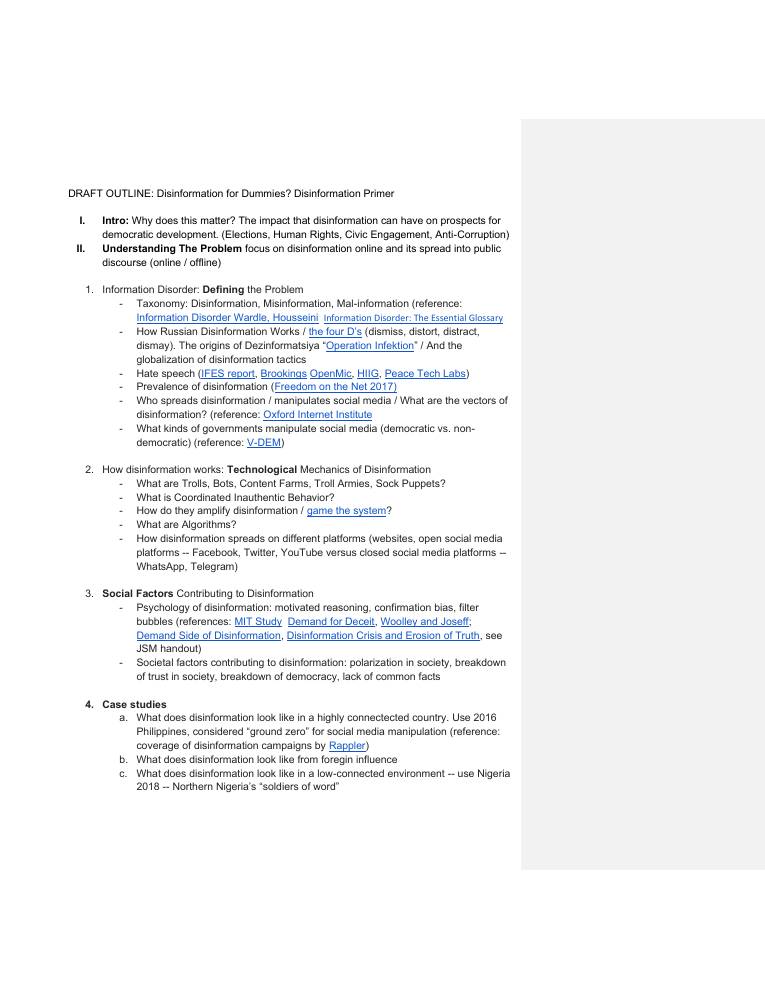
DRAFT OUTLINE: Disinformation for Dummies? Disinformation Primer I.
II.
Intro: Why does this matter? The impact that disinformation can have on prospects for democratic development. (Elections, Human Rights, Civic Engagement, Anti-Corruption) Understanding The Problem focus on disinformation online and its spread into public discourse (online / offline)
1. Information Disorder: Defining the Problem
• Taxonomy: Disinformation, Misinformation, Mal-information (reference: Information Disorder Wardle, Housseini Information Disorder: The Essential Glossary
• How Russian Disinformation Works / the four D’s (dismiss, distort, distract, dismay). The origins of Dezinformatsiya “Operation Infektion” / And the globalization of disinformation tactics
• Hate speech (IFES report, Brookings OpenMic, HIIG, Peace Tech Labs)
• Prevalence of disinformation (Freedom on the Net 2017)
• Who spreads disinformation / manipulates social media / What are the vectors of disinformation? (reference: Oxford Internet Institute
• What kinds of governments manipulate social media (democratic vs. nondemocratic) (reference: V-DEM) 2. How disinformation works: Technological Mechanics of Disinformation
• What are Trolls, Bots, Content Farms, Troll Armies, Sock Puppets?
• What is Coordinated Inauthentic Behavior?
• How do they amplify disinformation / game the system?
• What are Algorithms?
• How disinformation spreads on different platforms (websites, open social media platforms -- Facebook, Twitter, YouTube versus closed social media platforms -WhatsApp, Telegram) 3. Social Factors Contributing to Disinformation
• Psychology of disinformation: motivated reasoning, confirmation bias, filter bubbles (references: MIT Study Demand for Deceit, Woolley and Joseff; Demand Side of Disinformation, Disinformation Crisis and Erosion of Truth, see JSM handout)
• Societal factors contributing to disinformation: polarization in society, breakdown of trust in society, breakdown of democracy, lack of common facts 4. Case studies a. What does disinformation look like in a highly connectected country. Use 2016 Philippines, considered “ground zero” for social media manipulation (reference: coverage of disinformation campaigns by Rappler) b. What does disinformation look like from foregin influence c. What does disinformation look like in a low-connected environment -- use Nigeria 2018 -- Northern Nigeria’s “soldiers of word”
-
What stakeholders should you include in your program (data scientists, artists, influencers, local think tanks)
Engaging government
Who to engage with internationally (civil society, media, social media platforms, internet governance forums, other donors, like the FCO)
Key References / Guides:
Disinformation and Elections:
NDI Disinformation and Electoral Integrity:
IFES Social Media, Disinformation and Electoral Integrity Harvard Kennedy School/Misinformation Review
First Draft News
Original document
The PDF as released. If it does not display, open it directly.