USAID General Counsel FAQ sets rules for communicating with social media companies
An internal nine-page FAQ, drafted in October 2023 and updated September 27, 2024, explains how staff may engage platforms after the Missouri v. Biden and Murthy v. Missouri litigation.
What this record contains
The internal-use FAQ from USAID's Office of General Counsel says the agency may continue working with social media companies and on information integrity, in coordination with counsel. It says staff should only request that content be removed, retained, posted or promoted consistent with a company's own policies, and must avoid anything that could be read as coercion or significant encouragement. It describes procedures for reporting threatening content, requesting retention, and promoting content through paid tools or non-binding agreements, and lists State Department and White House guidance. The excerpt available omits several middle questions.
Full text of the record
Text extracted from the original PDF. Layout, tables and images are not reproduced. About 3,545 words.
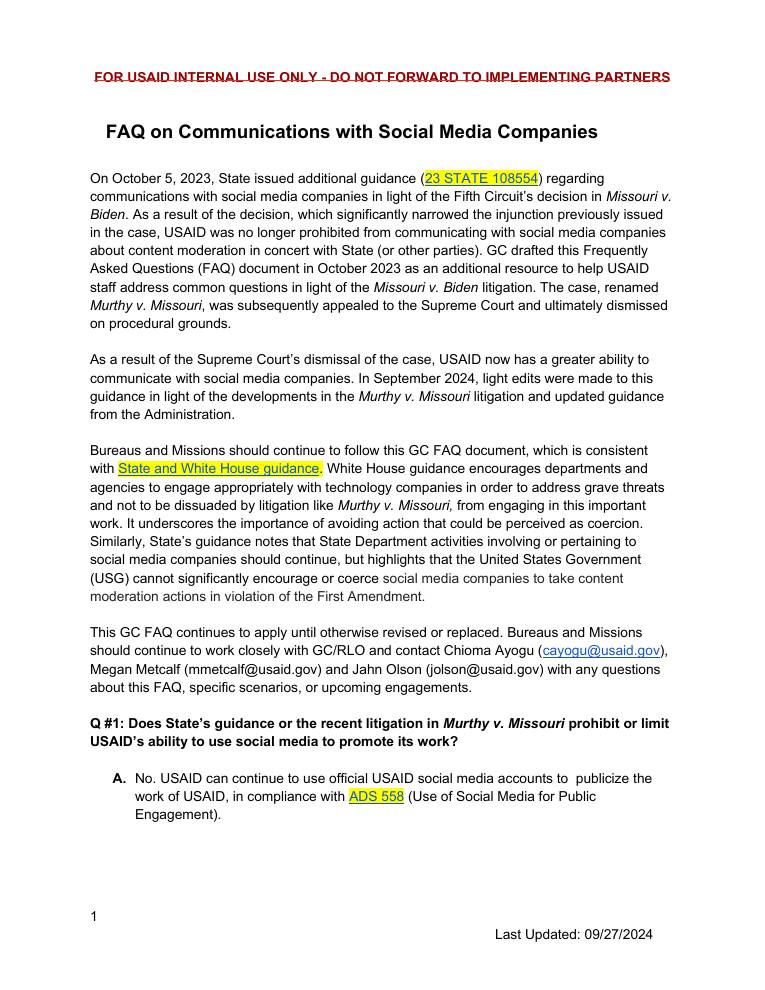
FAQ on Communications with Social Media Companies
On October 5, 2023, State issued additional guidance (23 STATE 108554) regarding communications with social media companies in light of the Fifth Circuit’s decision in Missouri v. Biden. As a result of the decision, which significantly narrowed the injunction previously issued in the case, USAID was no longer prohibited from communicating with social media companies about content moderation in concert with State (or other parties). GC drafted this Frequently Asked Questions (FAQ) document in October 2023 as an additional resource to help USAID staff address common questions in light of the Missouri v. Biden litigation. The case, renamed Murthy v. Missouri, was subsequently appealed to the Supreme Court and ultimately dismissed on procedural grounds.
As a result of the Supreme Court’s dismissal of the case, USAID now has a greater ability to communicate with social media companies. In September 2024, light edits were made to this guidance in light of the developments in the Murthy v. Missouri litigation and updated guidance from the Administration.
Bureaus and Missions should continue to follow this GC FAQ document, which is consistent with State and White House guidance. White House guidance encourages departments and agencies to engage appropriately with technology companies in order to address grave threats and not to be dissuaded by litigation like Murthy v. Missouri, from engaging in this important work. It underscores the importance of avoiding action that could be perceived as coercion. Similarly, State’s guidance notes that State Department activities involving or pertaining to social media companies should continue, but highlights that the United States Government (USG) cannot significantly encourage or coerce social media companies to take content moderation actions in violation of the First Amendment.
This GC FAQ continues to apply until otherwise revised or replaced. Bureaus and Missions should continue to work closely with GC/RLO and contact Chioma Ayogu (cayogu@usaid.gov), Megan Metcalf (mmetcalf@usaid.gov) and Jahn Olson (jolson@usaid.gov) with any questions about this FAQ, specific scenarios, or upcoming engagements.
Q #1: Does State’s guidance or the recent litigation in Murthy v. Missouri prohibit or limit USAID’s ability to use social media to promote its work?
A. No. USAID can continue to use official USAID social media accounts to publicize the work of USAID, in compliance with ADS 558 (Use of Social Media for Public Engagement).
Q #2: Is USAID prohibited from communicating with social media companies or working on issues involving information integrity and resilience?
A. No. USAID can continue to work with social media companies in accordance with the guidance provided here and in close coordination with GC/RLO.
The guidance is designed to help USAID continue its work to advance human rights and protect freedom of expression online, consistent with legal mandates in the Foreign Assistance Act of 1961 (FAA) and annual appropriations acts. This may include work to support information integrity, digital democracy, election security, digital security and media. For example, funds were specifically made available under Section 7032(g) of the FY 2023 Appropriations Act (Division K of P.L. 117-328) to advance digital security and counter disinformation in USAID partner countries in the manner described in the 2023 Joint Explanatory Statement (JES) under the heading Digital Security and Countering Disinformation:
1. address digital security to enhance the safety of implementers and beneficiaries;
2. support civil society organizations working to counter government surveillance, censorship, and repression by digital means;
3. combat weaponized technology, including the misuse of social media; 4. prevent the digital manipulation of elections, electoral data, and critical infrastructure; and
5. counter disinformation propagated by malign actors, including the People's Republic of China (PRC) and the Russian Federation.1
Q #3: Is USAID prohibited from partnering with social media companies on activities that do not involve content moderation?
A. No. USAID may continue to engage in these partnerships. A couple examples have been included below:
i.
Digital literacy bootcamps for university students in partner countries ii.
Ad buys on social media outlets to publicize USAID activities or programs in partner countries
iii.
Development of online tools that civil society can use to help address development challenges or business sustainability
Q #4: What are some considerations to keep in mind when communicating with social media companies in general or with respect to content moderation in particular? A. USAID employees and contractors should only request content be removed, retained, posted, or promoted consistent with the social media company’s policies.
Joint Explanatory Statement (JES) accompanying the FY 2023 Department of State, Foreign Operations and Related Programs Appropriations Act, Division K of P.L. 117-328 (SFOAA), pg. 63.
B. Avoid actions that could be considered “coercion” or “significant encouragement” to act
in accordance with USAID’s wishes or content moderation requests. USAID employees
and contractors must refrain from taking any actions that can be reasonably interpreted
as pressuring social-media companies to remove or post content.
a. “Coercion” includes actions that could reasonably be interpreted as pressuring
social media companies to remove, retain, post, promote content or take other
action by threatening to punish them or implying possible punishment if they fail
to do as USAID requests.
b. “Significant Encouragement” includes actions that could be reasonably
interpreted as excessive entanglement in a social media company’s decisionmaking process or attempts to exert meaningful control over the social media company’s decision-making.
C. Clearly communicate that any action taken in response to a request from USAID is
voluntary.
D. USAID employees and contractors must not be involved in or attempt to influence the
content moderation decisions of social media companies. They must avoid direct
involvement in the social media company’s content moderation decisions or
entanglement in the social media company’s independent decision-making. USAID staff
and contractors should not tell social media companies what to do or how to deploy their
resources (e.g., size, composition, or performance benchmarks for teams responsible for
content moderation).
E. USAID employees and contractors should only make content moderation requests
related to USAID staff,activities, or objectives. Exceptions to this approach must be
cleared with GC/RLO.
Avoiding Significant Encouragement or Coercion
Q #5: What are some examples of actions that could be considered “coercion?”
A. As highlighted in State’s guidance, depending on the context, the following could be
considered “coercion”:
• Public calls for action from the USG pressuring social media companies to endorse or adopt various industry or international principles or standards or implement certain standards or policies.
• Public statements from the USG urging social media companies to take specific action regarding content moderation or publicly criticizing social media companies for failing to do so;
• Public statements noting that social media should be held accountable for failing to take action through fundamental reforms, such as regulatory action. Q #6: What are some examples of actions that could be considered “significant encouragement?” A. As highlighted in State’s guidance, depending on the circumstances, the following could be considered “significant encouragement”:
• Actions inside and outside meetings with social media companies that identify certain posts as misinformation, identify options for labeling or addressing the misinformation in the post and asking for amplification of approved content the USG has determined are accurate. Enlisting the assistance of senior leadership at USAID to facilitate resolution of a content moderation request. Repeated requests for social media companies to change their content moderation policies, particularly where the requests do not end until the social media company makes changes that satisfy the USG’s concerns.
Content Moderation Requests
Q #7: Can USAID staff or contractors request removal of content that violates the Social Media Company’s terms of service/ use or policies?
A. Yes. Content moderation requests must be related to USAID staff, activities or objectives. USAID employees and contractors may only contact social media companies to request removal of content that violates the social media company’s terms of service/use. Exceptions to this approach must be cleared with GC/RLO. Such content frequently includes the following types of content: violent or graphic content, terrorist propaganda or support, harassment, spam, intellectual property infringement, impersonation of USG officials or official USG accounts, or certain privacy violations.
Q #8: How does USAID request removal of violent, harassing or other content that violates the social media company’s terms of service/use?
A. Outreach to request the removal of such content must follow the procedure outlined below. 1. Content of Request - The request for removal must be cleared by GC/RLO. The request for removal must identify the content USAID is requesting be removed, include a screenshot or direct link to the content and identify the terms of service or terms of use that the content violates. In each case, the social media company will decide how to respond to the request, in accordance with its policies. The request must not be coercive in tone or imply adverse consequences for the social media company if the content is not removed. The request cannot use examples of adverse consequences or reputational risk experienced by other social media companies that failed to take action to motivate or persuade the social media company to take action.
2. Means of Transmission - The request for removal must be transmitted to the social media company using existing channels as identified in platform terms of service, terms of use, or policies, unless the social media company directs use of a different process. 3. Escalation - The request for removal should be submitted and shepherded by an appropriate POC or identified alternative POC. Concerns should be escalated in accordance with the social media company’s existing policies. Senior leadership in USAID/W or Missions must not be engaged to help facilitate resolution of ongoing issues
unless requested by social media companies, particularly if they are not presenting new previously undiscussed issues or information.
4. Follow Up Outreach - USAID may engage in appropriate follow-up regarding its content moderation request after a reasonable period of time. If the social media company or online platform specifies a time frame for response, subsequent follow up or status checks must follow that time frame. Follow-up messages may flag changed conditions or additional relevant information that may have come to light since the original message was sent. Any appeals or requests for reconsideration of a content moderation decision must follow the social media company’s policy. If there is no appeals process then USAID cannot further engage regarding that particular content moderation request. Q #9: How does USAID request Removal of content that Poses a Threat to the Safety of USAID Staff or Recipients of USAID Foreign Assistance?
A. USAID may request that social media companies remove content that creates a serious threat to the safety of USAID staff or facilities, or to recipients of USAID funds. In such cases, Mission staff should contact the RSO or the DS Office of Protective Intelligence Investigations (DS/TIA/PII) at DSPIIDutyAgent@state.gov and copy the EXO for the Mission. USAID/Washington staff should contact the USAID Command Center at USAIDCommandCenter@usaid.gov). The email should include a screenshot or direct link to the content, an explanation of the threat posed, and information regarding the account owner/manager, if known. Any PII should be password protected. Failure to coordinate with EXO and RSO prior to outreach to the social media company may result in removal of the content before it can be recorded for further investigation, and may impede or preclude subsequent law enforcement action.
Q #10: How does USAID request Retention of content?
A. All requests for retention of content must demonstrate that the content did not violate the social media company’s terms of service or terms of use. USAID staff must follow the same procedures regarding means of transmission, escalation, and follow-up outreach as for requests for removal.
Q #11: How does USAID request Promotion of content?
A. USAID and its partners should rely on existing channels and tools developed by the social media company (e.g., paid boosting) to promote or raise awareness of USAID funded or supported activities. USAID may develop partnerships or execute memorandums of understanding (MOUs) or other non-binding agreements with social media companies to amplify or promote USAID projects or activities. USAID should ensure the “ask” or purpose of the partnership is clearly communicated. USAID should not conduct outreach to social media companies on behalf of its partners to encourage
social media companies or online platforms to promote or post content unless it is part of a partnership, MOU, or other non-binding agreement.
Q #12: Can multiple OUs or Missions send content moderation requests regarding the same content or enlist the assistance of senior leadership to help underscore the importance of the request or raise its profile?
A. No. OUs and Missions must follow the process outlined in this guidance. Senior leadership cannot be enlisted to help raise the profile or facilitate resolution of a content moderation request. OUs and Missions should coordinate where possible to ensure that the social media company is not receiving an influx of requests regarding identical content from multiple parts of USAID. Content moderation requests should be submitted and shepherded by an appropriate POC or identified alternative POC. Q #13: Can USAID staff or contractors contact social media companies to make content moderation requests on behalf of recipients of foreign assistance or members of the public?
A. USAID employees and contractors should only make content moderation requests related to USAID staff, activities, or objectives. Members of the public should be encouraged to contact the social media companies directly, rather than referring these incidents to USAID for follow up or action. Exceptions to this approach must be cleared with GC/RLO.
Q #14: Can USAID form partnerships with social media companies?
A. Yes. USAID may develop informal or formal partnerships or execute a memorandum of understanding (MOU) or other non-binding agreement with social media companies to amplify or promote USAID projects or activities or partner to address a development challenge or otherwise meet development objectives.
Q #15: Can USAID staff or contractors convene events that involve discussion of 1) common approaches taken by social media companies to safeguarding users, promoting human rights online, information integrity, or content moderation as well as 2) opportunities to strengthen these approaches by adopting or aligning with international standards, principles or best practices?
A. Yes. USAID staff and contractors must coordinate closely with GC/RLO when convening multi-stakeholder dialogues, listening sessions, or other public discussions that involve discussion of common approaches taken by social media companies to safeguarding users, promoting human rights online, information integrity, or content moderation as well as opportunities to strengthen these approaches by adopting or aligning with international standards, principles or best practices.
These discussions should not focus on any one social media company’s policies nor should they explicitly or implicitly encourage participants to advocate for changes in policy to social media companies and should not significantly encourage social media
companies to take action regarding specific content. Additional caution should be exercised if these dialogues or discussions include participants from social media companies. Any questions for social media companies should be submitted prior to the event and reviewed by GC/RLO and shared with social media company participants, if possible. USAID must communicate that social media company participation in Q&A is strictly voluntary.
Q #16: Can USAID staff or contractors have one-on-one discussions with social media companies about their policies for supporting users or promoting human rights online? A. Yes, but discussions with social media companies on the subject of their policies, practices or approaches to safeguarding users or promoting human rights online or opportunities to strengthen their policies by adopting or aligning with international standards, principles or best practices may only occur in strict accordance with this guidance and only in cases where it advances clear foreign policy objectives under the FAA or other applicable law.
• USAID staff and contractors must make clear that participation is entirely voluntary, that the conversations are intended to be informational only, that social media companies are under no obligation to provide information or create new data sets or documents for USAID, and that social media companies should not provide personally identifiable information (PII) or non-public information to USAID. If USAID staff or contractors plan to have ongoing discussions with social media companies or advocate for changes to company policies or practices, they are encouraged to develop a voluntary non-binding informal or formal partnership and memorialize it via email, MOU or a similar document. The document should identify the shared expectations and objectives. The agenda, talking points, and list of questions for these discussions must be cleared by GC/RLO prior to any discussions. The talking points should clearly communicate the purpose of the meeting, which should be informational only.
• Permissible topics of conversation include questions or clarifications regarding:
• Existing policies, procedures and staff responsibilities.
• Metrics or trends
• Policies, practices or approach and response to specific types of issues (e.g., such as addressing technology facilitated gender based violence (TFGBV))
• How current policies or procedures might address various problem sets or issues of concern not expressly addressed in existing social media company policy. USAID staff and contractors cannot identify specific posts or specific users and include them as a topic of discussion.
• Discussions should be limited in scope, duration and frequency and should not require significant expenditures of time or resources on the part of the social media company. USAID staff and contractors should not tell social media companies what to do or how to make staffing or resourcing decisions (e.g., size,
composition, or performance benchmarks for teams responsible for content
moderation). Requests for additional detail or information should not be
burdensome and should be limited to areas and issues that may be unclear.
Before engaging, USAID staff and contractors should determine the “tipping
point” when they will either discontinue discussions or pursue a voluntary nonbinding partnership with the social media company to tackle the issue in more depth.
Q #17: Can USAID reach out to social media companies to resolve “customer service
issues” related to its posts? For example, what if USAID paid the social media company
to “boost” or increase visibility of its posts on social media platforms, but the proposed
posts are consistently rejected?
A. Yes, USAID can reach out to a social media company to resolve “customer service
issues” related to its posts using the social media company’s existing channels or tools.
If there is no existing process or point of contact to resolve these issues for users,
USAID can develop partnerships with social media companies to help better amplify or
promote USAID projects or activities, consistent with the guidance above. USAID can
also flag this as a general issue for users, but cannot imply that the social media
company is expected to develop a process for use by the USG.
Q #18: How do the guidance from State and USAID address or take into consideration
freedom of expression?
A. This guidance reflects USAID’s longstanding commitment to protecting and promoting
freedom of expression, and free and independent media consistent with the United
States’ responsibilities as a party to the International Covenant on Civil and Political
Rights, which protects freedom of expression, and the right to freedom of speech
protected by the First Amendment to the United States Constitution. In the United
States, freedom of expression – whether exercised offline or online – receives strong
protection. The First Amendment to the U.S. Constitution states that “Congress shall
make no law ... abridging the freedom of speech.” The United States Supreme Court has
interpreted the right to freedom of speech broadly and has only identified a limited
number of narrowly defined categories of speech that do not receive First Amendment
protection.
In carrying out its development mission overseas in partner countries, in accordance
with the foreign policy objectives of the Foreign Assistance Act of 1961 (FAA), USAID
strives to amplify and extend the reach of the United States’ most cherished values and
beliefs: human dignity, freedom, and equality. USAID’s commitment to advancing and
protecting these values and beliefs, including freedom of expression, is reflected in the
Agency’s programs and policies. Further, it is the policy of the U.S. government to
encourage social media companies to respect human rights, including freedom of
expression.
Q #19: Where can I find additional guidance?
A. Please contact your GC or RLO and contact Chioma Ayogu (cayogu@usaid.gov), Meghan Metcalf (mmetcalf@usaid.gov) and Jahn Olson (jolson@usaid.gov) for additional guidance regarding specific scenarios or upcoming engagements. Additional Resources
• Agency Guidance on Information Integrity and Resilience (IIR) Guidance (New)
• Interim White House Guidance on Tech Engagement
• GC Summary
• State Department Guidance and Resources
• 24 STATE 27966 (Promoting Information Integrity and Resilience (New)
• REFTEL A ( 23 STATE 79110) (State’s Guidance on compliance with the preliminary injunction (PI) issued in Missouri v. Biden)
• REFTEL B ( 23 STATE 81494) (State’s guidance in light of the stay of the PI)
• REFTEL C (21 STATE 35924) (Department Guidance Concerning Engaging Online Platforms Regarding the Removal or Retention of Content on Third Party Accounts)
• REFTEL D ( 21 STATE 36050) (Department Guidance Concerning Engaging Online Platforms Regarding the Removal or Retention of Content on Third Party Accounts)
• 23 STATE 108554 (Updated Guidance in Light of Fifth Circuit Decision in State of Missouri, et al. v. Joseph R. Biden Jr., et al.)
• Guidance on Flagging Impersonation Accounts (10 FAM 184)
• Guidance on flagging content that violates the social media company’s terms of use (10 FAM 185(d))
The original document
Page through the PDF exactly as released. If it does not display, open it directly.