Session plan outlines democracy and anticorruption briefing for USAID mission directors
A conference session template for an October 25 mission directors' meeting lays out objectives, a run of show and breakout groups on disinformation, anticorruption and politically dynamic environments.
Summary
The session design describes an 80-minute session on democratic backsliding and anticorruption for USAID mission directors. It plans a plenary by the deputy assistant administrator for democracy, human rights and governance and the head of the Anti-Corruption Task Force, a facilitated discussion, and three breakout groups. One breakout, co-facilitated by the senior adviser on technology and democracy, covers how mis-, dis- and mal-information affects missions and what USAID is doing. Another addresses closing political environments, citing Belarus, Azerbaijan and Tajikistan. The template includes discussion questions and facilitator biographies; the year is not stated.
Written by AI from the text of the record.
Full text
Text extracted from the original PDF. Layout, tables and images are not reproduced. About 2,033 words.
Session Design
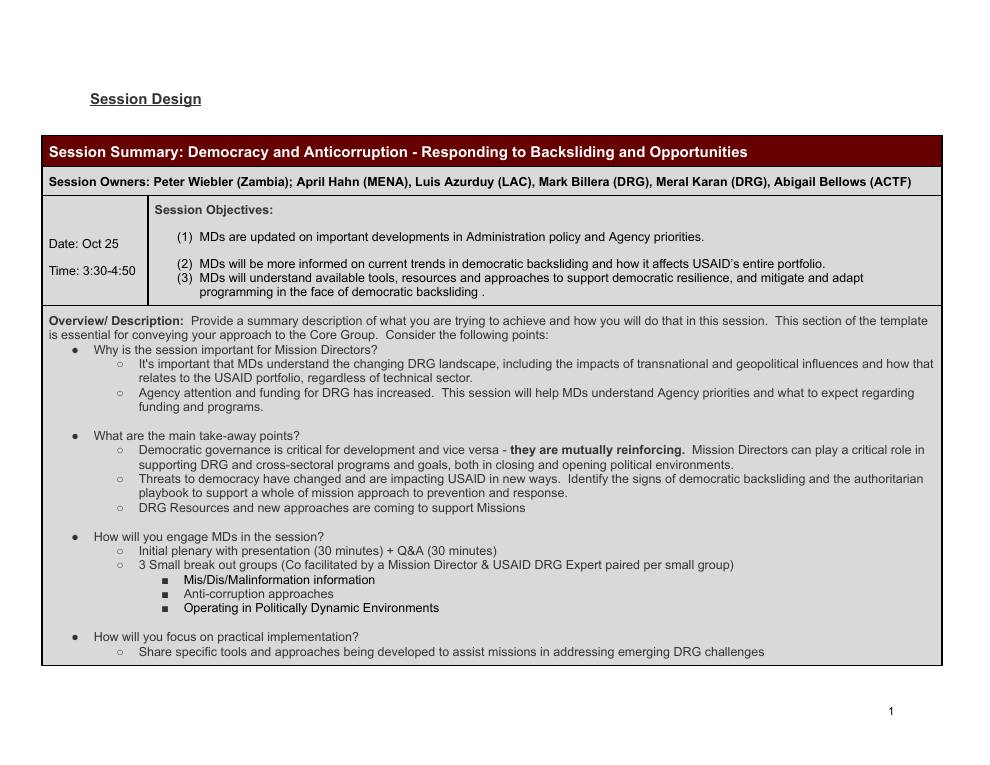
Session Summary: Democracy and Anticorruption - Responding to Backsliding and Opportunities
Session Owners: Peter Wiebler (Zambia); April Hahn (MENA), Luis Azurduy (LAC), Mark Billera (DRG), Meral Karan (DRG), Abigail Bellows (ACTF) Session Objectives:
Time: 3:30-4:50
(1) MDs are updated on important developments in Administration policy and Agency priorities. (2) MDs will be more informed on current trends in democratic backsliding and how it affects USAID’s entire portfolio. (3) MDs will understand available tools, resources and approaches to support democratic resilience, and mitigate and adapt programming in the face of democratic backsliding .
Overview/ Description: Provide a summary description of what you are trying to achieve and how you will do that in this session. This section of the template is essential for conveying your approach to the Core Group. Consider the following points:
• Why is the session important for Mission Directors?
• It's important that MDs understand the changing DRG landscape, including the impacts of transnational and geopolitical influences and how that relates to the USAID portfolio, regardless of technical sector.
• Agency attention and funding for DRG has increased. This session will help MDs understand Agency priorities and what to expect regarding funding and programs.
• What are the main take-away points?
• Democratic governance is critical for development and vice versa - they are mutually reinforcing. Mission Directors can play a critical role in supporting DRG and cross-sectoral programs and goals, both in closing and opening political environments.
• Threats to democracy have changed and are impacting USAID in new ways. Identify the signs of democratic backsliding and the authoritarian playbook to support a whole of mission approach to prevention and response.
• DRG Resources and new approaches are coming to support Missions
• How will you engage MDs in the session?
• Initial plenary with presentation (30 minutes) + Q&A (30 minutes)
• 3 Small break out groups (Co facilitated by a Mission Director & USAID DRG Expert paired per small group)
• Mis/Dis/Malinformation information
• Anti-corruption approaches
• Operating in Politically Dynamic Environments
• How will you focus on practical implementation?
• Share specific tools and approaches being developed to assist missions in addressing emerging DRG challenges
• Explore engagement beyond DRG programming, e.g. Mission-wide approaches, in the interagency, and donor coordination.
• Identify Mission Directors and USAID experts who can facilitate a practical discussion around topics
• Gather recommendations/requests from MDs for the upcoming Summit for Democracy
• Are there cross-cutting issues that are important to highlight?
• Many DRG issues are inherently cross cutting - we will make that point. Specific issues of anti-corruption, disinformation, foreign malign influence and gender are cross-cutting and will be included.
Detailed Session Plan (Run of Show)
Time
Topic/Activity
Activities/ Who is Responsible
3:30 - 3:35 pm
(5 mins)
Welcome!
Welcome participants to the session (DA Coleman). If she is not available, then Johnny Walsh, DAA/DRG) will introduce the session.
• Provide an introduction to the session
3:35 - 3:55 pm
(20 mins)
Democracy
Trends and How
USAID is
Responding
Plenary: Democracy Trends and USAID’s Response and Priorities: Johnny Walsh, DAA/DRG and Shannon Green, Executive Director, Anti-Corruption Task Force
Required
Materials/Equipment
Powerpoint
Presentation (20 minutes)
1) Current trends in democratic governance and anti-corruption (autocratic playbook and signs of backsliding as well as democratic openings) 2) How USAID and Administration policy is responding and what that means for Missions (Summit for Democracy, new approaches, more funding, USG legislation, interagency and tech sector engagement, etc.). What does the progress beyond programs mindset mean for DRG/AC?
3:55-4:15
(20 minutes)
Mission Director
Discussion
Forum
Facilitated Discussion: Q&A Facilitator (Peter Wiebler, USAID/Zambia) (20 minutes)
Reflections on what you heard or on how MDs can make an impact to advance democracy and combat corruption?
Mission Directors have considerable access and influence that can greatly support the
efforts of USAID programs. Reflecting on the information shared in the Plenary, Mission Directors will discuss and share their tips and how they approach supporting democratic governance and anticorruption efforts. This will be a discussion and opportunity for Mission Directors to share how they can advance “progress with (or without) programs.”
Discussion Questions:
1. What approaches have you tried to support democratic development and combat backsliding?
2. What trade offs do you face supporting democratic governance? How do we balance DRG goals with other USG/USAID interests?
3. What advice/asks do you have for Washington?
04:15 - 04:50
am/pm (35
mins)
Democracy Topic
Deep Dive:
Small Group
Breakouts
Individuals will self-select into 3 concurrent break out groups and Facilitators will open with a few remarks (5-10 minutes) to set context and then facilitate discussion. The sessions will end providing contact information to assist with further follow up, as requested.
Disinformation
Small Group A: Mis/Dis/Malinformation information: Why it matters to USAID and What We Can Do (Salon 1)
Co-Facilitators: Vera Zakem, Senior Adviser on Technology and Democracy, DDI/DRG Peter Wiebler, Mission Director, USAID Zambia
Powerpoint (Slides 15-18)
Vera provides a 5-10 minute overview of how mis/dis/malinformation is affecting USAID and development actors and USAID’s current steps to support Missions. She will then open it up for discussion with guiding questions for discussion. Questions to ask group:
1) How does your Mission experience mis/dis/malinformation?
2) What are you and the Mission doing? (Yes - it is not just State’s lane!) 3) What tools would help you better address this challenge?
Corruption
Small Group B: Combating Corruption (Salon 2)
Facilitator Melissa Brown –,Senior Advisor and Chief Operating Officer, Anti-Corruption Task Force
Melissa will share for 5 min about:
• The shifts in direction reflected in: a) the draft Policy (current vs. adapted approach), b) the Dekleptification Guide, and c) the Countering Corruption Across Sectors Guide.
• Transforming the Fight Against Corruption initiative: What it looks like to confront transnational corruption at the country level Questions to ask group:
• What does this new direction (from the draft Policy) mean for you, as you develop new strategies, programs, staffing decisions, etc?
• What new flexibilities and authorities would you need to execute in these new directions?
• What questions are you grappling with and where would it be useful to learn from others? (reference AC Mission Champions Circle) Closing/Openin g Environments
Small Group C: Operating in Politically Dynamic Environments (Plenary Room) This session will discuss common trajectories of closing political environments, impacts on programming, staff and security, and strategies to support democratic resilience and progress. Additionally, there are different US political considerations - some closing
political environments where we vigorously stand up for democracy (Belarus) and others where seek to engage with governments regardless of repressions (Azerbaijan or Tajikistan). We will need to address both environments and what it means for our DG work.
Co-Facilitator Laura Pavlovic, Deputy Director/DRG Center/DDI Ryan Washburn, Mission Director
Chris Cushing, Mission Director, El Salvador
Questions to ask group:
1. What diplomatic efforts or strategies have you used to address democratic backsliding or support democratic openings? What holds you back? 2. What are the trade offs, as a Mission Director, when working with counterparts
that are increasingly autocratic? Do you have best practices of working in the inter-agency to ensure the USG speaks with one voice on democratic backsliding?
3. What operational issues do you face in addressing these challenges and what would help you manage them? (i.e. cybersecurity, IP/staff security, crisis communications, etc)
4. Openings are crucial but they can close quickly. What should USAID do to prepare for them and keep them open?
Notetaker(s) Identified for My Session: Plenary (Danielle Roziewski (DRG) and April Hahn) Group A: Meral Karan (DRG), Group B: Abigail Bellows (ACTF) Anticorruption, Group C: Blair King (DRG),
Biography Annex
Information to be provided for each presenter and/or moderator is in the table below. Bios should be 3 to 5 sentences only. Name:
Johnny Walsh, Deputy Assistant Administrator, DRG/DDI
Contact Info:
jowalsh@usaid.gov
Short Bio (3 sentences):
Johnny Walsh serves as the Deputy Assistant Administrator for Democracy, Human Rights and Governance in the DDI Bureau. Prior to joining USAID, Mr. Walsh served as a Senior Expert at the United States Institute of Peace from 2017 to 2021. He previously served in government in a range of foreign policy roles, including as the U.S. Mission to the United Nations' Senior Policy Advisor for the Middle East and South Asia.
Name:
Shannon Green, Executive Director, Anticorruption Task Force
Contact Info:
sgreen@usaid.gov
Short Bio (3 sentences):
Shannon N. Green serves as Senior Advisor to the Administrator and Executive Director of the Anti-Corruption Task Force. Previously, Ms. Green was the Senior Director of Programs at the Center for Civilians in Conflict (CIVIC), where she oversaw the organization’s global efforts to recognize the dignity and rights of civilians, prevent civilian harm, and protect civilians caught in conflict. Before that, she was the Director and Senior Fellow of the Human Rights Initiative at the Center for Strategic and International Studies (CSIS), where her research focused on addressing threats to democratic institutions and norms; enhancing justice and accountability; and improving security forces’ respect for human rights.
Name:
Peter Wiebler
Contact Info:
pwiebler@usaid.gov
Short Bio (3 sentences):
Peter Wiebler is the Mission Director of USAID/Zambia. Before his appointment to Zambia, Mr. Wiebler served as Mission Director for USAID/Caucasus in Tbilisi, Georgia from 2018-2022. A career Senior Foreign Service Officer, Mr. Wiebler has extensive senior U.S. Government and private foundation experience in democratization. Prior to his assignment to Georgia, Mr. Wiebler served as the Acting Director of the Office of Budget and Resource Management (BRM) in USAID/Washington and has led the Democracy and Governance (DG) portfolios in some of the Agency's largest and most sensitive missions, including Afghanistan, Belarus, Moldova, West Bank/Gaza, Serbia, and Ukraine. Prior to joining USAID in 2002, Mr. Wiebler led Freedom House’s Budapest Regional Office for seven years, spearheading democratization initiatives across Central and Eastern Europe.
Name:
Vera Zakem
Contact Info:
vzakem@usaid.gov
Short Bio (3 sentences):
Vera Zakem is Senior Advisor for Technology and Democracy, based in the DRG Center, leading USAID’s efforts to strengthen information integrity and digital democracy. She has served as a Senior Technology and Policy Advisor at the Institute for Security and Technology and led strategy and research at Twitter.
She has worked for a number of national security policy and research organizations, including the CNA Corporation, where she spearheaded initiatives to understand and develop policies to counter disinformation and global malign influence.
Name:
Melissa Brown
Contact Info:
mebrown@usaid.gov
Short Bio (3 sentences):
Melissa Brown is the Senior Advisor and Chief Operating Officer of the Anti-Corruption Task Force. She has more than 25 years of experience with USAID and the U.S. Department of State on a wide range of democracy and governance, conflict mitigation and fragile states initiatives. Previously, Ms. Brown served as Senior Advisor in the Bureau for Policy, Planning and Learning, visiting faculty at the National Defense University’s Eisenhower School, the acting Deputy Assistant Administrator in USAID’s Bureau for Democracy, Conflict, and Humanitarian Assistance, and the Director of USAID’s Office of Conflict Management and Mitigation. She joined USAID as a Presidential Management Intern, contributing to the establishment of the Democracy and Governance Center of Excellence and also served at USAID/Nigeria.
Name:
Laura Pavlovic
Contact Info:
lpavlovic@usaid.gov
Short Bio (3 sentences):
Laura Pavlovic is a Deputy Director in the DRG Center. She began her USAID career in 2005 in USAID's East Africa regional mission, where she managed USAID's post conflict transition assistance program in Burundi. She has also served overseas in Ukraine, Serbia, and the Regional Development Mission for Asia. Laura also served in the DRG Center from 2012-2015 as the Division Chief of the Cross-Sectoral Programs Division. Prior to joining USAID, Laura worked as a corporate attorney in New York and Washington, where she also worked extensively on human rights and political asylum issues.
Session Resources and Documents
Session Resource Materials Links – This conference is making every effort to go as paperless as possible. Please list any materials you would like participants to have access to in advance of your session. Further information will be provided on where to upload materials. Should presenters want to provide paper copies of materials, presenters will need to provide their own copies of their materials for participants on the day of the conference.
None
Original document
The PDF as released. If it does not display, open it directly.