USAID and Telecom Infra Project sign memorandum on Asia Open RAN Academy
A five-page memorandum of understanding effective July 8, 2022 sets out cooperation between USAID and the non-profit Telecom Infra Project on open telecommunications networks in Asia.
Summary
The memorandum says the two participants intend to promote open, interoperable, standards-based telecommunications networks and supplier diversity. It centres on the Asia Open Radio Access Network Academy, a workforce development program USAID is piloting in the Philippines. USAID is to facilitate communication with missions and host governments, share learning, and promote Open RAN through its BEACON activity; the Telecom Infra Project is to provide curriculum expertise and promote the academy to members. The parties plan a joint work plan by September. It is signed for USAID by Gillian Caldwell on July 14, 2022.
Written by AI from the text of the record.
Full text
Text extracted from the original PDF. Layout, tables and images are not reproduced. About 1,580 words.
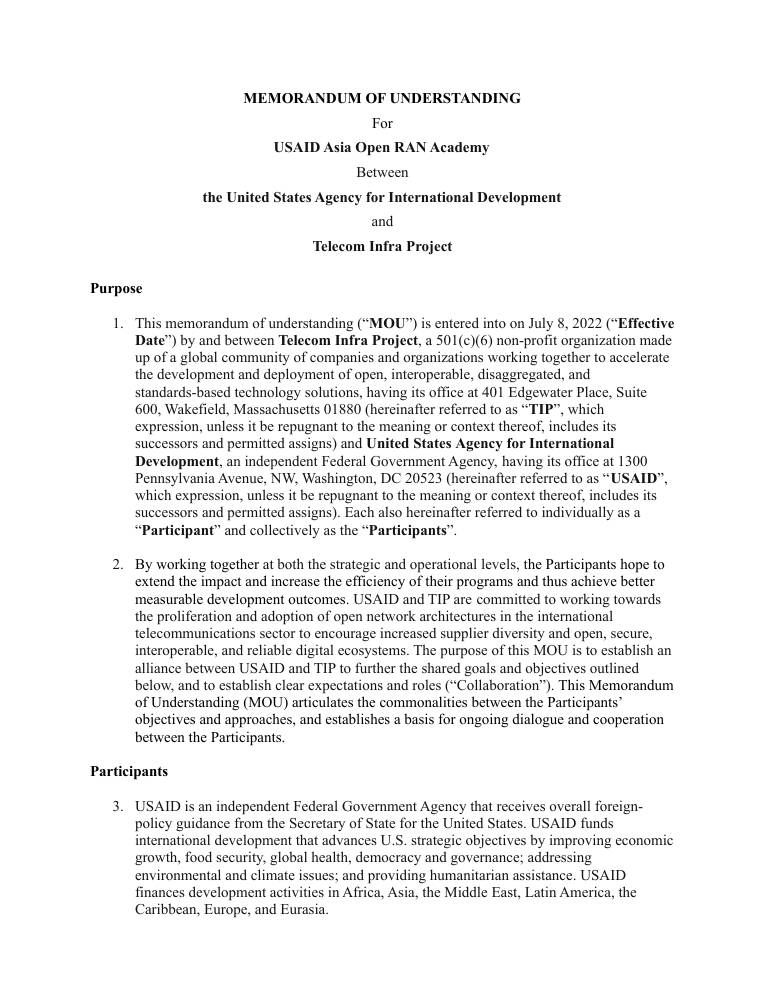
MEMORANDUM OF UNDERSTANDING
For
USAID Asia Open RAN Academy
Between
the United States Agency for International Development
and
Telecom Infra Project
Purpose
1. This memorandum of understanding (“MOU”) is entered into on July 8, 2022 (“Effective
Date”) by and between Telecom Infra Project, a 501(c)(6) non-profit organization made
up of a global community of companies and organizations working together to accelerate
the development and deployment of open, interoperable, disaggregated, and
standards-based technology solutions, having its office at 401 Edgewater Place, Suite
600, Wakefield, Massachusetts 01880 (hereinafter referred to as “TIP”, which
expression, unless it be repugnant to the meaning or context thereof, includes its
successors and permitted assigns) and United States Agency for International
Development, an independent Federal Government Agency, having its office at 1300
Pennsylvania Avenue, NW, Washington, DC 20523 (hereinafter referred to as “USAID”,
which expression, unless it be repugnant to the meaning or context thereof, includes its
successors and permitted assigns). Each also hereinafter referred to individually as a
“Participant” and collectively as the “Participants”.
2. By working together at both the strategic and operational levels, the Participants hope to
extend the impact and increase the efficiency of their programs and thus achieve better
measurable development outcomes. USAID and TIP are committed to working towards
the proliferation and adoption of open network architectures in the international
telecommunications sector to encourage increased supplier diversity and open, secure,
interoperable, and reliable digital ecosystems. The purpose of this MOU is to establish an
alliance between USAID and TIP to further the shared goals and objectives outlined
below, and to establish clear expectations and roles (“Collaboration”). This Memorandum
of Understanding (MOU) articulates the commonalities between the Participants’
objectives and approaches, and establishes a basis for ongoing dialogue and cooperation
between the Participants.
Participants
3. USAID is an independent Federal Government Agency that receives overall foreignpolicy guidance from the Secretary of State for the United States. USAID funds international development that advances U.S. strategic objectives by improving economic
growth, food security, global health, democracy and governance; addressing
environmental and climate issues; and providing humanitarian assistance. USAID
finances development activities in Africa, Asia, the Middle East, Latin America, the
Caribbean, Europe, and Eurasia.
4. TIP is a global not-for-profit company founded in 2016 that includes hundreds of companies, from service providers and technology partners to systems integrators and other connectivity stakeholders. TIP and its members work together to develop, test,validate, promote, and deploy open, interoperable, and disaggregated solutions that deliver the high quality connectivity that the world needs.
Goals and Objectives
5. The Participants have the following strategic goals and objectives in common:
• USAID and TIP intend to collaborate in the Asia region to promote the proliferation of open, interoperable, disaggregated, and standards-based telecommunications networks that encourage increased supplier diversity in the telecommunications sector. As part of USAID’s International Open RAN Initiative, USAID is piloting a workforce development program, the Asia Open Radio Access Network (O-RAN) Academy, in the Philippines to support the skills acquisition needed by current and future telecommunication sector workforce.
• TIP endeavors to bring its experience in the Open RAN space as well as leverage the expertise of its participant companies to (1) share lessons learned and perspectives on pertinent concepts to include in the Asia O-RAN Academy’s curriculum, (2) share potential opportunities to partner with TIP and its participants, and (3) to engage with the private sector in the Philippines.
• This Collaboration between the Participants demonstrates a model for public-private partnership that is designed for long-term success, replicability, scale, and effectiveness in opening up the telecommunications infrastructure market and promoting open, secure, interoperable, and reliable telecommunications networks in our partner countries by encouraging supplier diversity, with the aim to inspire additional public-private sector projects globally.
• In this partnership, USAID and TIP intend to work together to:
• Exchange non-confidential, non-proprietary information on the latest open network architecture advances to help identify relevant and applicable concepts to be included in the Asia O-RAN Academy curriculum for the Philippines.
• Support TIP’s efforts to develop, test and deploy open, interoperable, disaggregated, and standards-based solutions that deliver high quality connectivity in the Asia Region and beyond.
• Discuss ways to utilize opportunities for joint marketing and support the work being done within each organization around Open RAN.
Roles and Responsibilities
6. Under this MOU, USAID intends to accomplish the following:
• Facilitate communication and information sharing between TIP, USAID Mission and other U.S. Government staff in the field, host- country governments, and implementing partners and non-governmental organizations in this regard, and
• Provide its technical expertise, support monitoring, and evaluation expertise so as to share its learnings from the Asia O-RAN Academy and other USAID International Open RAN Initiative programs;
• Promote adoption of Open RAN to increase network interoperability and security in the Philippines through USAID’s Better Access and Connectivity (BEACON) activity.
• Promote TIP to government and industry partners.
• Collaborate and provide regular read-outs of its initiatives to TIP and mutually explore opportunities to publicize and generate awareness of one another’s open network architecture training opportunities and initiatives.
• Collaborate with Telkom University, as the TIP Community Lab host in the Indo-Pacific region, to support the implementation of capacity building programs. 7. TIP intends to accomplish the following:
• Provide technical expertise for the curriculum design for the Asia O-RAN Academy and promote the importance of open, interoperable, disaggregated, and standards-based solutions that deliver high-quality connectivity in the Philippines and the Asia region.
• Promote the Asia O-RAN Academy to its members and partners, to the extent that its offerings do not duplicate those offered by TIP.
• Collaborate and provide regular read-outs of its initiatives to USAID and mutually explore opportunities to publicize and generate awareness of one another’s open network architecture training opportunities and initiatives. Implementation 8. To achieve the above-stated objectives, the Participants agree to meet as needed in order to develop a mutually-agreed work plan by September 2022. Publicity and Communications 9. Public communications related to this MOU should appropriately attribute the efforts of both Participants, in each case subject to their consent. Each Participant intends to respond to a communication request by the other within three business days. Joint branding may be used with the written consent of each Participant. Each Participant may make its logo available for use on specific materials at its sole discretion. Each Participant should obtain written approval prior to the publication of all information and materials that contain the other’s logo. The Participants expect that any such materials give equal prominence. The Participants intend to respect each other’s confidentiality policies, with the mutual understanding that they publicize their alliance and its objectives without disclosing any confidential or proprietary information of the other.
Each Participant may make the existence and content of this MOU publicly available by press release, public commentary, or other disclosure, in accordance with their policies or procedures regarding the public disclosure of information, subject to the prior written consent of the other.
Reporting and Collaboration
10. The Participants understand the need for regular reporting on activities and results and intend to collaborate to meet any information needs or applicable reporting requirements in connection with the cooperation under this MOU. The participants expect any reporting requirements, including the designation of additional points of contact and cadence and nature of communications, to be established in the work plan. General Provisions
11. Duration: This MOU is expected to continue for 1 year from the date of signature and may be extended in writing. The Participants may renew or extend it by mutual written agreement. It is understood that either Participant may terminate this MOU by giving thirty (30) days of prior written notice to the other Participant.
12. Modifications: It is intended that the Participants may modify this MOU only in writing, signed by both Participants.
13. Effect of MOU: This MOU is not a treaty and does not give rise to rights or obligations under international law. The Participants specifically acknowledge that this MOU is not an obligation of funds, nor does it constitute a legally binding commitment by any Participant or create any rights in any third party. The Participants intend to maintain their own separate and unique missions and mandates and their own accountabilities. Unless specifically provided otherwise, the cooperation among the Participants as outlined in this MOU shall not be construed as a partnership or other type of legal entity or personality. Each Participant shall accept full and sole responsibility for any and all expenses incurred by itself related to this MOU. Nothing in this MOU shall be construed as superseding or interfering in any way with any agreements or contracts entered into among the Participants, either prior to or subsequent to the signing of this MOU. Nothing in this MOU shall be construed as an exclusive working relationship. Points of Contact
14. The primary Points of Contact for each Participant for administering this MOU appear below. Each Participant may, by written notice, replace or identify additional representatives.
Contact Person: Kate Dimsdale
Contact Person: Vish Mathur and Aulia Velmy
USAID
TIP
Address:
Address:
Phone:
Phone:
E-mail:
@usaid.gov
E-mail:
@telecominfraproject.com
@fb.com
The Participants, each acting through its duly authorized representative, have caused this Memorandum of Understanding to be signed in their names and delivered as of this 28 day of April, 2022.
UNITED STATES AGENCY FOR
INTERNATIONAL DEVELOPMENT
TELECOM INFRA PROJECT
By:
By:
_____/s/Gillian Caldwell___________
(Signature)
________________________
(Signature)
Kristian Toivo
Gillian Caldwell
Executive Director
Senior Official In Charge
Original document
The PDF as released. If it does not display, open it directly.