Talking points set out USAID asks for Google and YouTube call
A nine-page 2022 document gives USAID speakers an agenda, talking points and requests for a call with Google staff on Ukraine, with Google's responses and follow-ups noted.
What this record contains
The agenda covers mis- and disinformation and a rapid escalation process for content moderation concerns, the status of Google products in Ukraine, Belarus, Moldova and Russia, in-kind assistance such as search trends and ad credits, and the Google News Initiative. USAID asks how local partners can be referred for Google's $10 million funding, how researchers get data, and how to streamline US government feedback. Recorded Google responses say sensitive access runs through vetted networks such as the Trusted Flagger Program. Follow-ups include mission staff training and a meeting on ad revenue for Ukrainian, Belarusian and Russian newsrooms.
Full text of the record
Text extracted from the original PDF. Layout, tables and images are not reproduced. About 3,828 words.
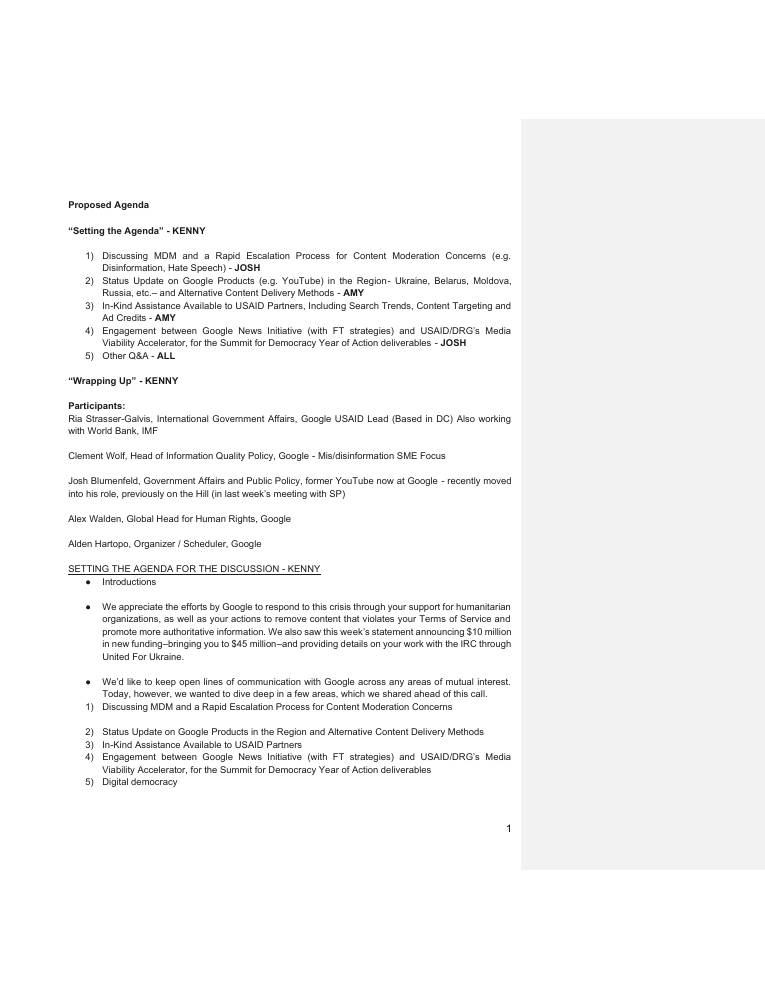
Proposed Agenda
“Setting the Agenda” - KENNY
1) Discussing MDM and a Rapid Escalation Process for Content Moderation Concerns (e.g. Disinformation, Hate Speech) - JOSH
2) Status Update on Google Products (e.g. YouTube) in the Region- Ukraine, Belarus, Moldova, Russia, etc.– and Alternative Content Delivery Methods - AMY
3) In-Kind Assistance Available to USAID Partners, Including Search Trends, Content Targeting and Ad Credits - AMY
4) Engagement between Google News Initiative (with FT strategies) and USAID/DRG’s Media Viability Accelerator, for the Summit for Democracy Year of Action deliverables - JOSH 5) Other Q&A - ALL
“Wrapping Up” - KENNY
Participants:
Ria Strasser-Galvis, International Government Affairs, Google USAID Lead (Based in DC) Also working with World Bank, IMF
Clement Wolf, Head of Information Quality Policy, Google - Mis/disinformation SME Focus Josh Blumenfeld, Government Affairs and Public Policy, former YouTube now at Google - recently moved into his role, previously on the Hill (in last week’s meeting with SP)
Alex Walden, Global Head for Human Rights, Google
Alden Hartopo, Organizer / Scheduler, Google
SETTING THE AGENDA FOR THE DISCUSSION - KENNY
• Introductions
We appreciate the efforts by Google to respond to this crisis through your support for humanitarian organizations, as well as your actions to remove content that violates your Terms of Service and promote more authoritative information. We also saw this week’s statement announcing $10 million in new funding–bringing you to $45 million–and providing details on your work with the IRC through United For Ukraine.
We’d like to keep open lines of communication with Google across any areas of mutual interest. Today, however, we wanted to dive deep in a few areas, which we shared ahead of this call. 1) Discussing MDM and a Rapid Escalation Process for Content Moderation Concerns 2) Status Update on Google Products in the Region and Alternative Content Delivery Methods 3) In-Kind Assistance Available to USAID Partners
4) Engagement between Google News Initiative (with FT strategies) and USAID/DRG’s Media Viability Accelerator, for the Summit for Democracy Year of Action deliverables 5) Digital democracy
We are also, of course, happy to hear from you all on your questions for USAID.
We’re happy to dive right in unless you all have any questions or points you want to raise. PAUSE
Ok. II’ll hand it over to Josh
Google Response: Schedule a follow-up meeting with Google News Lab (rep not here today). MIS/DIS/MALINFORMATION AND THE OVERALL INFORMATION ENVIRONMENT - JOSH
• We would like to hear more about Google’s efforts, challenges, and the organizations you are supporting or collaborating with on MDM.
• For instance, we saw a March 29 announcement of $10 million of funding, including new partnerships with think tanks and civil society organizations to conduct region -specific research into misinformation and disinformation, as well as cash grants to support fact-checking networks and nonprofits.
• When funds are awarded and research conducted, will this research be something we can share with our implementing partners, local partners, so that they can provide practical applications of the research in their interventions and activities? And if yes, how can we do so?
For the Europe/Eurasia region, we have a trusted network of local partners (both media and civil society organizations) in Ukraine and around the region who are fact-checking content, exposing disinformation and providing critical information. Our aim is to both get as much of a boost as possible to these organizations and to the content that they put out there. And when they surface bad MDM actors, we want to raise awareness through the appropriate channels to get tech platforms to respond.
• ASK: What is the application process by which the $10M funding is distributed? How might we refer local partners to Google for further consideration?
On research: There is an increased need to develop local research capacity to do this work in the countries where USAID works. Capacity levels vary depending on where we work. But in some of the countries that are the most vulnerable, USAID has contacts and potential partners that we could recommend or do outreach to. We can also commit to providing some of the capacity building needed for interested groups. We have a good ground-game and want to understand how we can be a partner to Google, respecting our current portfolios and with sensitivity to how USAID works in many of the countries of the global south.
• Some of the countries which have a high level of vulnerability, for example, to Russian disinformation, have underdeveloped local response (and research) capacity (for example, Central African Republic, Mali, Burkina Faso). The House has just passed legislation ‘Countering Malign Russian Activities in Africa Act”: https://www.congress.gov/bill/117th-congress/house-bill/7311/text to “monitor and report on Russian political influence and disinformation operations and the activities of Russian, Russia-connected, or Russian-funded private military contractors in Africa.”
• ASK: What is the process by which Google and YouTube currently works with independent researchers on MDM?
• ASK: Beyond what’s available through the built-in Analytics tools, how are you making data available to these independent researchers?
We also understand that USAID is not the only agency within the U.S. Government raising concerns related to MDM.
• ASK: From Google’s perspective, what would be the best way to streamline feedback from across U.S. departments / agencies, particularly on issues of concern?
• ASK: There are a variety of mechanisms that we could use, including working through G7’s Rapid Response Mechanism, Global Network Initiative’s Roundtables and State/GEC’s Silicon Valley Rep? What would be the most useful?
Google Response: Clement
• Thank you for raising these concerns.
• Dis/misinformation is the core of what Google tries to address as an organization that focuses on organizing trustworthy information. It’s a core part of what they do - not on the periphery.
• They have developed systems overtime to measure and address information quality - they uprank content to surface authoritative information and then downrank less authoritative information.
• They elevate content from news organizations for trending events e.g. Covid.
• They have policies that determine what is / is not allowed on the platform - content, user behaviors - and are working to make those as clear and specific as possible.
• Constantly trying to adapt systems based on user flags/feedback and refinements to ML/AI systems based on updates to their training data (e.g. content examples).
• Policies pre-exist the Ukraine conflict. Bad actors are active before, during and after conflict - have an evergreen approach.
• Realize that these systems are imperfect. Very well funded actors (state / non state / commercial / etc.) use Google to game their services, harm users, etc.
• They have two groups - Intelligence desks (track narratives / threats) and Threat Analysis Group (TAG).
• They share relevant information through sister companies to address cross-platform threats.
• The threat in Ukraine, Europe is not new - ongoing Russian aggression, manipulation of the information system, etc.
• Taking action to revise policies to make sure they are current (e.g. ads that profit from disinformation - Russia didn’t invade).
• Working to make sure the ranking services work in the region in terms of authoritative content in local languages.
• Provide notices to users when search results are changing quickly.
• On rapid escalation - if anyone sees something, Google wants to know and take action if it violates their process.
• Still mapping out potential partners for Trusted Flaggers, e.g. National Government, Local NGOs, etc.
• They err on the side of seeing more information rather than less.
• Investment in research - the goal is to find local partners who can provide more insight in threats, motivations, etc.
• On Ukraine: Deplatformed state-sponsored media. Removed 60K videos. 40M views of breaking news in Ukraine itself. What about other countries? What about Google support to other regions like Africa?
• They are working on it… hard to sort through the noise given the scale, complexity of the problem.
Commented [1]: f/u on this
-
Provide Clement with a list of potential partners to consider for dis/misinfo research projects, Trusted Flagger Program and any reports of problematic content / behavior. Provide Clement with recommendations on regions/countries of interest to USAID and different frameworks used to address risk to dis/misinformation.
Service And Product Availability - Amy
• Given the pace of the conflict and its many ripple effects, our partners are struggling to understand which platforms are still available to publish and monetize their content.
Like you, we want YouTube to remain online in Ukraine, Belarus and Russia as it is one of the most effective ways for democratic actors to reach and engage their audiences.
We are also aware that Google has temporarily paused ads and the monetization of content in Russia through Google Display Network.
So, we have two questions ○ ASK: Would it be possible to allow certain vetted partners – such as civil society organizations and media outlets – to continue monetizing their content inside Russia?
Commented [2]: @jmachleder@usaid.gov Maybe we
raise this follow-up on an upcoming "Ukraine
Messaging" call? Or I can ping OTI programs in the region...
_Assigned to jmachleder@usaid.gov_
Google Response: Clement
• Suspension of all ads was punitive towards any users. It was because of the financial and political ecosystem. Not making exceptions because of constraints they face.
• ASK: Are you noticing any changes in user behavior, such as platform hopping or VPN use, and how can we share those insights with our partners to pivot where they are placing content? (PAUSE.)
Commented [3]: f/u
Commented [4]: We'll weave this into a follow-up with Ria. I think it wasn't the right folks on the call. @jmachleder@usaid.gov
-
No useful insights here that they could share with us. They follow open source reporting on platform, VPN usage, etc.
Moving forward, we want to be thoughtful partners and better understand the pressures and tensions that you all are facing to keep YouTube online and moderate content in the region.
In-Kind Technical Assistance - Amy
Shifting topics, we’d also like to take some time today to talk about in-kind technical assistance in more depth...
As you know, USAID works across government, civil society and the media. Our local partners vary in their knowledge, experience and resources when it comes to working with search engines, content streaming platforms, advertising technology and cybersecurity tools.
We want to recognize and appreciate the resources that Google has already made available, through projects like Grow with Google, Google News Training Center, Google Skillshop, Analytics Academy and the Advanced Protection Program.
We’d love to have a conversation with you about how we can make these resources more readily accessible for our staff and partners in the field who have limited bandwidth or different language requirements..
• ASKS: Here are some of the questions that we hear from the Field:
• How might our partners access the ad credits that have been made available to humanitarian organizations?
• How might our partners get more granular information on local search trends to target their content on Google Display Network?
• How might our partners receive mentoring on how to test their content through Google and YouTube Analytics?
• How might we refer our partners into Google programs, like the Trusted Flagger Program?
• How might our partners tap into pro-bono web development similar to the program just announced with IRC?
We could probably spend another hour just digging into those questions, so we are happy to drop them in an email too. Let us know what you recommend for next steps. (PAUSE.)
Even for Google programs that have a clear online registration process - like the Advanced Protection Program - it’s still useful to have a human POC when there are issues.
• ASK: What is the best way to start building relationships between our USAID Missions and Google staff overseas?
Google Response: Clement, Alex and Ria
• Checkout this site. This is a good starting place in terms of ad credits.
• Some assistance is available through open calls (e.g. public UIs) others are more closed processes (not scaled to the public).
• For example, they need to go through internal vetting for anyone who can see search trends – these are usually the WHOs of the world.
• They have trusted partners and use their trusted networks for more sensitive process / data access e.g. Trusted Flagger Program.
• They can help us connect people based in regions, but they may not be responsible for making sure a partner gets through the vetting process.
• Ria offered to verify open vs. closed processes and do training (ToT) for staff at USAID Missions to help raise awareness about different types of in-kind assistance.
• For the more closed processes, send requests / referrals to Ria, Alex, Clement, etc. to make sure our partners are considered. NEWS AND MEDIA - JOSH
• Can USAID refer more local Ukrainian, Belarussian and Russian newsrooms into the Google News Initiative?
• USAID, for the Summit for Democracy, is supporting the Media Viability Accelerator (see fact sheet from White House, Summit for Democracy deliverables).
• This will include a data architecture to get data on local media around the globe, to better understand their business models, so that we can gain insight at scale on how local media is adapting/surviving and so that local media can build their own solutions.
• We are supporting a coalition of media development organizations to develop this product with an eye to have them maintain it / update it regularly.
• They (specifically Jason Lambert from Internews) have recently met with Ben Monnie from GNI, because there are some similarities with the GNI/Financial Times Accelerator initiative. We know that these initiatives are quite different (we are targeting small, local media, downstream from the kinds of media that GNI targets, and we are looking at creating something that will regularly be updated), but are there ways we could develop a working partnership on this? We are also working through MVA with Ads for News (WEF/GARM) and are looking to find ways that we can direct more ad revenue to independent media. We appreciate what Google has done with A4N (see background on p.5) and are looking for ways to scale up to get more independent media in more countries where we work onto Google Ad packages.
Google Response: Clement
• Doesn’t have a ton of answers here.
• Typically training, support, etc. seems like there is overlap, but doesn’t know where they are on budgets, etc. Advancing Digital Democracy
• Scaling up work on digital democracy; with events in Ukraine a lot of appetite to address digital authoritarianism.
• A/AID announced this during S4D. 3 objectives (1) helping to really underscore consensus around what digital democracy and what the standards are. Working in partner countries to align them with regulatory principles.(2) Thinking about culture of rights respecting technology - tech code of ethics. (3) civil society strengthening (4) establishment of multi-staeholder holder groups at country level. Build connective tissue around rights respecting the ecosystem. Google Response: Alex
• This is very timely. Just spent the morning talking about Ottawa agenda.
• Need to hold all stakeholder groups to account for what they do.
• Let them know when we are ready to have more conversations around the pillars of ADD. WRAPPING UP - KENNY
• IF THERE IS TIME - I was speaking with one of our teams that is focusing on economic growth and development in Ukraine. They were interested in the $5 million Google for Startups Ukraine Support Fund to allocate equity-free cash awards throughout 2022. Would you be able to share more about this by email? I’d like to connect you with them.
ASK: Moving forward, who is the best point of contact at Google to: (1) Respond to our questions on Google services and products as they evolve; (2) Escalate the review of content that undermines human rights and safety; and (3) Address concerns from our partners about the status of their accounts?
BACKGROUND
BLOCKING BAD ACTORS AND COUNTERING DISINFORMATION Google Press Releases
• (March 1) Beginning today, we’re blocking YouTube channels connected to RT and Sputnik across Europe. This builds on our indefinite pause of monetization of Russian state-funded media across our platforms, meaning media outlets such as RT are not allowed to monetize their content or advertise on our platforms. We have also significantly limited recommendations globally for a number of Russian state-funded media outlets across our platforms. And in the past few days, YouTube has removed hundreds of channels and thousands of videos for violating its Community Guidelines, including a number of channels engaging in coordinated deceptive practices.
• (March 10) - We continue our work to significantly limit recommendations globally for a number of Russian state-funded media outlets across our platforms. In Europe, we are removing apps from Russian state-funded media beyond RT and Sputnik from Google Play. And as stipulated by the EU's Council Regulation (EU) 2022/350, we have removed RT and Sputnik from our Search results in the European Union. As part of our standard process when we receive a notice of illegal content appearing in Search results, and to provide transparency into such requests, we submitted the request to the Lumen database.
• (March 29) A big part of the challenge is addressing the misinformation that is spreading about the realities and facts of the war in Ukraine. Today we’re committing an additional $10 million for this effort, including new partnerships with think tanks and civil society organizations to conduct regionspecific research into misinformation and disinformation, as well as cash grants to support fact checking networks and nonprofits. Jigsaw, a unit within Google that builds technology to counter threats to open societies, will partner with local experts and academics to develop approaches to both directly counter disinformation and help people more easily identify disinformation. Other Background YouTube has Community Guidelines that do not allow incitement to violence, harassment, or hate speech among others. YouTube relies on a combination of people and technology to flag inappropriate content and enforce these guidelines. Notifications come from YouTube’s automated flagging systems, from members of the Trusted Flagger program (nongovernmental organizations [NGOs], government agencies, and individuals), or from users in the broader YouTube community. Between October and December 2021, YouTube removed 3,850,275 channels hosting more than 77 million total videos. A tracker of platform performance during the war in Ukraine CJS shows that YouTube has taken down many Russian state-sponsored media, demonetized content from Russia, and/or restricted Russia from buying ads on YouTube. Despite YouTube’s public comments about combatting MDM on its platform, a number of civil-society groups have argued that YouTube has not done enough nor demonstrated with sufficient evidence or transparency that its current platform rules are effective. The Poynter Institute's International Fact-Checking Network published an open letter to Susan Wojcicki in January 2022 describing the ways in which YouTube's rules are not yet stemming the tide of MDM and outlining specific steps YouTube could take to do so. For example, it said YouTube should support or enable independent research on the impact of misinformation campaigns on its platform; disclose its full moderation policy; prevent its recommendation algorithms from promoting content from repeat offenders; and move beyond English to provide countryand language-specific data. PROMOTING AUTHORITATIVE INFORMATION
(March 1) Of course we are working to not just reduce the reach of unreliable information, but also to make reliable and trustworthy information readily available. Our systems are built to prioritize the most authoritative information in moments of crisis and rapidly-changing news. When people around the world search for topics related to the war in Ukraine on Search or YouTube, our systems prominently surface information, videos and other key context from authoritative news sources. (March 29) As an information company, we take our responsibility seriously to provide reliable, trustworthy information to people when they need it. We saw how many Ukrainians turned to Search to find up-to-date information, including where to find shelter or humanitarian aid, and relied on air raid alerts on their phones. To help, we’re also rolling out new features that enhance access to trusted information, including Info Panels in local languages and Transparency Labels for publisher content on YouTube.
NEWS AND MEDIA
One positive effort - though it only peripherally affects YouTube - is Google’s new Auction Package for Ads for News, which Google launched in summer 2021 to help advertising agencies and brands to place ads in trusted local websites (which often struggle to attract digital advertising) across 30 countries. Trusted organizations screen these news websites to exclude platforms that traffic in disinformation and hate speech that advertisers see as detrimental to “brand safety.” Such programs can help keep cru cial local news outlets afloat.
Internews is partnering with Google and the media investment firm GroupM on this initiative through the Media Program in Ukraine, and we encourage Google to continue to expand this program to other countries around the world where independent media struggle to compete in the ad market.
DRAFT FOLLOW-UP EMAIL
Hi all,
Thank you for your time on Friday. We appreciated the opportunity to hear from you about Google’s work across several critical topics. We are also grateful for Google’s response to this crisis through your critical funding and in-kind support for humanitarian organizations.
As discussed during the call, we have assembled a list of follow-up questions in the attached document. We’ve also included a long list of next steps for us to take forward. Most of these are on USAID to initiate.
Google to respond to the questions in the attached document.
Within the Google doc, Google to verify open vs. closed in-kind processes. Moving forward USAID will send requests / referrals to Ria, Alex, Clement, etc. to make sure our partners are considered for closed processes.
USAID will provide Google (Clement) with a list of potential partners to consider for dis/misinformation research projects, Trusted Flagger Program and any reports of problematic content / behavior.
USAID to follow-up with Google (Ria) for a training (ToT) for staff at USAID Missions to help raise awareness about different types of in-kind assistance.
USAID will provide Google (Clement) with recommendations on regions/countries of interest to USAID and different frameworks used to address risk to dis/misinformation.
USAID and Google to set up a meeting with the team at Google News to discuss unlocking ad revenue for Ukrainian, Belarussian and Russian newsrooms as well as broader global collaboration around the Summit for Democracy.
USAID will follow-up with Google to have further discussion on USAID’s Advancing Digital Democracy initiative.
We are eager to continue to engage with Google across the areas we covered during this call as well as other areas of mutual interest. Please do not hesitate to reach out to us if there are areas you would like to explore or updates you would like to share about how Google is responding to this crisis and thinking about what the future for Ukraine and the region might look like.
Very best,
Kenny
The original document
Page through the PDF exactly as released. If it does not display, open it directly.