Meta offers to involve USAID in expanding its Trusted Partners program
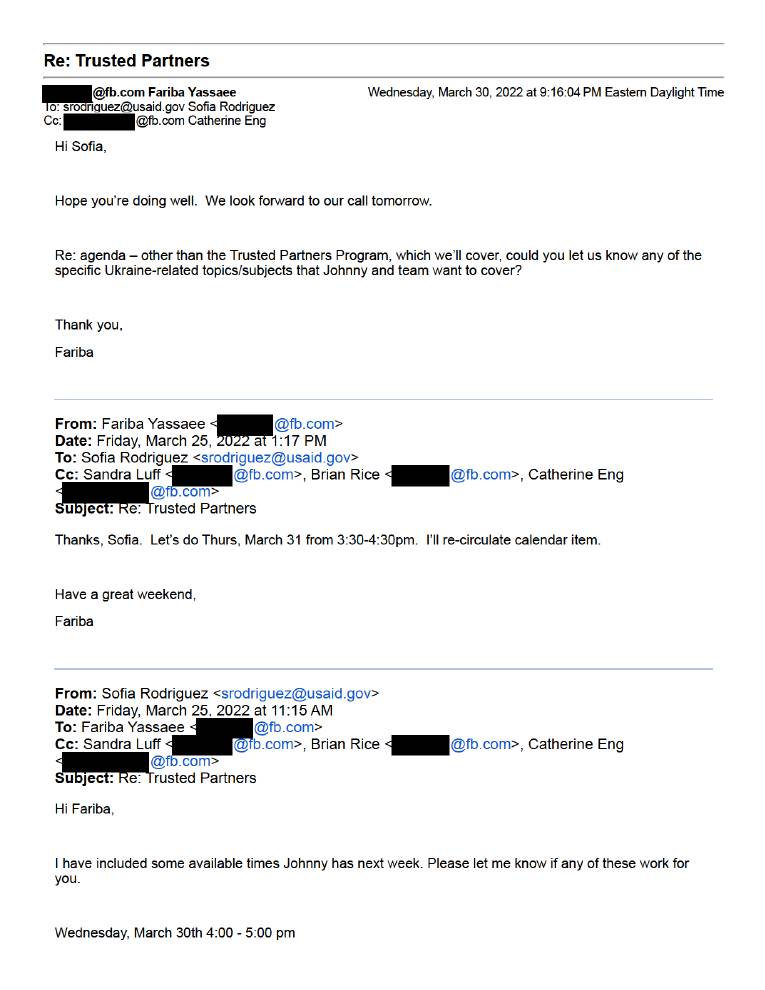
A March 2022 thread shows a Meta representative sending USAID's democracy deputy a one-page program description and both sides scheduling a call.
Summary
A Meta representative writes to USAID's deputy assistant administrator for democracy about how USAID might be involved in the Trusted Partners program's expansion, noting many USAID civil society partners are likely already members and welcoming suggestions. The pasted one-pager says Facebook works with more than 400 partners in 113 countries who report problematic content through a channel staffed around the clock, that only content violating Community Standards is removed, and that partners are kept confidential and consulted on policy. Scheduling messages follow; a March 25 meeting is postponed because of Ukraine-related work. The top of the thread is missing.
Written by AI from the text of the record.
Full text
Text extracted from the original PDF. Layout, tables and images are not reproduced. About 859 words.
Thursday, March 31st 1:00 - 2:00 pm; 2:30 pm - 5:00 pm Friday, April 1st 2:30 pm - 5:00 pm
Best,
Sofia
On Fri, Mar 25, 2022 at 9:47 AM Fariba Yassaee <
@fb.com> wrote:
Hi Sofia,
Not a problem. Let us know dates/times that work for him.
Best,
Fariba
On Mar 25, 2022, at 9:46 AM, Sofia Rodriguez <srodriguez@usaid.gov> wrote:
Hi Fariba,
I apologize for the last minute update but would we be able to reschedule today's meeting? Johnny got pulled into some Ukraine work for the Administrator who just landed in Poland.
We truly apologize for the inconvenience and last minute update but if there is a time next week that works, Johnny would love to reschedule.
Thanks again,
Sofia
On Mon, Mar 21, 2022 at 4:48 PM Fariba Yassaee <
@fb.com> wrote:
Thanks, Sofia. Yes, will include all.
If there is any topic other than the Trusted Partners Program that your colleagues would like to discuss, please let us know.
Best,
Fariba
On Tue, Mar 15, 2022 at 5:36 AM Sandra Luff <
@fb.com> wrote:
Johnny,
Hope you’re doing well…all things considering.
Apologies for the delay in getting back to you on the Trusted Partners program and how we might involve USAID in its expansion. Though I know you’re familiar with the program, I pasted below our “one-pager” on it. Also sharing at this link our recent transparency article with more of an update.
Our colleagues working on the Trusted Partners program note that many USAID civil society partners are likely already part of the program, though they and we would welcome hearing additional suggestions from you and your team.
Would you have some time in the next few days/weeks to set up a call with the right folks? + Becky to help schedule.
Thanks,
Sandy
-----------------
Every day, people come to Facebook and Instagram to share their stories, see the world through the eyes of others and connect with friends and causes. The conversations that happen on Facebook reflect the diversity of a community of more than two billion people communicating across countries and cultures and in dozens of languages. We recognize how important it is for Facebook to be a place where people feel empowered to communicate, and we take our role in keeping abuse off our service seriously. That's why we have developed a set of Community Standards, which govern the content that people are allowed to share on our platforms, with the goal to encourage expression and create a safe environment.
Background: Facebook works with trusted partner organizations who are familiar with our policies to provide critical insights and on-the-ground context to aid in our content moderation. We work with over 400 trusted partners in 113 countries around the globe.
The goal of the Trusted Partner program is to establish and maintain relationships and reporting channels with expert organizations that raise
queries and concerns about problematic content on Facebook and Instagram to:
address harmful content trends and prevent harm,
foster online safety and security, and
inform the development of fair and transparent policies.
Our partners are non-governmental organizations, human rights defenders, humanitarian organizations, activists, or researchers that enable us to: learn from on-the-ground actors across the globe, especially those representing marginalized communities,
identify and address policy, process, or training gaps to improve the standard report review process, and
ensure our review of high-priority content and accounts is informed by critical and up-to-date context.
Reporting: Our Trusted Partner Channel provides our partner organizations with an expedited way of reporting this content to Facebook. The channel is staffed 24/7 by a team of escalations specialists who triage reports and route them to expert teams for analysis. Once a report is received, our team will review the content against our Community Standards and if necessary, seek additional context from the Trusted Partner. We will then respond back to the Trusted Partner with our assessment. Trusted Partners are under no obligation to report to Facebook. When Trusted Partners do report, we will only remove the content and accounts that are in violation of our Community Standards. Confidentiality: Given the challenging environments many of our partner organizations work in, we keep all Trusted Partners and their reporting practices confidential. However, partner organizations should feel free to share the nature of our relationship and their reporting practices however they’d like. Policy Consultations: Our team, which manages the Trusted Partner program sits within Facebook’s Content Policy team, the group that creates our Community Standards. In the process of developing / revising our policies, we seek input from a broad spectrum of experts and users including academics, journalists, human rights defenders, and civil society organizations. When we are working to develop a policy that relates to our Trusted Partner’s work or community, we reach out to see if you would be willing to discuss the subject with us over a video conference or phone call. The feedback we receive during these calls informs the development of fair and transparent policies that help make our platform safer and advance freedom of expression for our users.
-Johnny Walsh
Deputy Assistant Administrator for Democracy, Human Rights, and Governance
U.S. Agency for International Development
Original document
The PDF as released. If it does not display, open it directly.