Transition initiatives office describes Facebook work in Honduras, Sri Lanka and Kenya
An undated email fragment signed by the acting director of USAID's Office of Transition Initiatives summarizes country-level engagement with Facebook on criminal use, hate speech and extremism.
Summary
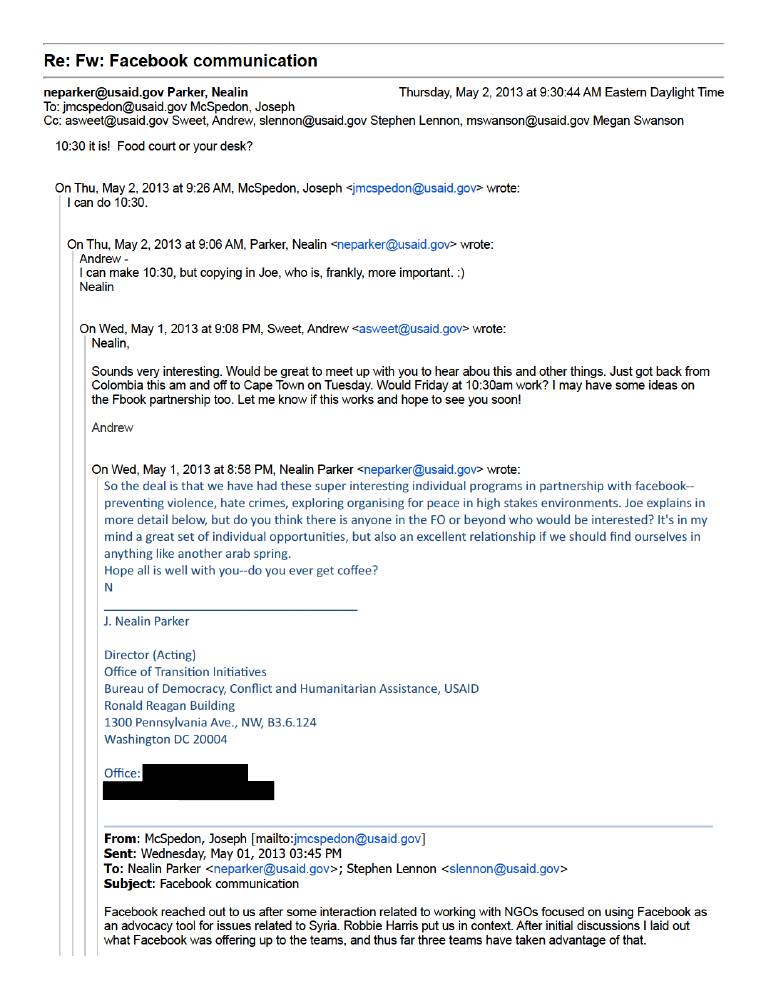
The visible text is the end of an email thread with no dates or headers. It says that in Honduras the first stage addresses Facebook use by criminal elements and helping police report violations of the terms of service. In Sri Lanka, the team sent Facebook a ranked list of accounts spreading anti-Muslim hate speech for removal if found to violate terms of use, with counter-narratives hoped for later. In Kenya, a proposed project would monitor extremist speech and train alternative voices. The author calls the relationship beneficial and notes interest in Facebook analytics for partners' advocacy.
Written by AI from the text of the record.
Full text
Text extracted from the original PDF. Layout, tables and images are not reproduced. About 301 words.
Honduras - first stage of interaction is looking at the issue of Facebook use by criminal elements, and helping the police and others recognize how they can report these as violations of Facebook's terms of service as well as how they can monitor these sources for information. The second stage would be to look at how Facebook is currently used in Honduras and find ways to better understand Facebook analytics to help local partners carry out advocacy.
Sri Lanka - initial discussion was last week focused on the use of Facebook to spread anti-Muslim hate speech. The Sri Lanka team has sent Facebook a list (in most egregious order) of offenders for Facebook to remove after it is determined that the content violates their terms of use. As with Honduras, we are hoping to get to a second stage, utilizing Facebook to create counter narratives.
Kenya - Galeeb is seeking funding for a project from the Embassy with a local partner that will promote utilizing social media to monitor extremist speech as well as train alternative voices on social media best practices. We have not yet gotten Facebook buy in on this, but they are quite interested.
As Nealin mentioned, this is a beneficial relationship for OTI for a number of reasons. In addition, the idea that we could start to understand some of the analytics that Facebook does on users from the marketing side, for our local partners use in advocacy campaigns, represents a big opportunity for our fruitful use of social media as a programming tool.
-J. Nealin Parker
Acting Director
Office of Transition Initiatives
Bureau for Democracy, Conflict and Humanitarian Assistance U S Agency for International Development
-J. Nealin Parker
Acting Director
Office of Transition Initiatives
Bureau for Democracy, Conflict and Humanitarian Assistance U.S. Agency for International Development
Original document
The PDF as released. If it does not display, open it directly.