USAID lawyer's talking points advise staff on engaging social media companies
Draft remarks for a July 8 presentation by an acting assistant general counsel tell staff to keep work factual, follow legal guidance and consult counsel before talking with tech companies.
What this record contains
The talking points say information manipulation remains under heavy congressional scrutiny and that existing General Counsel guidance still applies after the Supreme Court's Murthy v. Missouri decision. They state USAID cannot tell tech companies what to do or how to spend money, must remain viewpoint neutral, and should not repeatedly press companies on the same issue. Staff are told to have counsel review talking points, to write emails expecting FOIA or congressional requests, and that 2024 appropriations language requires programs to counter foreign actors abroad. A House Judiciary Committee document request is mentioned.
Full text of the record
Text extracted from the original PDF. Layout, tables and images are not reproduced. About 4,710 words.
So, what do I mean by keep it factual? No buzzwords, especially in CNs and consult notes because It is likely to result in follow up questions and holds. Keep it factual. Keep it out of the Washington Post. At the end of the day USAID is trying to promote access to factual, trustworthy information which is essential to the health of a democracy and sustainable development outcomes across all sectors, and protect freedom of expression. Make clear USAID is doing the same bread and butter development work that Congress has been authorizing for years.
• No DOD- style threat language that suggests ordinary citizens are a threat
• Due to first amendment legal considerations, any USAID work in this space must be viewpoint neutral. USAID cannot be perceived to be policing public opinion or categorizing all negative views of USAID's work as misinformation.
• What does viewpoint neutral mean? People are allowed to say bad things about USAID and its work. People are allowed to speculate about the USG’s motivations even if they are wrong. USAID cannot make decisions based on viewpoints of the speaker. Follow the guidance- The FAQs go through a wide range of specific scenarios and capture most of the situations that come up. The guiding principle is that USAID cannot tell social media and tech companies what to do or how to spend their money (i.e., why aren’t you allocating more money or people to the trusted partners program or other programs or activities). Here is where the rubber hits the road. We went through all those examples of things that are easy, pre-cleared. Here is where it gets more complicated. Partners are asking USAID to step in and be the hero and USAID wants to be the hero. A tiny women’s rights NGO
Here are the ones that get more complicated and frustrating. especially since the work that they are supporting is so important.
The Minister from your country pulls
Other toplines?
USAID doesn’t badger tech companies. If the question has been asked and answered let it go. Hypothetical example, if the working level folks, the Mission, the regional bureau, and the technical office have all called Meta to the carpet over the same trusted partners program over the past few months it helps fuel the narrative - Why is USAID still asking unless the intent is to
coerce the tech company to do something. That is, USAID says it is not coercing tech companies, but do its actions say otherwise?
Always prep talking points for any discussions with social media companies related to disinformation or information manipulation and have GC/RLO review them. This helps protect USAID and provides you all with some top cover if there are Hill inquiries or FOIA requests. Loop in GC - Work on information manipulation continues to make headlines so it is important to work closely with GC which can provide guidance tailored to the specific stiuation. Other dos and don’ts. Practice good document hygiene. Write emails and gchats as if you expect them to get FOIA’d or requested by the Hill. Remember there are some exceptions, but the default is disclosure. Most of them are likely to get turned over.
July 8 Presentation
Good morning/good afternoon/good evening everyone
My name is Chioma Ayogu. I am the acting Assistant General Counsel for Africa. Starting with the Bottom Line Up Front: Information manipulation remains a hot topic with a lot of Hill scrutiny so it is important to tread lightly and take additional care in particular when interacting with social media and tech companies. The guidance can help your teams do that safely and effectively. The guidance still applies as is for now. The recent Supreme Court decision in Murthy v. Missouri has not changed it. We are still waiting to see how the other Supreme court litigation related to social media shakes out before deciding if updates are needed. You should also be aware that, as highlighted in the guidance, due to new requirements in the 2024 appropriations act programs specifically designed to address information manipulation must counter foreign state and non-state actors abroad; just countering information manipulation in general is not good enough.
Dos and Dont’s- To sum up, this is a hot issue so the best defense is to keep it factual, follow the guidance, and loop in GC.
Let me explain what I mean by that.
So, what do I mean by keep it factual? No buzzwords, especially in CNs and consult notes because It is likely to result in follow up questions and holds. Keep it factual. Keep it out of the Washington Post. At the end of the day USAID is trying to promote access to factual, trustworthy information which is essential to the health of a democracy and sustainable development outcomes across all sectors, and protect freedom of expression. Make clear USAID is doing the same bread and butter development work that Congress has been authorizing for years.
• No DOD- style threat language that suggests ordinary citizens are a threat Due to first amendment legal considerations, any USAID work in this space must be viewpoint neutral. USAID cannot be perceived to be policing public opinion or categorizing all negative views of USAID's work as misinformation.
• What does viewpoint neutral mean? People are allowed to say bad things about USAID and its work. People are allowed to speculate about the USG’s motivations even if they are wrong. USAID cannot make decisions based on viewpoints of the speaker.
Follow the guidance- The FAQs go through a wide range of specific scenarios and capture most of the situations that come up.
The guiding principle is that USAID cannot tell social media and tech companies what to do or how to spend their money (i.e., why aren’t you allocating more money or people to the trusted partners program or other programs or activities).
Other toplines?
USAID doesn’t badger tech companies. If the question has been asked and answered let it go. Hypothetical example, if the working level folks, the Mission, the regional bureau, and the technical office have all called Meta to the carpet over the same trusted partners program over the past few months it helps fuel the narrative - Why is USAID still asking unless the intent is to coerce the tech company to do something. That is, USAID says it is not coercing tech companies, but do its actions say otherwise?
Always prep talking points for any discussions with social media companies related to disinformation or information manipulation and have GC/RLO review them. This helps protect USAID and provides you all with some top cover if there are Hill inquiries or FOIA requests. Loop in GC - Work on information manipulation continues to make headlines so it is important to work closely with GC which can provide guidance tailored to the specific stiuation. Other dos and don’ts. Practice good document hygiene. Write emails and gchats as if you expect them to get FOIA’d or requested by the Hill. Remember there are some exceptions, but the default is disclosure. Most of them are likely to get turned over.
July 8 Presentation Notes
This guidance is important because the USAID has legal authority to do work related to I want to highlight the 3 key points from the guidance.
With heavy congressional scrutiny in the form of a House Judiciary Committee investigation that does not look like it is going away anytime soon and legal challenges regarding
disinformation work, including recent Supreme Court litigation in cases including Murthy v. Missouri, USAID staff have asked for guidance on whether and how to engage with technology companies.
Work on disinformation or information manipulation continues to make headlines so we wanted to provide some guardrails for working in this space, which can be found in the the IIR guidance document, which contains GC FAQs on engaging with social media companies.
One quick note folks have asked whether the GC FAQs still apply now that the Murthy v. Missouri Supreme Court case has been decided. In that case the plaintiffs were found to lack standing to bring the litigation which was about USG interactions with social media companies. The answer? No change for now. Continue to follow the guidance. There are other cases still pending before the supreme court regarding USG interactions with social media companies. If there are any changes we will let you know.
• Two -USAID can continue to work with social media and tech companies. For activities that do not involve content moderation, it is largely business as usual. But for matters touching on content moderation, follow the guidance and coordinate closely with GC.
• If possible, stick to flagging general issues or trends or discussion of what the platform and USAID are doing programmatically or via policy to address those issues or trends and redirect or table anything that is potentially a landmine or complicated. Three- As the guidance explains, Congress directed USAID to counter disinformation and specifically appropriated funds for it under Section 7032(g) of the FY 2023 Appropriations Act. The third point is important to remember because there has been some Hill scrutiny on work to combat disinformation (or information manipulation as I believe we are now calling it). Some members of Congress support it and some do not. Other dos and don’ts. Practice good document hygiene. Write your emails and gchats as if you expect them to get FOIA’d or requested by the Hill. Remember there are some exceptions, but the default is disclosure.
With increased congressional scrutiny in the form of a House Judiciary Committee inquiry that does not look like it is going away anytime soon and legal challenges regarding this work, Mission staff in particular have asked for (1) clarification on and definitions of the terms USAID uses in this realm and (2) clarification on whether and
how to engage with technology companies. The draft guidance in Tab 1 attempts to answer these questions.
• Murthy v. Missouri, the social media censorship case that USAID was involved in back when it was captioned Missouri v. Biden. It was decided on standing (which the plaintiffs were found to lack), but still interesting in its framing of the underlying issues. One or two clients flagged the Murthy v. Missouri decision as well and already want to know what additional guidance, if any, GC has. For instance, Vera set up a couple of calls weeks ago with Bureau leadership to discuss social media contacts and disinformation so we are On June 26, 2024 the Supreme Court issued its decision in Murthy v. Missouri, Decision about two hours ago. It was decided on basis standing (which the plaintiffs were found to lack). Talking through next steps, likely in consultation with State/L and what additional guidance, if any, should be provided. As advised by our GC, there are legal considerations and sensitivities when engaging in this space lately and they are spelled out in USAID GC guidance and White House guidance (linked at the end of the USAID GC guidance). One central tenet is USAID cannot tell the social media company what to do. The other is that any engagements should be coordinated with GC. USAID can educate but it can't advocate. That is, USAID can talk to social media companies to raise awareness about issues, but should not be involved in any advocacy to social media companies about specific issues or advocacy to host governments to implement certain laws. The president's office can contact YouTube or some advocacy groups (such as Access Now) that work with YouTube directly. Some of our Implementing Partners like IREX and Internews may know such groups but I do not know if we can connect them in this context. Adding +Chioma Ayogu, our Senior Counsel for any guidance on that. indeed, as previously discussed, experience has shown that affected individuals are often more successful than USAID in getting content removed. Updated Set of Topline Points
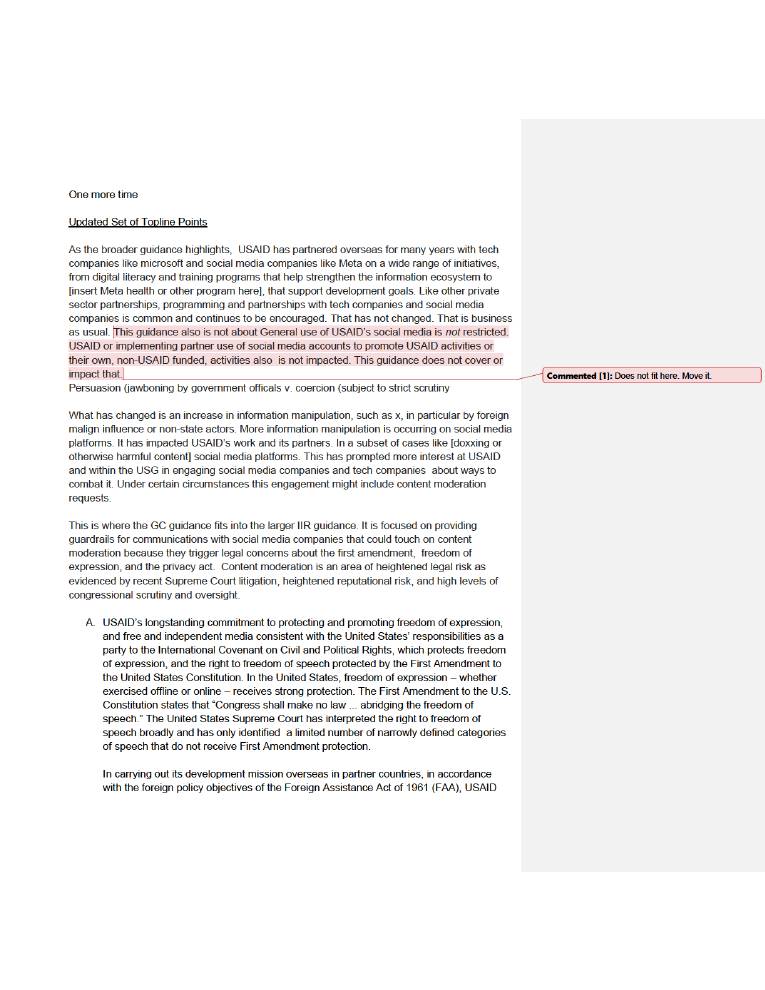
• One - General use of social media is not restricted. USAID or implementing partner use of social media accounts to promote USAID activities or their own, non-USAID funded, activities is not impacted.
• Two - Disinformation, social media and the first amendment are hot issues right now. There are a couple cases before the Supreme Court (Murthy v. Missouri and NRA v. Vullo) and there is intense scrutiny from the Hill. General use of social media to further
USAID’s work is not impacted. The issues are typically arising either with content moderation or social media scraping issues.
• For content moderation it’s arising when or proposals to hide or take down content for various reasons or when staff or leadership want to sit down with the Metas of the world and ask them about how they are, for example, reacting to address criticism of their trusted partners program or combat violence online in x or y country. I helped GC draft some FAQs on content moderation based on a bunch of scenarios received from field and USAID/W staff that hyperlinks to State and White House guidance. The FAQs advise that all work with social media companies should follow the guidance and be coordinated closely with GC.
• For social media scraping where AI or tech is used to scrape info on the internet about what people are saying about USAID and take action. The legal issue is that the privacy act prohibits the USG from collecting info about how US citizens exercise their 1st amendment rights without consent. These scraping tools typically cannot tell the difference b/x
• Although the administration is forward leaning on combatting disinformation, there has been intense Hill scrutiny on work to combat disinformation or information manipulation. Some members of Congress support that work and some do not. The agency is rolling out guidance to the field, but the 2024
• For work Three- As the guidance explains, Congress directed USAID to counter disinformation and specifically appropriated funds for it under Section 7032(g) of the FY 2023 Appropriations Act.
• That third point is important to remember because there has been some Hill scrutiny on work to combat disinformation or information manipulation. Some members of Congress support that work and some do not.
• USAID received a letter from Congressman Jordan, Chairman of the Judiciary Committee, requesting documents and asking questions about USAID's work on disinformation and content moderation, specifically as it relates to the civil liberties of American citizens. USAID sent a response letter explaining that the agency works exclusively overseas. There will likely be more LPA engagement with the Hill about the letter in the near future. USAID's new investigations counsel, Graham Markiewicz, who is splitting his time between GC and LPA, is helping coordinate USAID’s response to the Jim Jordan letter.
• Thanks for your time. I also dropped the link to the GC guidance in the chat for ease of reference. If you have any questions about engaging with social media companies or the GC Guidance please feel free to reach out to me or to Jahn Olsen.
Supreme Court Notes on Murthy v. Missouri
DA Coleman’s Truepoint talking points
Copy of IRC Briefer with A/AID- Highlights StartComms in a useful way
USAID Products about how it is dealing with content moderation Tips
• No clickbait or buzzwords. Make it factual, not spicy. Describe what the activity does in plain English.
• If the language potentially veers into landmines
• Recommend adding a reference to or framing in terms of foreign malign influence or foreign state or non-state actors abroad given limitations in the FY 2024 appropriations act.
• Make sure commonly agreed upon definitions of misinformation are being used. Define misinformation in the context. For example, is it malign actor information from the Kremlin?
• Due to first amendment legal considerations, any USAID work in this space must be viewpoint neutral. USAID cannot be perceived to be policing public opinion or categorizing all negative views of USAID's work as misinformation.
• What does viewpoint neutral mean? People are allowed to say bad things about USAID and its work. People are allowed to speculate about the USG’s motivations even if they are wrong. USAID cannot make decisions based on viewpoints of the speaker.
• Topline Guidance for Communications with Social Media Platforms
Topline GC guidance: If the conversation veers toward discussions about having specific posts or content removed, retained, posted, or promoted, USAID should redirect the conversation. If possible, stick to flagging general issues or trends or discussion of what the platform and USAID are doing programmatically or via policy to address those issues or trends and redirect or table anything that is potentially a landmine or complicated.
Guidance from GC
Thank you for your patience. My understanding from your email is that Meta sent an email to your leadership, Marcela Escobari and Mileydi Guilarte, requesting that they meet with Meta’s Public Policy Director for Meta in Mexico, Central America, and the Caribbean while he is in DC in early April to provide an overview of their key workstreams, including an update on Meta initiatives in the region, how they are addressing the root cause of migration, and election integrity. I think it would be fine for USAID to take this meeting.
I would recommend a couple general guardrails: Prep talking points or a briefer. If no such documents are prepared I recommend flagging one key landmine for your principals. If the conversation veers toward discussions about having specific posts or content removed, retained, posted, or promoted, redirect. If possible, stick to flagging general issues or trends or discussion of what Meta and USAID are doing programmatically or via policy to address those
• One - General use of social media is not restricted. USAID or implementing partner use of social media accounts to promote USAID activities or their own, non-USAID funded, activities is not impacted. Two -USAID can continue to work with social media companies. For activities that do not involve content moderation, it is largely business as usual. But for matters touching on content moderation, please follow the guidance and coordinate closely with GC. Three- As the guidance explains, Congress directed USAID to counter disinformation and specifically appropriated funds for it under Section 7032(g) of the FY 2023 Appropriations Act. That third point is important to remember because there has been some Hill scrutiny on work to combat disinformation or information manipulation. Some members of Congress support that work and some do not. USAID received a letter from Congressman Jordan, Chairman of the Judiciary Committee, requesting documents and asking questions about USAID's work on disinformation and content moderation, specifically as it relates to the civil liberties of American citizens. USAID sent a response letter explaining that the agency works exclusively overseas. There will likely be more LPA engagement with the Hill about the letter in the near future. USAID's new investigations counsel, Graham Markiewicz, who is splitting his time between GC and LPA, is helping coordinate USAID’s response to the Jim Jordan letter. Thanks for your time. I also dropped the link to the GC guidance in the chat for ease of reference. If you have any questions about engaging with social media companies or the GC Guidance please feel free to reach out to me or to Jahn Olsen.
Summary for DRG CLM
I hope you all had a nice holiday.
The Supreme Court stayed (or lifted) the injunction issued by the Fifth Circuit in Missouri v. Biden until the case is heard by the court. You might recall the injunction previously restricted communications with social media companies regarding content moderation. State and USAID GC issued guidance on how to navigate in this space.
The GC guidance will be most relevant if you are contacting social media companies about content moderation (including removal, promotion or retention of content). It will also be relevant if you will be discussing social media companies’ policies or practices and there is a possibility that discussions might touch on content moderation.
I want to highlight the 3 key points from the guidance.
If Asked
I would also note DRG would need to work closely with GC on any events that discuss how social media companies safeguarding users, promoting human rights online, information integrity, or content moderation as well as 2) opportunities to strengthen these approaches by adopting or aligning with international standards, principles or best practices? This is because these types of events may get close to legal redlines. They may directly or indirectly touch on content moderation and protecting users by removing content or strengthening policies regarding content moderation.
Other summary
On Friday, September 8, 2023, the Fifth Circuit issued an order significantly narrowing the scope of the preliminary injunction in Missouri v. Biden.
As a result, USAID is no longer prohibited from engaging in activities touching on content moderation in concert with State.
The Fifth Circuit found the injunction to be vague and overbroad, vacated the majority of it, narrowed it to apply only to the White House, the Surgeon General, CDC, and FBI and excluded all other parties, including the State Department. The Fifth Circuit determined certain White House, CDC and FBI officials' content moderation activities regarding COVID-19 disinformation might have violated the First Amendment, but did not find sufficient evidence that the other named defendants were likely to have done so.
Talking points for the committee folks
CONTENT MODERATION
Background: On July 4, 2024, a federal district court in Louisiana issued a preliminary injunction in Missouri v. Biden prohibiting the State Department, several other federal agencies, White House officials and anyone acting "in concert" with them from directly or indirectly (through third parties or implementing partners) urging or pressuring social media companies to remove or suppress "protected free speech.” The injunction identified a few exceptions to this prohibition.
USAID was not named in the injunction, but its activities were impacted in certain circumstances, such as when USAID collaborated on activities with the State Department or
other federal agencies named in the injunction. State issued guidance regarding content moderation activities. USAID was prohibited from engaging in content moderation activities in concert with State or other parties named in the injunction. OUs were instructed to consult GC for guidance.
On July 14, 2023, the Fifth Circuit granted a temporary administrative stay of the preliminary injunction previously issued in the case of Missouri v. Biden. The stay remains in place pending further orders from the court. Oral arguments were heard on August 10, 2023. GC is closely monitoring the status of this case and will inform DRG of any changes. As a result of the stay, DRG can resume activities that involve engagement with social media companies and can coordinate with State on such matters, with some guardrails.
In short, USAID should continue to exercise appropriate caution in how it engages with tech companies. Put your FOIA+ or litigation lens on.
More detail on the guardrails is provided below:
• Avoid "content moderation" - My understanding is that DRG does not anticipate flagging to social media companies content for removal or increased scrutiny or attention ( (e.g., posts by certain individuals or entities), but if it does occur, DRG should only do it in the most limited and exceptional circumstances, and only in close consultation with GC. Avoid or exercise significant caution regarding any discussions with social media companies of their "content moderation" policies - Similarly, If DRG will be reaching out to any social media companies to discuss their policies or approaches to content moderation (e.g., encourage them to strengthen safeguards), please touch base with GC prior to outreach. Cleared talking points are recommended. Maximize use of cleared talking points for DRG led meetings -If DRG will be hosting meetings involving discussions with social media companies that might directly or indirectly touch on content moderation, GC recommends preparing agendas and talking points and clearing them with GC. Coordination - Confirm (if possible) that State L has cleared on/is aware of any State-led joint State/USAID engagements with social media companies involving discussions of "content moderation" - Talking points cleared by GC are recommended. GC should also be consulted on any planned strategies to promote or amplify any frameworks or documents to help reduce the risk that such efforts are misconstrued as coercive. USAID should exercise additional caution in re-engaging with State on any initiative involving "content moderation" which lacks a written roadmap or overview for social media company engagement, cleared talking points, or clearance/socialization with State L.
Carve out for doxing regarding local partners and staff - Named -Escalation
We don't have an escalation process yet, at least not in writing. Last time we had a doxing incident, our local partner had a direct POC at Meta and resolved the issue without us.
Independent reporting
Content moderation question pushed to platform (content moderation referral) vs. content moderation direction to pull down)
Sabeen Dhanani - Relationship manager for USAID
General Tips
-Have to recognize what they already have and how we could help them strategically direct their resources
-Follow up mixed based on company priorities
-Microsoft always eager to collaborate and have a development focus and CSR push. Structurally set up to respond. Meta and Alphabet, typically easier to adjust things they are already doing.
-Include threat reporting protocol? Ask vera
Latest Order
On Friday, September 8, 2023, the Fifth Circuit issued an order significantly narrowing the scope of the preliminary injunction in Missouri v. Biden.
This was some good news for USAID because it meant the agency was no longer prohibited from engaging in activities touching on content moderation in concert with State. The Fifth Circuit found the injunction to be vague and overbroad, vacated the majority of it, narrowed it to apply only to the White House, the Surgeon General, CDC, and FBI and excluded all other parties, including the State Department. The Fifth Circuit determined certain White House, CDC and FBI officials' content moderation activities regarding COVID-19 disinformation might have violated the First Amendment, but did not find sufficient evidence that the other named defendants were likely to have done so. In short order, On August 18, Chairman Jordan sent a letter to USAID requesting a wide range of communications related to records content moderation, dis, mis and malinformation, . Although correlation does not equal causation and there is no explicit mention of the Missouri v. Biden case, the timing of the request and the nature and scope of the request suggest there
might be some correlation. This is a request that could have broad implications for the agency’s work and the response to it could take up significant bandwidth. Further, other agencies have received similar letters.
The oversight request from Jordan has been picked up by the Washington Post (9/23 article) and a few other news outlets.
GC is working closely with LPA on an agency-wide approach to the letter since it affects equities agency wide. GC is also drafting guidance on content moderation. Happy to share some initial general considerations and some general tips for file hygiene moving forward. HYGIENE
• Only write things that pass the Washington Post Test Be thoughtful about word choice. Gossip, angry comments, profanity, and other unprofessional statements generally WILL be disclosed.
• The fact that the release of a record would be personally embarrassing is not grounds to not disclose.
• Do not write, “this is too sensitive to discuss over email,” “this is highly sensitive, we shouldn’t put any of this in writing” or “not to be shared further.” Think about the word choice. Is there another word you can use? (e.g., peer competitor) If in doubt, pick up the phone. Less than gracious comments about other components of USAID or the USG are good fodder for fire
• Keep emails professional and courteous.
• Be precise about language. Avoid language that might raise red flags (e.g., influence, change, shape)
• Terminology - peer competitors (coordinate with LPA) Miscellaneous Text to Add to documents
• Content moderation remains a highly sensitive issue. There is ongoing Supreme Court litigation and USAID is currently responding to a Congressional oversight request from the House Judiciary Committee seeking emails from USAID leadership and staff and programmatic documents related to content moderation and disinformation. Due to these sensitivities, USAID should redirect or table any discussions of specific content moderation requests or about account suspensions or terminations.
The original document
Page through the PDF exactly as released. If it does not display, open it directly.