Democracy center staff refine research question on information ecosystems
A November 2021 email thread among USAID democracy, human rights and governance staff works out the wording of a learning-agenda question on mis-, dis- and malinformation.
Summary
A senior learning adviser circulates a proposed research question asking what factors influence the information ecosystem related to disinformation, with subquestions on susceptibility, supply and enabling environment, and requests edits by November 22. A media adviser cautions against duplicating a State Department Global Engagement Center index on country susceptibility. The countering-disinformation lead offers to connect that work and notes that an interagency meeting flagged a research gap on building resilience. The excerpted thread runs 17 pages and largely repeats earlier messages.
Written by AI from the text of the record.
Full text
Text extracted from the original PDF. Layout, tables and images are not reproduced. About 5,729 words.
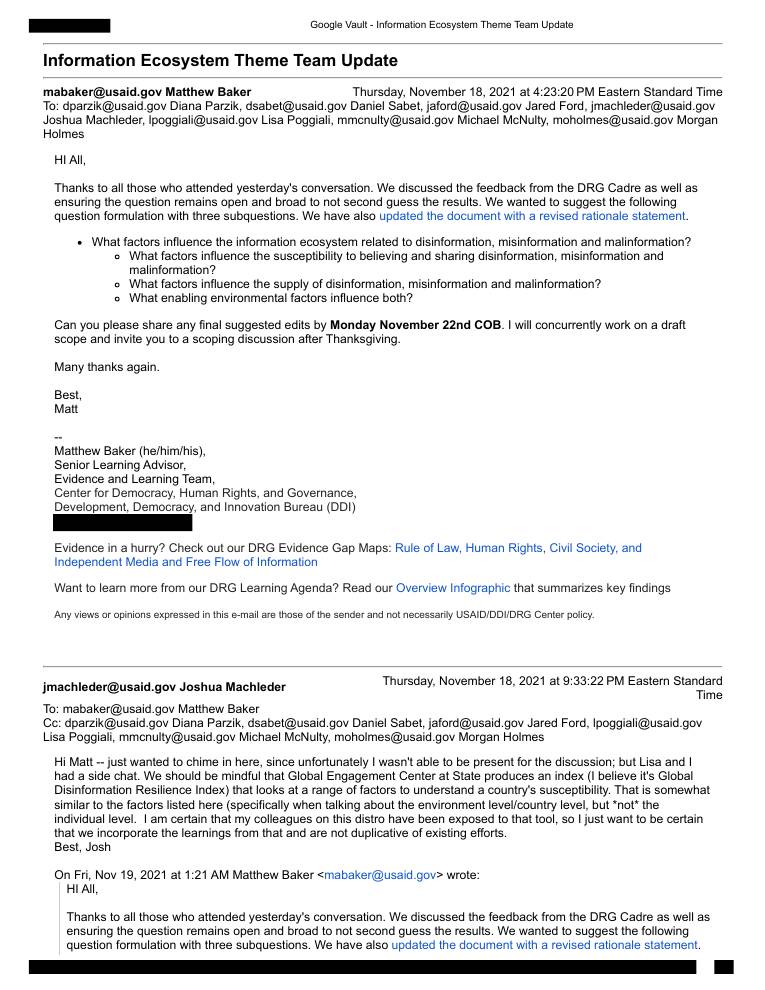
Information Ecosystem Theme Team Update
mabaker@usaid.gov Matthew Baker
Thursday, November 18, 2021 at 4:23:20 PM Eastern Standard Time
To: dparzik@usaid.gov Diana Parzik, dsabet@usaid.gov Daniel Sabet, jaford@usaid.gov Jared Ford, jmachleder@usaid.gov Joshua Machleder, lpoggiali@usaid.gov Lisa Poggiali, mmcnulty@usaid.gov Michael McNulty, moholmes@usaid.gov Morgan Holmes
HI All,
Thanks to all those who attended yesterday's conversation. We discussed the feedback from the DRG Cadre as well as ensuring the question remains open and broad to not second guess the results. We wanted to suggest the following question formulation with three subquestions. We have also updated the document with a revised rationale statement. What factors influence the information ecosystem related to disinformation, misinformation and malinformation? What factors influence the susceptibility to believing and sharing disinformation, misinformation and malinformation?
What factors influence the supply of disinformation, misinformation and malinformation? What enabling environmental factors influence both?
Can you please share any final suggested edits by Monday November 22nd COB. I will concurrently work on a draft scope and invite you to a scoping discussion after Thanksgiving.
Many thanks again.
Evidence in a hurry? Check out our DRG Evidence Gap Maps: Rule of Law, Human Rights, Civil Society, and Want to learn more from our DRG Learning Agenda? Read our Overview Infographic that summarizes key findings Any views or opinions expressed in this e-mail are those of the sender and not necessarily USAID/DDI/DRG Center policy.
jmachleder@usaid.gov Joshua Machleder
Thursday, November 18, 2021 at 9:33:22 PM Eastern Standard Time
To: mabaker@usaid.gov Matthew Baker
Cc: dparzik@usaid.gov Diana Parzik, dsabet@usaid.gov Daniel Sabet, jaford@usaid.gov Jared Ford, lpoggiali@usaid.gov Lisa Poggiali, mmcnulty@usaid.gov Michael McNulty, moholmes@usaid.gov Morgan Holmes
Hi Matt -- just wanted to chime in here, since unfortunately I wasn't able to be present for the discussion; but Lisa and I had a side chat. We should be mindful that Global Engagement Center at State produces an index (I believe it's Global Disinformation Resilience Index) that looks at a range of factors to understand a country's susceptibility. That is somewhat similar to the factors listed here (specifically when talking about the environment level/country level, but *not* the individual level. I am certain that my colleagues on this distro have been exposed to that tool, so I just want to be certain that we incorporate the learnings from that and are not duplicative of existing efforts.
Best, Josh
On Fri, Nov 19, 2021 at 1:21 AM Matthew Baker <mabaker@usaid.gov> wrote:
HI All,
Thanks to all those who attended yesterday's conversation. We discussed the feedback from the DRG Cadre as well as ensuring the question remains open and broad to not second guess the results. We wanted to suggest the following question formulation with three subquestions. We have also updated the document with a revised rationale statement.
What factors influence the information ecosystem related to disinformation, misinformation and malinformation? What factors influence the susceptibility to believing and sharing disinformation, misinformation and malinformation?
What factors influence the supply of disinformation, misinformation and malinformation? What enabling environmental factors influence both?
Can you please share any final suggested edits by Monday November 22nd COB. I will concurrently work on a draft scope and invite you to a scoping discussion after Thanksgiving.
Many thanks again.
Evidence in a hurry? Check out our DRG Evidence Gap Maps: Rule of Law, Human Rights, Civil Society, and Want to learn more from our DRG Learning Agenda? Read our Overview Infographic that summarizes key findings Any views or opinions expressed in this e mail are those of the sender and not necessarily USAID/DDI/DRG Center policy
-Josh Machleder (he / him/ his)
Senior Media and Internet Freedom Advisor
USAID │ Center of Excellence on Democracy, Human Rights and Governance Email:jmachleder@usaid.gov
P Please consider the environment before printing this email.
dparzik@usaid.gov Diana Parzik
Friday, November 19, 2021 at 2:27:30 PM Eastern Standard Time
To: jmachleder@usaid.gov Joshua Machleder
Cc: mabaker@usaid.gov Matthew Baker, dsabet@usaid.gov Daniel Sabet, jaford@usaid.gov Jared Ford, lpoggiali@usaid.gov Lisa Poggiali, mmcnulty@usaid.gov Michael McNulty, moholmes@usaid.gov Morgan Holmes
MattThanks for pulling this together, I think we're on the home stretch. The GEC's program is the Digital Disinfo Index (DDI) and I'm happy to pull folks together so we can integrate that work into this research.
I added a few comments below Josh's in the questions, mostly minor tweaks (e.g. including mal-information where we just reference mis- and dis) and also language on 'building resilience'. In the IIR R&D meeting this morning, Mary Beth and Brian intentionally flagged the NSM LOE on 'building resilience' and the research gap we have in that space. I think this is mostly covered by question 3.
Also, I put some comments in about further clarification for question 5 on 'non-democratic actors'. Thanks,
Diana
On Thu, Nov 18, 2021 at 9:33 PM Joshua Machleder <jmachleder@usaid.gov> wrote:
Hi Matt -- just wanted to chime in here, since unfortunately I wasn't able to be present for the discussion; but Lisa and I had a side chat. We should be mindful that Global Engagement Center at State produces an index (I believe it's Global Disinformation Resilience Index) that looks at a range of factors to understand a country's susceptibility. That is somewhat similar to the factors listed here (specifically when talking about the environment level/country level, but *not* the individual level. I am certain that my colleagues on this distro have been exposed to that tool, so I just want to be certain that we incorporate the learnings from that and are not duplicative of existing efforts. Best, Josh
On Fri, Nov 19, 2021 at 1:21 AM Matthew Baker <mabaker@usaid.gov> wrote:
HI All,
Thanks to all those who attended yesterday's conversation. We discussed the feedback from the DRG Cadre as well as ensuring the question remains open and broad to not second guess the results. We wanted to suggest the following question formulation with three subquestions. We have also updated the document with a revised rationale statement.
What factors influence the information ecosystem related to disinformation, misinformation and malinformation?
What factors influence the susceptibility to believing and sharing disinformation, misinformation and malinformation?
What factors influence the supply of disinformation, misinformation and malinformation?
What enabling environmental factors influence both?
Can you please share any final suggested edits by Monday November 22nd COB. I will concurrently work on a draft scope and invite you to a scoping discussion after Thanksgiving.
Many thanks again.
Evidence in a hurry? Check out our DRG Evidence Gap Maps: Rule of Law, Human Rights, Civil Society, and Want to learn more from our DRG Learning Agenda? Read our Overview Infographic that summarizes key findings Any views or opinions expressed in this e-mail are those of the sender and not necessarily USAID/DDI/DRG Center policy.
-Josh Machleder (he / him/ his)
Senior Media and Internet Freedom Advisor
USAID │ Center of Excellence on Democracy, Human Rights and Governance Email:jmachleder@usaid.gov
P Please consider the environment before printing this email. --
Diana J. Parzik
Counter-Disinformation Coordinator
Democracy Resiliency and Innovation (DRI)
U.S. Agency for International Development - USAID 3/17
mabaker@usaid.gov Matthew Baker
Friday, November 19, 2021 at 4:27:09 PM Eastern Standard Time
To: dparzik@usaid.gov Diana Parzik
Cc: jmachleder@usaid.gov Joshua Machleder, dsabet@usaid.gov Daniel Sabet, jaford@usaid.gov Jared Ford, lpoggiali@usaid.gov Lisa Poggiali, mmcnulty@usaid.gov Michael McNulty, moholmes@usaid.gov Morgan Holmes Thanks for all the comments and reflections. I did a quick look but wanted to flag that at this point we should ideally focus on the first - prioritized - learning question. The remaining questions are here for reference and of course we can improve upon.
I am going to take note of these points too as we transition to thinking of scoping research as these points should be considered when we scope and researchers eventually craft a concept.
Many thanks.
On Fri, Nov 19, 2021 at 2:28 PM Diana Parzik <dparzik@usaid.gov> wrote:
MattThanks for pulling this together, I think we're on the home stretch. The GEC's program is the Digital Disinfo Index (DDI) and I'm happy to pull folks together so we can integrate that work into this research.
I added a few comments below Josh's in the questions, mostly minor tweaks (e.g. including mal-information where we just reference mis- and dis) and also language on 'building resilience'. In the IIR R&D meeting this morning, Mary Beth and Brian intentionally flagged the NSM LOE on 'building resilience' and the research gap we have in that space. I think this is mostly covered by question 3.
Also, I put some comments in about further clarification for question 5 on 'non-democratic actors'. Thanks,
Diana
On Thu, Nov 18, 2021 at 9:33 PM Joshua Machleder <jmachleder@usaid.gov> wrote:
Hi Matt -- just wanted to chime in here, since unfortunately I wasn't able to be present for the discussion; but Lisa and I had a side chat. We should be mindful that Global Engagement Center at State produces an index (I believe it's Global Disinformation Resilience Index) that looks at a range of factors to understand a country's susceptibility. That is somewhat similar to the factors listed here (specifically when talking about the environment level/country level, but *not* the individual level. I am certain that my colleagues on this distro have been exposed to that tool, so I just want to be certain that we incorporate the learnings from that and are not duplicative of existing efforts. Best, Josh
On Fri, Nov 19, 2021 at 1:21 AM Matthew Baker <mabaker@usaid.gov> wrote:
HI All,
Thanks to all those who attended yesterday's conversation. We discussed the feedback from the DRG Cadre as well as ensuring the question remains open and broad to not second guess the results. We wanted to suggest the following question formulation with three subquestions. We have also updated the document with a revised rationale statement.
What factors influence the information ecosystem related to disinformation, misinformation and malinformation?
What factors influence the susceptibility to believing and sharing disinformation, misinformation and malinformation?
What factors influence the supply of disinformation, misinformation and malinformation?
What enabling environmental factors influence both?
Can you please share any final suggested edits by Monday November 22nd COB. I will concurrently work on a draft scope and invite you to a scoping discussion after Thanksgiving.
4/17
Many thanks again.
Evidence in a hurry? Check out our DRG Evidence Gap Maps: Rule of Law, Human Rights, Civil Society, and Want to learn more from our DRG Learning Agenda? Read our Overview Infographic that summarizes key findings Any views or opinions expressed in this e mail are those of the sender and not necessarily USAID/DDI/DRG Center policy
-Josh Machleder (he / him/ his)
Senior Media and Internet Freedom Advisor
USAID │ Center of Excellence on Democracy, Human Rights and Governance Email:jmachleder@usaid.gov
P Please consider the environment before printing this email. --
Diana J. Parzik
Counter-Disinformation Coordinator
Democracy Resiliency and Innovation (DRI)
U.S. Agency for International Development - USAID
Evidence in a hurry? Check out our DRG Evidence Gap Maps: Rule of Law, Human Rights, Civil Society, and Want to learn more from our DRG Learning Agenda? Read our Overview Infographic that summarizes key findings Any views or opinions expressed in this e mail are those of the sender and not necessarily USAID/DDI/DRG Center policy
5/17
lpoggiali@usaid.gov Lisa Poggiali
Friday, November 19, 2021 at 5:27:01 PM Eastern Standard Time
To: mabaker@usaid.gov Matthew Baker
Cc: dparzik@usaid.gov Diana Parzik, jmachleder@usaid.gov Joshua Machleder, dsabet@usaid.gov Daniel Sabet, jaford@usaid.gov Jared Ford, mmcnulty@usaid.gov Michael McNulty, moholmes@usaid.gov Morgan Holmes Hi Matt and others,
I took a stab at trying to make the question more concrete -- it seemed to be getting so abstract it was hard to see how someone would start answering it -- and also capture Diana and Josh's points.
I think the addition of resilience captures that we're interested in both mis/mal/disinformation and the information ecosystem at large. I added the specific factors and dynamics to signal what existing research has shown us about the influences on information ecosystems. Would suggest Diana and Josh review since they are up on the existing literature. Thanks to Matt for corralling all of us thus far!
best,
Lisa
On Fri, Nov 19, 2021 at 5:25 PM Matthew Baker <mabaker@usaid.gov> wrote:
Thanks for all the comments and reflections. I did a quick look but wanted to flag that at this point we should ideally focus on the first - prioritized - learning question. The remaining questions are here for reference and of course we can improve upon.
I am going to take note of these points too as we transition to thinking of scoping research as these points should be considered when we scope and researchers eventually craft a concept.
Many thanks.
On Fri, Nov 19, 2021 at 2:28 PM Diana Parzik <dparzik@usaid.gov> wrote:
MattThanks for pulling this together, I think we're on the home stretch. The GEC's program is the Digital Disinfo Index (DDI) and I'm happy to pull folks together so we can integrate that work into this research. I added a few comments below Josh's in the questions, mostly minor tweaks (e.g. including mal-information where we just reference mis- and dis) and also language on 'building resilience'. In the IIR R&D meeting this morning, Mary Beth and Brian intentionally flagged the NSM LOE on 'building resilience' and the research gap we have in that space. I think this is mostly covered by question 3.
Also, I put some comments in about further clarification for question 5 on 'non-democratic actors'. Thanks,
Diana
On Thu, Nov 18, 2021 at 9:33 PM Joshua Machleder <jmachleder@usaid.gov> wrote:
Hi Matt -- just wanted to chime in here, since unfortunately I wasn't able to be present for the discussion; but Lisa and I had a side chat. We should be mindful that Global Engagement Center at State produces an index (I believe it's Global Disinformation Resilience Index) that looks at a range of factors to understand a country's susceptibility. That is somewhat similar to the factors listed here (specifically when talking about the environment level/country level, but *not* the individual level. I am certain that my colleagues on this distro have been exposed to that tool, so I just want to be certain that we incorporate the learnings from that and are not duplicative of existing efforts. Best, Josh
On Fri, Nov 19, 2021 at 1:21 AM Matthew Baker <mabaker@usaid.gov> wrote:
HI All,
Thanks to all those who attended yesterday's conversation. We discussed the feedback from the DRG Cadre as well as ensuring the question remains open and broad to not second guess the results. We wanted to suggest the following question formulation with three subquestions. We have also updated the document with a revised rationale statement.
6/17
What factors influence the information ecosystem related to disinformation, misinformation and malinformation?
What factors influence the susceptibility to believing and sharing disinformation, misinformation and malinformation?
What factors influence the supply of disinformation, misinformation and malinformation? What enabling environmental factors influence both?
Can you please share any final suggested edits by Monday November 22nd COB. I will concurrently work on a draft scope and invite you to a scoping discussion after Thanksgiving.
Many thanks again.
Evidence in a hurry? Check out our DRG Evidence Gap Maps: Rule of Law, Human Rights, Civil Society, and Want to learn more from our DRG Learning Agenda? Read our Overview Infographic that summarizes key findings
Any views or opinions expressed in this e mail are those of the sender and not necessarily USAID/DDI/DRG Center policy
-Josh Machleder (he / him/ his)
Senior Media and Internet Freedom Advisor
USAID │ Center of Excellence on Democracy, Human Rights and Governance Email:jmachleder@usaid.gov
P Please consider the environment before printing this email. --
Diana J. Parzik
Counter-Disinformation Coordinator
Democracy Resiliency and Innovation (DRI)
U.S. Agency for International Development - USAID
7/17
Evidence in a hurry? Check out our DRG Evidence Gap Maps: Rule of Law, Human Rights, Civil Society, and Want to learn more from our DRG Learning Agenda? Read our Overview Infographic that summarizes key findings Any views or opinions expressed in this e mail are those of the sender and not necessarily USAID/DDI/DRG Center policy
-Lisa Poggiali, Ph.D. (she/her)
Democracy, Data and Technology Specialist
Center for Democracy, Human Rights and Governance U.S. Agency for International Development
│ E: lpoggiali@usaid.gov
mabaker@usaid.gov Matthew Baker
Tuesday, November 23, 2021 at 3:47:15 PM Eastern Standard Time
To: lpoggiali@usaid.gov Lisa Poggiali
Cc: dparzik@usaid.gov Diana Parzik, jmachleder@usaid.gov Joshua Machleder, dsabet@usaid.gov Daniel Sabet, jaford@usaid.gov Jared Ford, mmcnulty@usaid.gov Michael McNulty, moholmes@usaid.gov Morgan Holmes Thank you, Lisa for the updated question and looks good.
I also wanted to share this interesting report with you all that might be of interest: https://publications.jrc.ec.europa.eu/ repository/handle/JRC117161
On Fri, Nov 19, 2021 at 5:26 PM Lisa Poggiali <lpoggiali@usaid.gov> wrote:
Hi Matt and others,
I took a stab at trying to make the question more concrete -- it seemed to be getting so abstract it was hard to see how someone would start answering it -- and also capture Diana and Josh's points.
I think the addition of resilience captures that we're interested in both mis/mal/disinformation and the information ecosystem at large. I added the specific factors and dynamics to signal what existing research has shown us about the influences on information ecosystems. Would suggest Diana and Josh review since they are up on the existing literature.
Thanks to Matt for corralling all of us thus far!
best,
Lisa
On Fri, Nov 19, 2021 at 5:25 PM Matthew Baker <mabaker@usaid.gov> wrote:
Thanks for all the comments and reflections. I did a quick look but wanted to flag that at this point we should ideally focus on the first - prioritized - learning question. The remaining questions are here for reference and of course we can improve upon.
I am going to take note of these points too as we transition to thinking of scoping research as these points should be considered when we scope and researchers eventually craft a concept.
Many thanks.
On Fri, Nov 19, 2021 at 2:28 PM Diana Parzik <dparzik@usaid.gov> wrote:
MattThanks for pulling this together, I think we're on the home stretch. The GEC's program is the Digital Disinfo Index (DDI) and I'm happy to pull folks together so we can integrate that work into this research.
8/17
I added a few comments below Josh's in the questions, mostly minor tweaks (e.g. including mal-information where we just reference mis- and dis) and also language on 'building resilience'. In the IIR R&D meeting this morning, Mary Beth and Brian intentionally flagged the NSM LOE on 'building resilience' and the research gap we have in that space. I think this is mostly covered by question 3.
Also, I put some comments in about further clarification for question 5 on 'non-democratic actors'. Thanks,
Diana
On Thu, Nov 18, 2021 at 9:33 PM Joshua Machleder <jmachleder@usaid.gov> wrote:
Hi Matt -- just wanted to chime in here, since unfortunately I wasn't able to be present for the discussion; but Lisa and I had a side chat. We should be mindful that Global Engagement Center at State produces an index (I believe it's Global Disinformation Resilience Index) that looks at a range of factors to understand a country's susceptibility. That is somewhat similar to the factors listed here (specifically when talking about the environment level/country level, but *not* the individual level. I am certain that my colleagues on this distro have been exposed to that tool, so I just want to be certain that we incorporate the learnings from that and are not duplicative of existing efforts.
Best, Josh
On Fri, Nov 19, 2021 at 1:21 AM Matthew Baker <mabaker@usaid.gov> wrote:
HI All,
Thanks to all those who attended yesterday's conversation. We discussed the feedback from the DRG Cadre as well as ensuring the question remains open and broad to not second guess the results. We wanted to suggest the following question formulation with three subquestions. We have also updated the document with a revised rationale statement.
What factors influence the information ecosystem related to disinformation, misinformation and malinformation?
What factors influence the susceptibility to believing and sharing disinformation, misinformation and malinformation?
What factors influence the supply of disinformation, misinformation and malinformation? What enabling environmental factors influence both?
Can you please share any final suggested edits by Monday November 22nd COB. I will concurrently work on a draft scope and invite you to a scoping discussion after Thanksgiving.
Many thanks again.
Evidence in a hurry? Check out our DRG Evidence Gap Maps: Rule of Law, Human Rights, Civil Society, and Want to learn more from our DRG Learning Agenda? Read our Overview Infographic that summarizes key findings
Any views or opinions expressed in this e mail are those of the sender and not necessarily USAID/DDI/DRG Center policy
-Josh Machleder (he / him/ his)
9/17
Senior Media and Internet Freedom Advisor
USAID │ Center of Excellence on Democracy, Human Rights and Governance Email:jmachleder@usaid.gov
P Please consider the environment before printing this email. --
Diana J. Parzik
Counter-Disinformation Coordinator
Democracy Resiliency and Innovation (DRI)
U.S. Agency for International Development - USAID
Evidence in a hurry? Check out our DRG Evidence Gap Maps: Rule of Law, Human Rights, Civil Society, and Want to learn more from our DRG Learning Agenda? Read our Overview Infographic that summarizes key findings Any views or opinions expressed in this e-mail are those of the sender and not necessarily USAID/DDI/DRG Center policy.
-Lisa Poggiali, Ph.D. (she/her)
Democracy, Data and Technology Specialist
Center for Democracy, Human Rights and Governance
U.S. Agency for International Development
│ E: lpoggiali@usaid.gov
Evidence in a hurry? Check out our DRG Evidence Gap Maps: Rule of Law, Human Rights, Civil Society, and Want to learn more from our DRG Learning Agenda? Read our Overview Infographic that summarizes key findings Any views or opinions expressed in this e mail are those of the sender and not necessarily USAID/DDI/DRG Center policy
10/17
mabaker@usaid.gov Matthew Baker
Tuesday, November 30, 2021 at 10:13:55 PM Eastern Standard Time
To: lpoggiali@usaid.gov Lisa Poggiali
Cc: dparzik@usaid.gov Diana Parzik, jmachleder@usaid.gov Joshua Machleder, dsabet@usaid.gov Daniel Sabet, jaford@usaid.gov Jared Ford, mmcnulty@usaid.gov Michael McNulty, moholmes@usaid.gov Morgan Holmes Just to formally close the loop, I have accepted the suggested edits to the learning question and am finalizing the action memo which I will share with all Theme Teams in due course.
Many thanks for all your efforts.
On Tue, Nov 23, 2021 at 3:47 PM Matthew Baker <mabaker@usaid.gov> wrote:
Thank you, Lisa for the updated question and looks good.
I also wanted to share this interesting report with you all that might be of interest: https://publications.jrc.ec.europa.eu/ repository/handle/JRC117161
On Fri, Nov 19, 2021 at 5:26 PM Lisa Poggiali <lpoggiali@usaid.gov> wrote:
Hi Matt and others,
I took a stab at trying to make the question more concrete -- it seemed to be getting so abstract it was hard to see how someone would start answering it -- and also capture Diana and Josh's points.
I think the addition of resilience captures that we're interested in both mis/mal/disinformation and the information ecosystem at large. I added the specific factors and dynamics to signal what existing research has shown us about the influences on information ecosystems. Would suggest Diana and Josh review since they are up on the existing literature.
Thanks to Matt for corralling all of us thus far!
best,
Lisa
On Fri, Nov 19, 2021 at 5:25 PM Matthew Baker <mabaker@usaid.gov> wrote:
Thanks for all the comments and reflections. I did a quick look but wanted to flag that at this point we should ideally focus on the first - prioritized - learning question. The remaining questions are here for reference and of course we can improve upon.
I am going to take note of these points too as we transition to thinking of scoping research as these points should be considered when we scope and researchers eventually craft a concept.
Many thanks.
On Fri, Nov 19, 2021 at 2:28 PM Diana Parzik <dparzik@usaid.gov> wrote:
MattThanks for pulling this together, I think we're on the home stretch. The GEC's program is the Digital Disinfo Index (DDI) and I'm happy to pull folks together so we can integrate that work into this research. I added a few comments below Josh's in the questions, mostly minor tweaks (e.g. including mal-information where we just reference mis- and dis) and also language on 'building resilience'. In the IIR R&D meeting this morning, Mary Beth and Brian intentionally flagged the NSM LOE on 'building resilience' and the research gap we have in that space. I think this is mostly covered by question 3.
Also, I put some comments in about further clarification for question 5 on 'non-democratic actors'. Thanks,
Diana
…
11/17
On Thu, Nov 18, 2021 at 9:33 PM Joshua Machleder <jmachleder@usaid.gov> wrote:
Hi Matt -- just wanted to chime in here, since unfortunately I wasn't able to be present for the discussion; but Lisa and I had a side chat. We should be mindful that Global Engagement Center at State produces an index (I believe it's Global Disinformation Resilience Index) that looks at a range of factors to understand a country's susceptibility. That is somewhat similar to the factors listed here (specifically when talking about the environment level/country level, but *not* the individual level. I am certain that my colleagues on this distro have been exposed to that tool, so I just want to be certain that we incorporate the learnings from that and are not duplicative of existing efforts.
Best, Josh
On Fri, Nov 19, 2021 at 1:21 AM Matthew Baker <mabaker@usaid.gov> wrote:
HI All,
Thanks to all those who attended yesterday's conversation. We discussed the feedback from the DRG Cadre as well as ensuring the question remains open and broad to not second guess the results. We wanted to suggest the following question formulation with three subquestions. We have also updated the document with a revised rationale statement.
What factors influence the information ecosystem related to disinformation, misinformation and malinformation?
What factors influence the susceptibility to believing and sharing disinformation,
misinformation and malinformation?
What factors influence the supply of disinformation, misinformation and malinformation? What enabling environmental factors influence both?
Can you please share any final suggested edits by Monday November 22nd COB. I will concurrently work on a draft scope and invite you to a scoping discussion after Thanksgiving.
Many thanks again.
Evidence in a hurry? Check out our DRG Evidence Gap Maps: Rule of Law, Human Rights, Civil Society, and Independent Media and Free Flow of Information
Want to learn more from our DRG Learning Agenda? Read our Overview Infographic that summarizes key findings
Any views or opinions expressed in this e mail are those of the sender and not necessarily USAID/DDI/DRG Center policy
-Josh Machleder (he / him/ his)
Senior Media and Internet Freedom Advisor
USAID │ Center of Excellence on Democracy, Human Rights and Governance Email:jmachleder@usaid.gov
P Please consider the environment before printing this email. -12/17
Diana J. Parzik
Counter-Disinformation Coordinator
Democracy Resiliency and Innovation (DRI)
U.S. Agency for International Development - USAID
Evidence in a hurry? Check out our DRG Evidence Gap Maps: Rule of Law, Human Rights, Civil Society, and Want to learn more from our DRG Learning Agenda? Read our Overview Infographic that summarizes key findings Any views or opinions expressed in this e mail are those of the sender and not necessarily USAID/DDI/DRG Center policy
-Lisa Poggiali, Ph.D. (she/her)
Democracy, Data and Technology Specialist
Center for Democracy, Human Rights and Governance
U.S. Agency for International Development
│ E: lpoggiali@usaid.gov
Evidence in a hurry? Check out our DRG Evidence Gap Maps: Rule of Law, Human Rights, Civil Society, and Want to learn more from our DRG Learning Agenda? Read our Overview Infographic that summarizes key findings Any views or opinions expressed in this e-mail are those of the sender and not necessarily USAID/DDI/DRG Center policy.
13/17
Evidence in a hurry? Check out our DRG Evidence Gap Maps: Rule of Law, Human Rights, Civil Society, and Want to learn more from our DRG Learning Agenda? Read our Overview Infographic that summarizes key findings Any views or opinions expressed in this e mail are those of the sender and not necessarily USAID/DDI/DRG Center policy
lpoggiali@usaid.gov Lisa Poggiali
Tuesday, November 30, 2021 at 10:37:18 PM Eastern Standard Time
To: mabaker@usaid.gov Matthew Baker
Cc: dsabet@usaid.gov Daniel Sabet, dparzik@usaid.gov Diana Parzik, jaford@usaid.gov Jared Ford, jmachleder@usaid.gov Joshua Machleder, mmcnulty@usaid.gov Michael McNulty, moholmes@usaid.gov Morgan Holmes
Thanks for the updates and for your efforts Matt!
On Tue, Nov 30, 2021 at 23:11 Matthew Baker <mabaker@usaid.gov> wrote:
Just to formally close the loop, I have accepted the suggested edits to the learning question and am finalizing the action memo which I will share with all Theme Teams in due course.
Many thanks for all your efforts.
On Tue, Nov 23, 2021 at 3:47 PM Matthew Baker <mabaker@usaid.gov> wrote:
Thank you, Lisa for the updated question and looks good.
I also wanted to share this interesting report with you all that might be of interest: https:// publications.jrc.ec.europa.eu/repository/handle/JRC117161
On Fri, Nov 19, 2021 at 5:26 PM Lisa Poggiali <lpoggiali@usaid.gov> wrote:
Hi Matt and others,
I took a stab at trying to make the question more concrete -- it seemed to be getting so abstract it was hard to see how someone would start answering it -- and also capture Diana and Josh's points.
I think the addition of resilience captures that we're interested in both mis/mal/disinformation and the information ecosystem at large. I added the specific factors and dynamics to signal what existing research has shown us about the influences on information ecosystems. Would suggest Diana and Josh review since they are up on the existing literature.
Thanks to Matt for corralling all of us thus far!
best,
Lisa
On Fri, Nov 19, 2021 at 5:25 PM Matthew Baker <mabaker@usaid.gov> wrote:
Thanks for all the comments and reflections. I did a quick look but wanted to flag that at this point we should ideally focus on the first - prioritized - learning question. The remaining questions are here for reference and of course we can improve upon.
I am going to take note of these points too as we transition to thinking of scoping research as these points should be considered when we scope and researchers eventually craft a concept.
Many thanks.
On Fri, Nov 19, 2021 at 2:28 PM Diana Parzik <dparzik@usaid.gov> wrote:
Matt-
14/17
Thanks for pulling this together, I think we're on the home stretch. The GEC's program is the Digital Disinfo Index (DDI) and I'm happy to pull folks together so we can integrate that work into this research. I added a few comments below Josh's in the questions, mostly minor tweaks (e.g. including mal-information where we just reference mis- and dis) and also language on 'building resilience'. In the IIR R&D meeting this morning, Mary Beth and Brian intentionally flagged the NSM LOE on 'building resilience' and the research gap we have in that space. I think this is mostly covered by question 3.
Also, I put some comments in about further clarification for question 5 on 'non-democratic actors'. Thanks,
Diana
On Thu, Nov 18, 2021 at 9:33 PM Joshua Machleder <jmachleder@usaid.gov> wrote:
Hi Matt -- just wanted to chime in here, since unfortunately I wasn't able to be present for the discussion; but Lisa and I had a side chat. We should be mindful that Global Engagement Center at State produces an index (I believe it's Global Disinformation Resilience Index) that looks at a range of factors to understand a country's susceptibility. That is somewhat similar to the factors listed here (specifically when talking about the environment level/country level, but *not* the individual level. I am certain that my colleagues on this distro have been exposed to that tool, so I just want to be certain that we incorporate the learnings from that and are not duplicative of existing efforts.
Best, Josh
On Fri, Nov 19, 2021 at 1:21 AM Matthew Baker <mabaker@usaid.gov> wrote:
HI All,
Thanks to all those who attended yesterday's conversation. We discussed the feedback from the DRG Cadre as well as ensuring the question remains open and broad to not second guess the results. We wanted to suggest the following question formulation with three subquestions. We have also updated the document with a revised rationale statement.
What factors influence the information ecosystem related to disinformation, misinformation and malinformation?
What factors influence the susceptibility to believing and sharing disinformation,
misinformation and malinformation?
What factors influence the supply of disinformation, misinformation and malinformation? What enabling environmental factors influence both?
Can you please share any final suggested edits by Monday November 22nd COB. I will concurrently work on a draft scope and invite you to a scoping discussion after Thanksgiving.
Many thanks again.
Evidence in a hurry? Check out our DRG Evidence Gap Maps: Rule of Law, Human Rights, Civil Society, and Independent Media and Free Flow of Information
Want to learn more from our DRG Learning Agenda? Read our Overview Infographic that summarizes key findings
Any views or opinions expressed in this e-mail are those of the sender and not necessarily USAID/DDI/DRG Center policy.
15/17
-Josh Machleder (he / him/ his)
Senior Media and Internet Freedom Advisor
USAID │ Center of Excellence on Democracy, Human Rights and Governance Email:jmachleder@usaid.gov
P Please consider the environment before printing this email. --
Diana J. Parzik
Counter-Disinformation Coordinator
Democracy Resiliency and Innovation (DRI)
U.S. Agency for International Development - USAID
Evidence in a hurry? Check out our DRG Evidence Gap Maps: Rule of Law, Human Rights, Civil Society, and Want to learn more from our DRG Learning Agenda? Read our Overview Infographic that summarizes key findings
Any views or opinions expressed in this e-mail are those of the sender and not necessarily USAID/DDI/DRG Center policy.
-Lisa Poggiali, Ph.D. (she/her)
Democracy, Data and Technology Specialist
Center for Democracy, Human Rights and Governance
U.S. Agency for International Development
│ E: lpoggiali@usaid.gov
Evidence in a hurry? Check out our DRG Evidence Gap Maps: Rule of Law, Human Rights, Civil Society, and Want to learn more from our DRG Learning Agenda? Read our Overview Infographic that summarizes key findings 16/17
Any views or opinions expressed in this e-mail are those of the sender and not necessarily USAID/DDI/DRG Center policy.
Evidence in a hurry? Check out our DRG Evidence Gap Maps: Rule of Law, Human Rights, Civil Society, and Want to learn more from our DRG Learning Agenda? Read our Overview Infographic that summarizes key findings Any views or opinions expressed in this e mail are those of the sender and not necessarily USAID/DDI/DRG Center policy
-Lisa Poggiali, Ph.D. (she/her)
Democracy, Data and Technology Specialist
Center for Democracy, Human Rights and Governance U.S. Agency for International Development
│ E: lpoggiali@usaid.gov
17/17
Original document
The PDF as released. If it does not display, open it directly.