Draft question-and-answer document compiles USAID responses on democracy topics
An undated 14-page draft with staff comments gathers prepared answers on elections, civil society, Central America, Bangladesh and a question about Facebook and misinformation, for democracy bureau drafting and clearance.
Summary
The draft is organized by hot topics, regions and bureaus, with comment bubbles assigning sections to USAID staff. Visible answers cover U.S. assistance to the Northern Triangle, including about $2.4 billion allocated from fiscal 2013 to 2018, democracy programs in Bangladesh, USAID's approach to closing civic space and coordination with the State Department. One question addressed to the recipient cites their writing that Facebook has been weaponized and asks how USAID can respond; the answer is not in the excerpt. OCR text is partly garbled.
Written by AI from the text of the record.
Full text
Text recognized from scanned page images by OCR; expect errors, especially in names and addresses. About 5,957 words.
I+
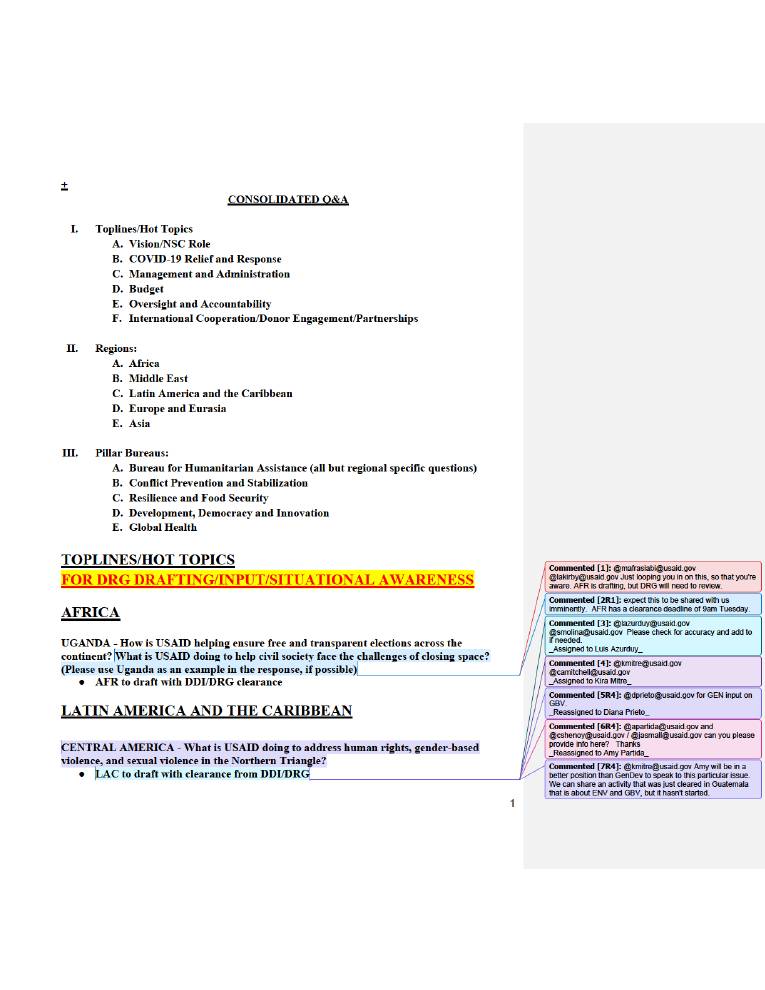
CONSOLIDATED O&A
I. Toplines/Hot Topics
. Vision/NSC Role
. COVID-19 Relief and Response
. Management and Administration
. Budget
. Oversight and Accountability
International Cooperation/Donor Engagement/Partnerships
Sm oO w >
Il. Regions:
A. Africa
B. Middle East
C. Latin America and the Caribbean
D. Europe and Eurasia
E. Asia
Il. Pillar Bureaus:
Bureau for Humanitarian Assistance (all but regional specific questions) . Conflict Prevention and Stabilization
. Resilience and Food Security
. Development, Democracy and Innovation
. Global Health
h- een
TOPLINES/HOT TOPICS
FOR DRG DRAFTING/INPUT/SITUATIONAL AWARENESS
AFRICA
UGANDA - How is USAID helping ensure free and transparent elections across the continent? [What i is USAID doing to help civil society face the challenges of closing space? (Please use Uganda as an example in the response, if possible)
‘Commented [1]: @mafrasiabi@usaid.gov
gov Just looping you in on this, so that you're
@lakirby@usaid «
/ | aware. AFR is drafting, but DRG will need to review.
‘Commented [2R1]: expect this to be shared with us imminently. AFR has a clearance deadline of 9am Tuesday.
Commented [3]: @lazurduy@usaid.gov
ae gov Please check for accuracy and add to
ifneeded.
_Assigned to Luis Azurduy_
e AFR to draft with DDI/DRG clearance
Latin America And The Caribbean
CENTRAL AMERICA - What is USAID doing to address human rights, gender-based violence, and sexual violence in the Northern Triangle? e LAC to draft with clearance from DDI/DR
Commented [4]: @kmitre@usaid.gov
@camitchell@usaid.gov
_Assigned to Kira Mitre_
/ GBv.
‘Commented [5R4]: @dprieto@usaid.gov for GEN input on _Reassigned to Diana Prieto_
‘Commented [6R4]: @apartida@usaid.gov and
@cshenoy@usaid.gov / @jasmali@usaid.gov can you please provide info here? Thanks
_Reassigned to Amy Partida_
‘Commented [7R4]: @kmitre@usaid.gov Amy will be in a better position than GenDev to speak to this particular issue. We can share an activity that was just cleared in Guatemala that is about ENV and GBV, but it hasn't started.
e__ The United States has provided assistance to the Northern Triangle of Central America - El Salvador, Guatemala, and Honduras - for many years to address poverty.
weak governance, and insecurity.
e Introduced in 2014, and updated in 2017, the U.S. Strategy for Engagement in Central America (CEN Strat supports the objectives of improving prosperity, governance. and security. The State Department coordinates implementation of the Strategy’s
biecti ious USG .
2 To support their prosperity, governance, and security objectives, the Departments of State (State), Defense (DOD), Agriculture (USDA), and USAID allocated about $2.4 billion from FY 2013 through 2018 for 370 projects in the Northern Triangle.
• USAID and State implemented most of these projects, with some supporting more than one sector and objective. o_For example, USAID implemented projects to address poverty, while State trained prosecutors and police to address governance and security needs. e_Some of the CEN Strategy’s most important results are: o_In FY 2018, USAID assisted 1,376 individuals in workforce development
programs in Guatemala, exceeding the target of 1,000, hvhile it assisted 651
individuals in Honduras, falling short of the target of 5,000, Commented [8]: @thublin@usaid.gov I'm not sure we o__State and USAID trained 12,557 justice system personnel in the Northern see ee on wine
Triangle, exceeding the target of 2,275.
)_USDA rehabilitated school kitchens in Honduras as part of its school feeding program.
>_ DOD helped Guatemala establish a budget system to increase accountability for military funds, but DOD reported persistently low public trust in Northern Triangle militaries.
e GAO recommended that DOS collaborate with DOD and USDA to develop a
comprehensive approach to monitoring and evaluation of projects that support
Strategy objectives.
lo
lo
ASIA
IBANGLADESH - Amid the consolidation of power under Prime Minister Sheikh Hasina, what is USAID doing to strengthen democracy and governance in Bangladesh?
|Asialto draft with DDI/DRG clearance Commented [9]: Mackenzie and Linnea, FYI and to
coordinate our response on thi keller @usaid :
e The closing of democratic space and slide towards authoritarianism in Bangladesh is @lbeatty@usaid gov ca ant disconcerting. In 2019, Freedom House downgraded Bangladesh’s freedom rating, Commented [10]: @dblack@usaid.gov } while Transparency International ranked Bangladesh 146th of 180 countries on its ———— = =
2019 Corruption Perception Index, citing corruption as the most problematic factor eereariee Tiere Seen for business in Bangladesh. The consolidation of power in one party has also affected Toeeiedio ah Bureau to help. the ability of civil society and opposition parties to engage with the Government of ‘Commented [12R10]: Yes! Just to be clear, though, | am Bangladesh (GoB) and advocate for needed reforms. corey ea Hemp Wom AS
Commented [13R10]: Yes, thanks Renne )
e@ USAID supports programs that protect human rights and fundamental freedoms in Bangladesh and prioritize political party transparency and inclusivity.
e For example, USAID is currently increasing public awareness and access to information by utilizing digital technology and platforms and linking them with
overnment watchdog agencies; strengthening civil society and media capacity to
inhibit authoritarian practices that lead to corruption, illegitimate financial transactions, and poor public services; training judicial personnel and legal officers at the national, district, and local levels are able to deliver more effective and responsive
legal-aid services to citizens: combating human trafficking: working with political parties, citizens, and CSOs to reinforce their understanding of and commitment to democratic
principles: and creating leadership opportunities for youth, women, and minorities.
@ In 2019. USAID trained 81 young political leaders from three major political parties for a four-month training in democracy. Jeadership, internal party governance, and conflict
Awami League increased women's representation in the central party committee from 15 to 25 percent in 2019.
@ Through its Global Labor Program (GLP). implemented by the Solidarity Center. USAID
has been empowering citizens to advocate to their elected officials for accountability. in part
by supporting community-based organizing in seven impoverished worker communities that have pressed for maintaining roadways and sewage systems and increasing access to public
and private services. During the pandemic, Worker Community Associations marshalled support for workers and their families facing job loss. eviction and hunger.
e Under its new 2020-2025 Country Development Cooperation Strategy (CDCS), USAID will support democratic governance across all technical sectors by improving citizens” ability to hold elected and appointed officials accountable and strengthening the institutional capacity of government bodies to meet constituent needs.
e The overall aim within Development Objective 1 is to improve democratic systems that promote transparency, accountability and integrity. USAID is also designing new
programs to improve governance, strengthen civil society institutions, and create advocacy forums to promote positive democratic reforms.
BANGLADESH - What is USAID doing to strengthen worker rights in Bangladesh? e Asia to draft with DDI/DRG clearance!
• J|USAID is adopting a multi-pronged approach to address challenges to labor rights within Bangladesh’s shrinking democratic space. Since 2014, USAID’s support for factory workers and labor organizers has empowered 71,000 workers to join unions and advocate for their rights. Our support for these
efforts remains strong and consistent across fiscal years.
• Through its Global Labor Program (GLP) USAID supports programs that build
workers’ power to organize and participate in independent unions: prevent and address gender-based violence and harassment: and promote constructive labor relations and collective bargaining. GLP also provides legal support to workers in
<—|
Commented [14]: @kmitre@usaid.gov
_Assigned to Kira Mitre_
Commented [15R14]: Giewnocler@usaid gov Jef - can Cpe ee
to Jeffrey Wheeler.
‘Commented [16R14]: Thanks, | added here and
in next section, Jason and | edited
Commented [17R14]: @jewheeler@usaid.gov Thanks for your input. Suggest to coordinate this with Asia Bureau as the country-specific questions are now led by regional bureaus and backstopping.
Export Processing Zones (EPZ). including in the garment sector. where USAID is
also collaborating with international brands to improve engagement with factory owners. In addition, the program supports migrant and domestic worker rights,
including through new area-based committees offering education, support and advocacy.
• USAID is also coordinating with international partners to advocate for improvements to_the Bangladesh Government’s labor policy, and collaborating with the private sector to build workers’ skills and knowledge about their
rights. | __—{ Commented [18]: Per Asia draft QFRs
Development, Democracy And Innovation
_ Formatted: Strikethrough
Commented [19]: NOTE THIS was taken out of the final
eo Next mitietves-ikethet. Self Reals the Nev-D. iss Taitints questions. 2 gency x p-
QIPD_L 1, and then A anata id Accict, Stent, hich in: " Formatted: Strikethrough
Formatted: Strikethrough
Formatted: Strikethrough
Formatted: Strikethrough
Formatted: Strikethrough
en Formatted: Strikethrough
Formatted: Strikethrough
~ Formatted: Strikethrough
Formatted: Strikethrough
Labor Program. What are your plans for this program and how should USAID support labor Formatted: Strikethrough
: : qe : the :
" : Formatted: Strikethrough
DEMOCRACY - The previous administration sought to end support for the existing Global = Strikethrough
rights? (CPCE Lead - DONE, moved to other document) Formatted: Strikethrough
CK J_A_A_I_SJ_A_ SILI SL
e@ Currently, USAID has a two-pronged approach to GLP: (1) a one-year extension of the current Global Labor Program (GLP) program, and (2) a new Global Labor Program -- New Frontiers (GLP-NF) procurement. The extension of the current program will help ensure continuity as the new program launches. USAID recommends continuing this current approach.
e Last year, based on agency best practices and evolving needs in the global labor space, USAID decided to expand the scope of the GLP through a full-and-open competitive process. This decision is in line with USAID’s technical recommendations and procurement best practices. The new competition will continue and build upon the successes of the existing GLP, while also seeking out and testing new partnerships and innovative approaches.
e@ USAID should advance labor rights by continuing to support democratic worker organizations, and by identifying promising new means of advancing labor rights in a changing environment. USAID interventions should seek to: advance workers’ rights, taking into account the impact of civic space restrictions on labor rights, the inclusion of
marginalized groups and the need to increase local ownership in labor rights activities. COVID has created significant disruptions to the advancement of labor rights and also needs to be a key consideration in new and existing programs.
[DEMOCRACY - How does USAID promote democracy abroad when we are faced with so many challenges here at home? How will you rebuild US credibility for democracy promotion abroad? Given that the Trump Administration cut democracy funds, what will you do to
adequately resource this important work? l Commented [20]: +mgoldenbaum@usaid.gov _Assigned to Mark Goldenbaum_
2 pe ote a ee naguralacer ct - Commented [21]: Pull from letter to cadre! Mark G with
example of our power, but the power of our example.” I firmly believe that USAID’s inputs from SP on budget. democracy assistance can embrace--and be strengthened by--the example of our own Commented [22R21]: @mgoldenbaum@usaid.gov
democracy’s resilience. If confirmed, I will convey that the most powerful and enduring contribution to “democracy promotion” is the model we provide to others on our own commitment to these core principles.
e Healthy democracy is not_a system without challenges, but a system designed to effectively manage the challenges it inevitably has. And as all of us in this hearing know, our nation’s democracy has faced challenges at every turn in its history, many more dire than the ones we confront now. Fortunately, guided by our Constitution’s
enduring pursuit of a “more perfect Union,” our democracy has weathered and overcome challenges for more than 200 years, often after long, highly contested and bitterly fought struggles.
o__ By design, our democracy has become more responsive and inclusive over time and dealt with challenges that could not have been envisioned by the original framers. And in a sense, that’s the basic distillation and inspiration for a core premise of DRG technical assistance: our purpose is not to replicate the form of American institutions abroad, but to instill the commitment and ability of partner institutions to learn, respond and adapt to changing needs and circumstances.
e_Ifconfirmed. I will encourage providing assistance with more humility and empathy in our work. While autocrats in Moscow, Beijing. Tehran and elsewhere seize on our own domestic challenges as evidence of American weakness and hypocrisy, those in the democracy promotion space believe that acknowledging our own challenges and
examining those issues, is an axiomatic aspect of American democracy and precisely = as =
e_ Ifconfirmed, I will continue to champion USAID in applying three principal approaches to supporting civil society in restrictive environments: prevention. adaptation and innovation. e Many restrictive governments are using COVID-19 as an excuse to incorporate further restrictions. USAID recognizes that these restrictions have increased threats to civil society.
• As COVID-19 began to spread globally. USAID partners were among the first to highlight that it was not just a public health crisis. but also a crisis for civic space. In just over two weeks after the WHO officially declared a pandemic. ICNL and the European Center for Nonprofit Law (ECNL) launched the COVID-19 Civic Freedom Tracker, assessing 164 countries and more than 400 measures — emergency declarations, laws. and practices that affect the freedoms of association, assembly. and expression.
• Since the start of the global pandemic. some of the most alarming highlights are:
w__50 countries have issued measures against freedom of expression w__130 countries affect freedom of assembly and.
m__ 53 countries issue measures that affect citizen’s privacy| ___-{ Commented [23]: moved to COID paper response
e USAID also recognizes that democracy promotion needs to be a two-way conversation, and - particularly on emerging issues such as countering misinformation and what freedom of expression means in the digital space. In some instances, our development partners have been confronting these issues (and under more direct pressure) for longer periods of time than the US. And as Tom Carothers noted in his 2016 “Look Homeward Democracy Promoter,” perhaps countries that have graduated from DRG assistance should be re-engaged as partners in our collective efforts to learn and share.
Lunderstand USAID’s mission is not to advance “American-style democracy” abroad, but rather, to support the advancement and defense of democratic principles. To the
extent to which USAID’s positioning and role exposes us to effective approaches on
these issues that may have relevance and utility domestically, we should embrace that opportunity to learn,
e@ I understand that USAID recognizes an increase in global democratic backsliding and continues to support citizens and civil society affected by these restrictions globally. If confirmed, I will ensure that USAID continues to address the increasing restrictions on civil society which negatively impact its ability to partner with local organizations, and support their work in every sector, including health, economic growth, women’s empowerment, humanitarian assistance, and democracy. human rights, and governance.
e I£fconfirmed. I would continue to prioritize an increase in Democracy Funds (DF ) for the 4 USAID’s DRG Center to adequately address ongoing and unforeseen challenges in the sector. When fundamental rights such as freedom of association are repressed, grievances and perceptions of injustice can fuel instability and extremism, which ultimately threaten our own national security interests.
‘Commented [24]: @scarter@usaid.gov
@mafrasiabi@usaid.gov @kmitre@usaid gov | will be in a training tomorrow, so | won't be able to update or tweak. But here's a first crack at a response, drawing on the paper.
Commented [25R24]: Thanks Mark! Looks
great. Appreciate all your dedication on this, especially over the weekend.
‘Commented [26]: @droziewski@usaid.gov
Dani, can you please review/revise this language on democracy funding? | want to make sure we're framing the
resources language appropriately.
_Assigned to Danielle Roziewski_
9)
e
L | ‘Commented [27]: +mgoldenbaum@usaid.gov
een wh - over me past eer years, we have seen inereciple global democratic Sissi ieee L
ac! g- What shou SAID io about this? How the Agency address these alarming Font: (Default) Aral, 11 pt, Font color Bick | trends— crackdowns on media, free speech, and assembly-- what should our response be?
Formatted: Widow/Orphan control )
How can we effectively fight back against this? (CPCE, J&R, DPP & CCEI- Laura to lead -
DONE)
e@ Global democratic backsliding is an urgent development challenge. If confirmed, I will make it a priority for the agency. In many countries, local actors use the contexts of conflict, economic inequality, and the rise of illiberal populism to eliminate space for civil and political rights and undermine democratic institutions. At the same time, malign actors, such as China and Russia, sow informational chaos, support digital authoritarianism, and contribute to debt dependency, while eroding liberal democratic values at the international level.
e Ifconfirmed, I would focus on building our partner countries’ resilience to authoritarianism, while ensuring, with our allies, that the rules of the game are conducive to enabling democracy
to thrive. I would continue and expand support for civil society actors to take proactive measures to challenge restrictive legislation and regulations as well as to support and enhance countries’ legal frameworks to prevent violations. I would also continue to support civil society to adapt and innovate to the changing landscapes. I would increase support to independent media by supporting new and stronger economic foundations, enabling stronger legal and regulatory environments, and increase the capacity to utilize breakthroughs in data and technology to conduct deep investigations into fraud, abuse, and corruption. I would continue to ensure USAID leads with other donors and countries in responding to these threats to democratic freedoms.
e Because resistance to authoritarianism and backsliding correlates with strong mechanisms for accountability, I would prioritize strengthening checks and balances through support for institutional independence including the integrity of judiciaries, independent election bodies and consolidation of the separation of powers. Fundamental rights and freedoms--including assembly and speech as well as an independent media--serve as the first line of defense in countering the capture of independent, democratic institutions. If I am confirmed, I would deepen Agency investments in these areas. Recognizing the threat of digital authoritarianism, I would continue to advocate for the promotion and protection of human rights online, including limits and safeguards on the use of 5G for surveillance and data privacy violations.
@ As authoritarianism surges across the world, the U.S. government must rise, together with democratic allies, to preserve the liberal democratic order while protecting our democracy at home.
e
FOR REFERENCE ONLY -USAID’s Approach: USAID response to increasing global democratic backsliding:
e If confirmed, I will continue to champion USAID’s approach to_apply three principal approaches to supporting civil society in restrictive environments: prevention: adam
2) Prevention: USAID provides technical assistance to enhance countries’ legal
frameworks to prevent violations against civil society’s rights. USAID also supports
indexes such _as_ the CSO Sustainability Index _and_the International Center for
Nonprofit Law (ICNL)’s NGO Law Monitor. These efforts. when coordinated with
like-minded governments, donors, and CSO partners. have been effective in reshaping. mitigating. and in some cases, rolling back restrictive laws.
3) Adaptation: USAID aims to be flexible and strengthen CSOs’ capacity to manage new regulations. as well as CSOs’ capacity across all development sectors that might be affected by restrictive conditions.
4) _ Innovation: USAID continues supporting CSOs through innovation. often through regional platforms and with a focus on information security.
Formatted: Font: (Default) Arial, 11 pt, Font color: Custom
[DEMOCRACY - You have written that Facebook has become weaponized— a tool for Color(RGB(34,34,34)), Highlight
malicious actors to justify human rights abuses, steal elections, or target ethnic and religious minorities. We’ve seen this in Myanmar, the Philippines, Brazil, and elsewhere. This trend greatly concerns me. You have also written that Facebook needs to take additional steps to stem the flow of misinformation. How can USAID work to curb the weaponization of social
media platforms in partner countries?
USAID can and should work with its civil society partners on the ground to involve them, to a greater extent, in multi-stakeholder governance of social media platforms. Civil society can play a critical role in curbing the spread of hate speech and misinformation. In some countries where USAID works, social media platforms are left unregulated and unattended by local civil society, posing great risk in fragile environments. At the other extreme, platforms are highly regulated by governments and are often the target for misapplication of security legislation or, more recently, Covid 19-related restrictions, resulting in the abuse of fundamental freedoms online.
I understand that in countries such as Myanmar and the Philippines, USAID supports local civil society and media organizations that monitor, identify, and expose hate speech and disinformation online. These local partners operate in countries where social media platforms do not have a presence and where social media is the internet. They bring valuable local language knowledge, conflict dynamics awareness, and other local context competencies that are critical for social media platforms to operate responsibly, ensuring that they are not weaponized in a way that disrupts democratic processes or exacerbates human rights violations.
IfI am confirmed, I will make sure that these local organizations get much needed capacity support, including enhanced cutting edge tools and skills to provide actionable data for social media platforms, such as Facebook. USAID can and should work with its civil society partners on the ground to involve them, to a greater extent, in governing social media platforms, working directly with governments and the platforms themselves. I would expand USAID’s support for local civil society to conduct human rights impact assessments: participate in local standards-setting and rulemaking processes; and create “situation rooms” to watchdog social media performance during elections.
USAID should also ramp up support for increased media literacy and fact-checking initiatives, working with local independent media and civil society groups that can promote media literacy competencies and support fact-based media. I would also prioritize academic partnerships with universities and think-tanks in the countries where USAID works to engage local researchers and academics in studying disinformation. Finally, as skepticism over the compatibility of democracy and social media grows, I believe it is important to cost-share with social media, and will explore such arrangements with social media platforms to address harms to democracy and human rights through jointly-financed activities to mitigate them.
Commented [28]: @jmachleder@usaid.gov
_Assigned to Joshua Machleder_
DEMOCRACY - How does USAID stem corruption in the countries in which it works?) Commented [29]: @cjohnston@usaid gov Assigned to Cory _
e As the outset, I'd like to stress the importance of USAID’s work in helping countries
prevent and fight corruption, as well as enhance transparency, accountability and good ee
governance. Corruption and related crime and kleptocracy are on the rise around the world, undermining development outcomes across all sectors and perpetuating a cycle of poverty and dependency. At USAID, we know that corruption diverts resources from essential public services; undermines democratic norms and institutions; diminishes citizen trust: drives human rights violations: and allows corrupt actors to profit from crime, terror and exploitation. It impacts USAID’s ability to meet our objectives in health, education, economic growth, climate change, and biodiversity. And sadly, as shown by COVID-19 related corruption, it also impacts the response to global health and other emergencies.
e@ USAID’s approach to combating corruption reflects our understanding of it as both a system and a norm. Our programs aim to replace the practices, drivers, incentives and behaviors that feed systemic corruption with ones that instead build systemic accountability to citizens.
e USAID programs in countries such as El Salvador, Ukraine, the Philippines, Haiti, and Ghana are supporting systems and practices that build the capacity of governing institutions to prevent, detect, investigate, and sanction corruption. This includes enhancing oversight of public spending, strengthening asset declaration, supporting anti-corruption agencies, and building the capacity of government auditors. Other programs strengthen justice sector institutions and anti-corruption courts, enhance inter-governmental coordination, and build the capacity of prosecutors, judges, law enforcement and investigators to detect and combat financial crime and corruption.
@ On the governance side, our programs in countries such as Jordan, Albania, Sri Lanka and Uganda support public administration tools aimed at preventing corruption, including e-
government and public expenditure systems; internal control processes; and procurement reforms. Other programs are supporting ethics, codes of conduct, and leadership programs.
e And finally, USAID programs are fighting corruption by empowering citizens and strengthening external accountability mechanisms. In countries such as Kosovo, Nigeria, Georgia and Paraguay we are leveraging technology. access to information laws, and open data processes to strengthen the ability of civil society organizations, investigative journalists, and the private sector to hold the government to account. We are also supporting implementation of key global partnerships - such as the Open Government Partnership (OGP) and the Extractive Industry Transparency Initiative (EITI) - as tools to deepen transparency, inclusion and accountability to citizens.
e Anti-corruption programming remains a key technical priority of USAID’s democracy and governance work around the world. Yet despite the critical nature of this work to securing both democracy and broader development outcomes, USAID funding levels for anti- corruption have declined consistently in the past few years, with 2020 funding levels a full 44% lower than in 2017. If confirmed, I will prioritize replenished funding in this area, so that anti-corruption work at USAID can be re-invigorated and re-elevated.
DEMOCRACY - Do you believe there is duplication of democracy assistance implemented by USAID, the National Endowment for Democracy, and the Department of State’s Bureau of Democracy, Human Rights and Labor, International Narcotics Law Enforcement and Conflict and Stabilization Operations Bureaus, and if so, what will you do about it?
e@ USAID manages most of the US government’s democracy assistance funding and supports the broadest range of democracy, human rights and governance programming, but the National Endowment for Democracy and the Department of State also play important roles in the United States’ overall efforts to promote and defend democracy around the world.
@ While there is some overlap, each entity has distinct comparative advantages, giving the US a multi-faceted and more effective approach in increasingly complex environments.
e Furthermore, I understand that there is regular information-sharing and coordination efforts to avoid duplication and help make the most strategic use of assistance funds. This coordination takes place both in DC and at our missions overseas.
e That being said, more can be done to strengthen orchestration of effort among US democracy assistance providers and to prevent duplication, including providing whole-of-
egy gui e on key areas. h as civil socie m e of law an anti-corruption
Commented [31]: @dblack@usaid.gov
Assigned to David Black_
e = Ifconfirmed, I will work closely with my counterparts to ensure that coordination continues to take place and every effort is made to maximize the impact of our assistance funding.
Penne - How does democracy programming help to counter violent extremism (CVE)?
Commented [32]: Jen, why specify ROL and corruption, esp when most DRL and NED work is around civil society and media?
‘Commented [33R32]: We can include those too, but there is tons of overlap on AC and ROL(and duplication). Also the question covers both DRL and INL
e_USAID, as the USG’s lead implementer of development and humanitarian policy and rogramming, helps to protect U.S. national security by shaping the conditions for
successful USG engagement in CVE.
e Relationship between democracy programming and CVE:
oO Recent research shows that democratic governance is key to countering violent
extremism.
Commented [34]: @kmitre@usaid.gov
_Assigned to Kira Mitre_
<q
Commented [35R34]: @mgoldenbaum@usaid.gov
_Reassigned to Mark Goldenbaum_
• As USAID, the State Department, and others grapple with these exigencies,
researchers and practitioners have moved away from an approach that focuses exclusively on presuming that economic factors drive extremism. Reinforcing
effective governance that addresses grievances is now seen as a central pillar to addressing violent extremism.
a_A State’s legitimacy and strong democratic governance structures are needed to prevent extremism but also to combat it.
s__Findings from the Mercy Corps report, “Youth and Consequences:
Unemployment, Injustice, and Violence”, indicate that what is needed are programs that are “paired with meaningful governance reforms.”
e Stabilization activities are designed to support governing entities to fill a power vacuum where no other governing structure exists and non-state actors are likely to exploit citizen grievances for thei
e__Capacity-building activities are meant to help reform corrupt governing institutions and strengthen inefficient ones to bolster their local legitimacy.
e Best practice often includes a strategic sequencing of these two efforts: using stabilization programs to set the foundation upon which longer-term capacity development can build.
u__Include more specific USAID examples here...
wn benefit.
DEMOCRACY - How do you measure success with respect to advancing the goal of promoting democracy?
e Weuse a variety of methods to measure the impact of our democracy, human rights and governance programs. A dedicated Evidence and Learning team was established
in th enter in 2013 and has since supported the completion o O o two
hundred learning products, including impact and performance evaluations, surveys. assessments, and literature reviews. Most of these learning products were produced collaboratively by academics who employed rigorous research methodologies and practitioners who incorporated field perspectives to produce findings that are reliable and actionable. Upon completion. they are made publicly available. thereby creating an evidence base that can be consulted in the design of future USAID programs.
e We monitor and measure country-level indicators. such as fidelity of electoral institutions, strength of the legislature and judiciary. and the population’s perceptions of democracy. that are produced by reputable sources such as Freedom House, the regional Barometer surveys. the Varieties of Democracy Institute, etc. These key indicators are included on annually-updated country data portraits and made available to USAID staff.
e At the program-level, we measure the outcomes that programs ultimately want to impact (like corruption in procurement spending. belief of accurate information, and reintegration of former combatants). plus the chain of intermediate outcomes that
lead from the program to those ultimate outcomes. Success is improving and/or maintaining those ultimate outcomes at a high level.
‘Commented [38]: @jtaggart@usaid.gov
processes. The principle of supporting d He ec notonieemeric alse articulated Formatted: Font: Bold, Underline ~ Formatted: Font: Bold, Underline
AD r . = ; sos Assigned to Joseph Taggart_ J
sinnersand losers USAID? Ss electoral assistance 5 supports democratic p processes, not _— Formatted: Font: Bold, Underline ) Particular glection outcomes. The goal of USAID's elections and political processes Formatted: Font: Bold, Underline } programs is to promote the conduct of free, fair, transparent, and inclusive electoral Formatted: Font: Bold, Underline }
e USAID programs partner with democratic actors under the most fundamental principle defining credible elections:;+het they must reflect the free expression of the will of the people.-and:
e@ The principle of supporting democratic processes and not outcomes is also articulated in
USAID’s Political Party Assistance Policy. USAID's political party assistance is governed by two principles: USAID programs support representative. multiparty systems: and USAID
programs do not seek to determine election outcomes.
e@ USAID’s elections and political processes programs are designed to support local efforts to develop and consolidate representative democracies. develop inclusive and accountable
political processes. establish viable democratic political parties, and ensure the conduct of free and fair elections.
• Formatted: Font: (Default) Arial, 11 pt, Font color: Black, ] Not Highlight
Formatted: Indent: Left: 0.5", No bullets or numbering }
Commented [39]: @kmitre@usaid.gov
Assigned to Kira Mitre_
‘Commented [40R39]: @acotton@usaid.gov
Anthony for any additional thoughts on this oe as well.
DEMOCRACY - How should we respond to countries that pass anti-homosexuality legislation —Reassigned to Anthony Cotton. |
or support/promote violence and discrimination that targets lesbian, gay, bisexual, and Commented [41R39]: Done - | used language from a
transgender (LGBT) people? Should we cut off assistance to send a strong message? ee rs a se Commented [42R39]: Thanks, Anthony, for the quick J
and concise response!
e@ Most countries where USAID works have anti-LGBTI laws and high rates of violence, discrimination, stigma, and criminalization.
e This Administration will support protections for LGBTI people, advocate for their human rights, and integrate LGBTI considerations into USAID’s broader development efforts.
e@ We should be guided by two principles: “do no harm” and “do nothing about them without them.” Most LGBTI people and organizations in developing countries have warned that cutting off assistance based exclusively on how a government treats LGBTI people could lead to more anti-LGBTI backlash. Therefore, consistent with USAID’s long standing approach, I do not support aid conditionality based solely on a country’s record on LGBTI issues.
e That said, if confirmed, I will ensure USAID pursues more productive measures to support and assist LGBTI people. Examples could include funding research, providing grants to LGBTI organizations leading decriminalization campaigns, training judiciaries and legislatures on criminalization issues, and identifying the funding sources of anti-LGBTI campaigns and engaging with them about their impacts.
[DEMOCRACY - Ending modern slavery is a top priority for members of this Committee. Could you share your thoughts on what can be done to ensure that USAID has a more impactful role in ending modern slavery?|
[DEMOCRACY - Democracy is coming under attack internationally, as China and Russia are actively undermining liberal democracies around the world, as well as this model of government, more generally. How should the United States weigh the tradeoffs between democracy and stability? Do you believe that democracy promotion can be counter- productive?|
e It is true that authoritarian governments, like those in China, Russia, and Iran, are actively trying to undermine the appeal of democratic governance while promoting their own autocratic models in an effort to justify their continued grasp on power in their own countries. This trend has been accelerated during the COVID-19 pandemic. It is essential that USAID, and the U.S. Government as a whole, push back forcefully on this harmful narrative.
e@ Idon’t believe that championing democratic governance- which prizes transparency, responsiveness to citizen needs and demands, and application of the rule of law- is counter- productive. In fact, I believe that it is central to our development and national security goals. As China and Russia try to revise the global world order to their advantage, we need to strongly make the case that democratic governance is the key to sustainable development, economic growth, and the empowerment of citizens to reach their potential.
e Ifconfirmed. I will be a vocal advocate for democratic governance, and I will make common cause with our allies and partners who share our democratic values to more effectively make the positive case for democracy. Yes, democratic governance can be messy- as citizens and groups compete for influence and power, that contestation often does lead to tensions. Over the long haul, however, democracies have proven themselves to be more resilient, innovative, vibrant, and economically successful than authoritarian regimes.
e Studies have shown that authoritarian governance often provides an illusion of stability, at the cost of human rights and liberties. Evidence suggests that democratic systems are more
__—| Commented [43]: @ngraber@usaid.gov Nichole - can you
provide input on this STIP question?
_ Assigned to Nichole Graber_
|
Commented [44]: @ngraber@usaid.gov
@kmitre@usaid.gov
_Assigned to Nichole Graber_
‘Commented [45]: @nmueller@usaid.gov
_Assigned to Nils Mueller_
stable than autocratic systems of government in that they do not suffer dramatic regime disruptions, like coups. In country after country, those governments that attempt to implement authoritarianism and restrict the rights of their citizens ultimately see a rise in popular unrest, as we saw last year in Armenia, Angola, Ethiopia and Algeria.
[DEMOCRACY - Coordination of Democracy Assistance: How does USAID work with the Department of State’s Bureau of Democracy, Human Rights and Labor (DRL)?
e@ USAID and the State Department coordinate democracy promotion efforts in multiple ways with each other and with other governments, partners and international organizations. In Washington, USAID and the State Department participate in both working-level coordination meetings between technical staff and NSC-led interagency meetings that address democracy and human rights issues. Overseas, the country teams and interagency assistance working groups collaborate and share information related to government counterparts and organizations that work on democracy promotion efforts.
e@ USAID and the State Department coordinate democracy promotion activities at both the policy and program implementation levels. We place a high value on working together because complementing each other’s core competencies strengthens the U.S. Government’s wider impact.
Commented [46]: @dblack@usaid.gov
_Assigned to David Black_
Original document
The PDF as released. If it does not display, open it directly.